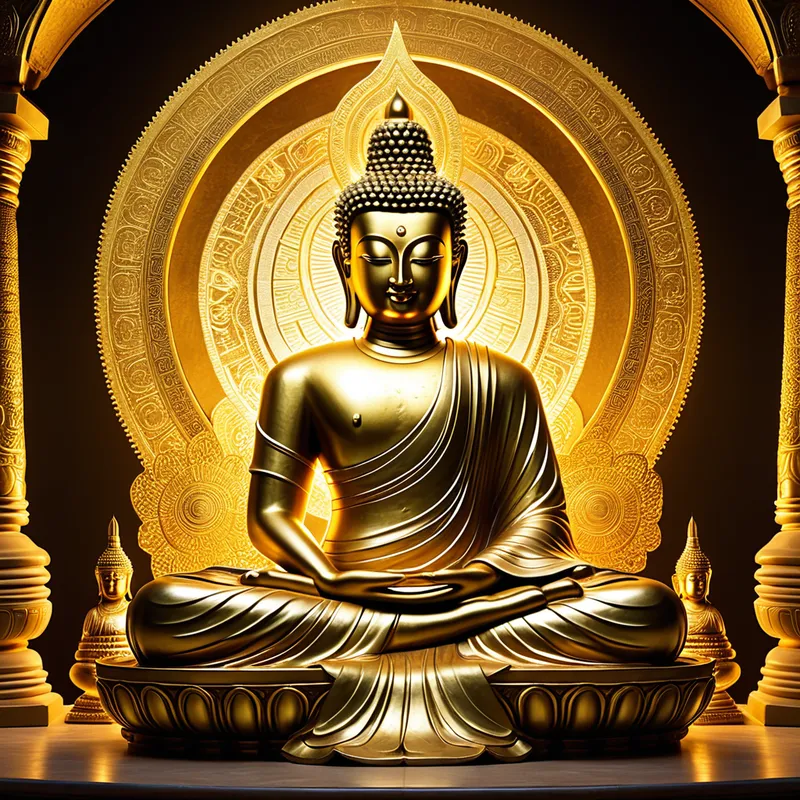
Maitreya Buddha Myth Meaning & Symbolism
The myth of Maitreya, the future Buddha, who waits in Tushita Heaven to descend and teach a world reborn in compassion.
The Tale of Maitreya Buddha
Listen. In the celestial realm of Tushita, where time is a melody and not a chain, a being of profound serenity abides. He is not a god of thunder, nor a warrior of light. He is [Maitreya](/myths/maitreya “Myth from Buddhist culture.”/), the Kindly One, [the Buddha](/myths/the-buddha “Myth from Buddhist culture.”/) who is yet to come. He sits in the posture of royal ease, a slight, knowing smile upon his lips, his gaze turned not inward, but downward, toward a distant, turning sphere of blue and green and dust.
Here, in our world, the wheel of the Dharma turns, but its spokes sometimes groan. The teachings of Shakyamuni Buddha grow faint, like an echo in a vast canyon. Compassion cools into ritual; wisdom hardens into dogma. The age darkens, not with cataclysm, but with a slow forgetting. People become distant from their own hearts, [the world](/myths/the-world “Myth from Tarot culture.”/) weary with strife.
But this is not the end of the story. It is the necessary pause, the held breath.
For in Tushita, Maitreya waits. He teaches the devas there, preparing them. His waiting is not passive; it is a profound, active gestation. He is the seed in the cosmic soil, the promise held in trust. The myth whispers that when our world’s lifespan stretches long, when human virtue blooms anew and people’s hearts naturally turn toward kindness, when a Chakravartin king establishes peace, then the moment will ripen.
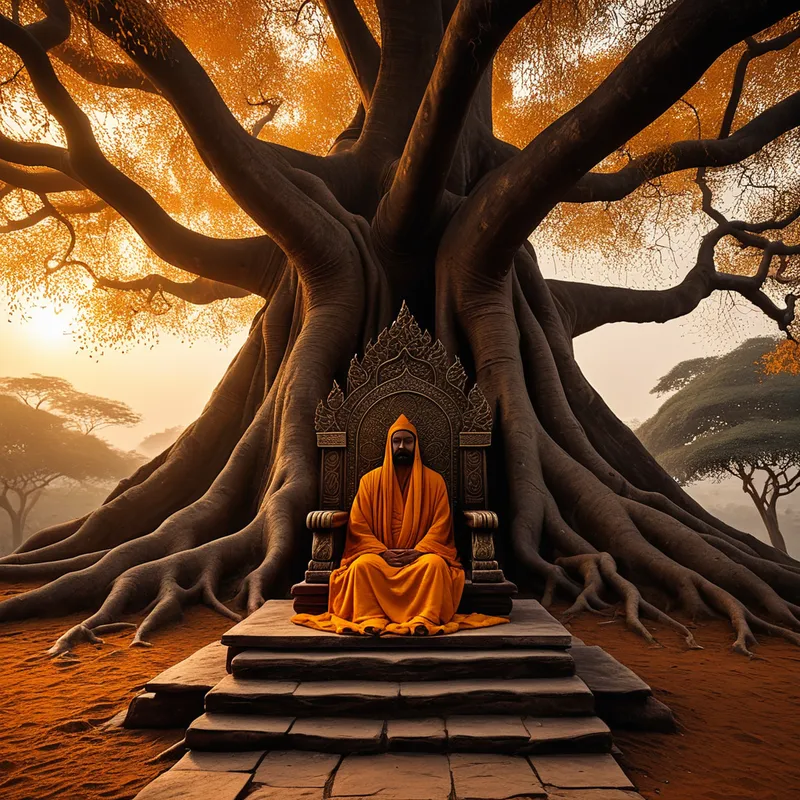
Then, Maitreya will descend. He will be born among us, in the city of Ketumati, will take up the saffron robe, and will walk to the same Bodhi tree—or its descendant—under which Shakyamuni attained awakening. There, he will sit. And under that tree, in a world ready to listen, he will turn [the Wheel of Dharma](/myths/the-wheel-of-dharma “Myth from Universal culture.”/) once more. His teaching will be one of immense, accessible compassion. His very presence will be a balm. He will not come to conquer, but to remind. He will not bring a new truth, but will rekindle the ancient, eternal one that sleeps in every heart: that of boundless, active love. His reign will be an age where the very ground is soft, where trees bear cloth and fruit in abundance, and where the primary struggle is not for survival, but for deeper understanding. He is the dawn held in the heart of the long night.
Cultural Origins & Context
The figure of Maitreya emerges from the early strata of <abbr title=“The “Great Vehicle” branch of Buddhism”>Mahayana Buddhism, around the first few centuries BCE to CE. He is unique among Bodhisattvas and Buddhas: he is the only one recognized across all major Buddhist traditions—Theravada, Mahayana, and Vajrayana—as the next Buddha of this world system.
This myth functioned as a powerful cultural and psychological engine. In societies often marked by [impermanence](/myths/impermanence “Myth from Buddhist culture.”/) and suffering, Maitreya provided a teleology of hope. He answered the implicit question: “What happens when the current Buddha’s teachings fade?” The answer was not oblivion, but a future renewal. This was passed down through sutras like the Maitreyavyakarana (The Prophecy of Maitreya), in monastic teachings, and in vibrant art—from the giant stone sculptures of the Chinese Northern Wei dynasty to the smiling pot-bellied Budai figures. The myth served to stabilize the long-term view of Buddhist cosmology, encouraging ethical living and spiritual practice not just for personal escape, but to help create the conditions for Maitreya’s coming. It made every act of kindness a brick in the road of his descent.
Symbolic Architecture
Maitreya is not merely a future [event](/symbols/event “Symbol: An event within dreams often signifies significant life changes, transitions, or emotional milestones.”/); he is a profound psychological [symbol](/symbols/symbol “Symbol: A symbol can represent an idea, concept, or belief, serving as a powerful tool for communication and understanding.”/) existing in the present tense of the [soul](/symbols/soul “Symbol: The soul represents the essence of a person, encompassing their spirit, identity, and connection to the universe.”/).
He represents the Future Potential Self, the fully realized, compassionate being we are destined to become, not in a [linear](/symbols/linear “Symbol: Represents order, predictability, and a direct, step-by-step progression. It symbolizes a clear path from cause to effect.”/) future, but as the telos of our deepest [nature](/symbols/nature “Symbol: Nature symbolizes growth, connectivity, and the primal forces of existence.”/). He is the Buddhahood latent within all beings, waiting for the correct internal conditions to manifest.
The future is not a point in time we reach, but a quality of consciousness we prepare for. Maitreya abides in the Tushita of our own latent potential.
His residence in Tushita [Heaven](/symbols/heaven “Symbol: A symbolic journey toward ultimate fulfillment, spiritual transcendence, or connection with the divine, often representing life’s highest aspirations.”/) symbolizes this state of pre-manifest potential. It is the inner sanctum where the [blueprint](/symbols/blueprint “Symbol: A blueprint represents the foundational plan or design for something, often symbolizing potential, structure, and the mapping of one’s inner self or future.”/) of our wholeness is held in perfect, patient [suspension](/symbols/suspension “Symbol: A state of being held in limbo, neither progressing nor regressing, often representing unresolved tension or transitional phases in life.”/). His descent represents the [integration](/symbols/integration “Symbol: The process of unifying disparate parts of the self or experience into a cohesive whole, often representing psychological wholeness or resolution of internal conflict.”/) of this potential into [reality](/symbols/reality “Symbol: Reality signifies the state of existence and perception, often reflecting one’s understanding of truth and life experiences.”/), the [moment](/symbols/moment “Symbol: The symbol of a ‘moment’ embodies the significance of transient experiences that encapsulate emotional depth or pivotal transformations in life.”/) when our highest nature informs our daily [life](/symbols/life “Symbol: The symbol of ‘Life’ represents a journey of growth, interconnectedness, and existential meaning, encompassing both the joys and challenges that define human experience.”/). The long wait signifies the necessary [period](/symbols/period “Symbol: Periods in dreams can symbolize cyclical patterns, renewal, and the associated emotions of loss or change throughout life.”/) of [incubation](/symbols/incubation “Symbol: A period of internal development, rest, or hidden growth before emergence, often associated with healing, creativity, or transformation.”/)—the often-frustrating time of practice, failure, and slow growth where nothing seems to happen, yet everything is being prepared.
The Dreamer’s Resonance
When this myth stirs in the modern unconscious, it rarely appears as a literal golden Buddha. Its dream language is more subtle. One might dream of:
- A waiting room or antechamber: A serene, timeless space where one is content to stay, knowing a great journey or meeting is pending.
- A seed or a bulb that refuses to sprout: Yet it feels alive, full of promise, not dead. There is anxiety but also trust.
- A trusted mentor or elder who has promised to return: Their absence is felt, but their guidance is internally sustained.
- A landscape in deep winter, with the absolute, quiet knowledge that spring is irrevocably coming.
Somatically, this can feel like a pregnant pause in life—a career plateau, a creative dry spell, a period of recovery or integration after a major life event. Psychologically, it is the process of holding the tension of the opposites between who you are now and who you sense you could be. There is a struggle with impatience and doubt (“Will I ever change? Will my work ever bear fruit?”), countered by a deep, almost cellular sense of right-timing. The dream-ego is learning the virtue of active waiting—not lethargy, but the focused preparation of the inner ground.
Alchemical Translation
The alchemical process mirrored in Maitreya’s myth is that of [solutio](/myths/solutio “Myth from Alchemical culture.”/) followed by coagulatio—dissolution into potential, then coagulation into new form. Our current, rigid identities and compulsive patterns (the “faded Dharma” of the dark age) must first dissolve. This is the often painful, confusing stage where old certainties fail. We enter our own Tushita—a state of liminality, of not-knowing, of being “between stories.”
The work in this heavenly realm is the opus of inner preparation: purifying intention (metta), cultivating patience (kshanti), and clarifying wisdom (prajna). This is the incubation.
The descent of Maitreya is the individuated Self descending from the abstract realm of potential into the concrete reality of the personality. It is the moment when insight becomes embodiment.
The “Chakravartin king” who pacifies the land is [the ego](/myths/the-ego “Myth from Jungian culture.”/) that has been rightly ordered, no longer a tyrant but a steward serving the deeper Self. The “long lifespan” and “virtuous people” are the psychological conditions of a [psyche](/myths/psyche “Myth from Greek culture.”/) that has achieved relative integration and harmony. Only then can the ultimate treasure—the fully realized Self (Maitreya as Buddha)—be safely received and embodied without inflation or distortion.
Thus, the myth guides us to stop anxiously looking to [the horizon](/myths/the-horizon “Myth from Various culture.”/) for a savior. Instead, it directs us to the patient, meticulous work of preparing the inner kingdom. We build Ketumati in our own hearts through every act of integrity, we lengthen our spiritual lifespan through sustained practice, and we become the virtuous people who make the world ready. In doing so, we discover the astonishing secret: the Buddha we await is, and always has been, the Buddha we are preparing to become. The future Buddha is the seed of the present moment, lovingly tended.
Associated Symbols
Explore related symbols from the CaleaDream lexicon: