Magic Mirror Myth Meaning & Symbolism
A myth of a mirror that reveals not the surface, but the soul's hidden truth, demanding courage to face what lies within.
The Tale of Magic Mirror
Listen, and I will tell you of the thing that does not lie. Not in the high halls of kings, nor in the deep groves of the wise, but in the silent places between breaths, there exists the Magic Mirror. It was not forged by smiths, but condensed from the first question ever asked: "What am I?"
In a time when the world was younger and shadows held more substance, a seeker, weary of the masks of the world, journeyed beyond the map's edge. They were guided by whispers on the wind, tales of a pool that was not water, a surface that showed not the skin, but the sinew of the soul. Their path led through a forest where trees were pillars of memory, to a cavern mouth exhaling a cold, clear light.
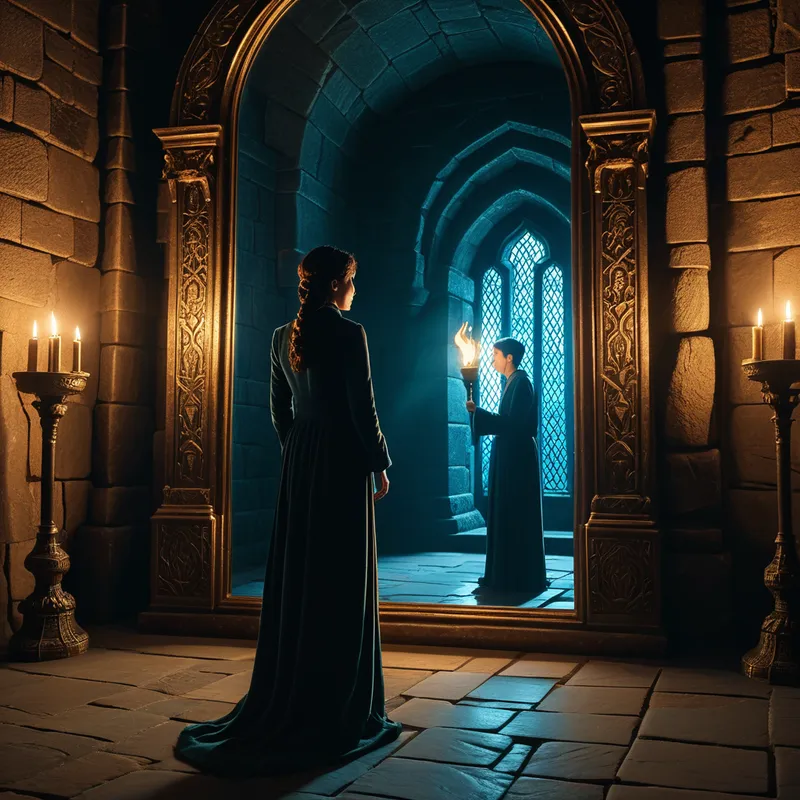
Within the cavern's heart, untouched by time or torch, it stood. No frame of gold adorned it, but a simple border of stone that seemed both ancient and unborn. Its surface was neither silver nor glass, but a stillness so profound it was a kind of being. The seeker approached, their breath catching. They expected to see their travel-worn face, their tired eyes.
The Magic Mirror showed them something else.
It did not show a single image. It showed a multitude. There was the face they knew, yes, but etched with lines of fears they had never named. Beside it flickered the child they had been, radiant and untamed. Coiled in the reflection's shadow was a creature of rage and envy, its eyes glowing with a familiar fire. And behind it all, a figure of pure, calm light—a potential self, waiting. The reflection was not flat, but deep, a corridor into a hidden interior world. The seeker saw not just who they were, but who they had failed to be, who they pretended to be, and who they might yet become. The truth was not cruel, but it was absolute and overwhelming. It was the unedited story of the self.
The seeker did not shatter the mirror, nor did they flee. The myth tells us they sat before it for days uncounted, in a vigil of seeing. They spoke to the angry shadow, acknowledged the forgotten child, and reached toward the latent light. When they finally rose, they did not turn their back on the mirror. They carried its silent, revealing depth within them. They returned to the world not as a different person, but as a whole one, for they had met all the tenants of their own inner house.
Cultural Origins & Context
The motif of the magical, truth-telling mirror is a true archetype, appearing in fragments and full tales across the globe. We find it in the scrying mirror of African diasporic traditions, a tool for contacting the ancestors and seeing beyond the veil. It echoes in the Buddhist concept of the Mirror of Wisdom, which reflects reality perfectly, without the smudges of ego or desire.
In European folklore, it crystallizes in tales like "Snow White," where the queen's mirror is an oracle of destructive comparison, and in the Celtic legends of truth-showing lakes. In Mesoamerican lore, tezcatl mirrors were portals to the spirit world. This was not a myth owned by one culture, but one discovered by humanity collectively, wherever people gathered around fires and pondered the nature of identity. It was told by elders to youths on the cusp of adulthood, by shamans to those seeking vision, and by poets to all who would listen. Its function was societal inoculation against self-deception—a cultural tool for fostering accountability, self-awareness, and the courage to confront the inner unknown.
Symbolic Architecture
The Magic Mirror is the ultimate symbol of consciousness itself—not the ego-consciousness that manages our daily persona, but the objective, witnessing consciousness. It represents the faculty of pure, non-judgmental awareness.
The mirror does not create the image; it only reveals what is placed before it. So too, consciousness does not create the self; it illuminates the self that is.
The seeker in the tale represents the ego, the "I" that ventures forth seeking answers. The cavern is the psyche, the inner world. The multitude of images within the mirror is a perfect map of the psyche's structure: the Persona (the known face), the Shadow (the creature of rage), the Divine Child (the radiant child), and the Self (the figure of light). The myth's power lies in its depiction of integration. The seeker does not battle these fragments; they acknowledge them. This is the essence of shadow work. The mirror forces a confrontation with the fact that we are not a singularity, but a parliament of selves. Wholeness, or individuation, is not about eliminating parts, but about bringing them into relationship under the light of awareness.
The Dreamer's Resonance
When the Magic Mirror appears in a modern dream, it signals a critical moment of psychic readiness. The dreaming culture.") mind is presenting its own scrying surface. To dream of a mirror that shows a strange or frightening reflection—perhaps one that is older, younger, monstrous, or divine—is the psyche's way of saying, "Look. This too is you."
The somatic experience can be one of chilling awe, a freeze response before a profound truth. The dreamer might feel exposed, vulnerable, as if their most private self is being displayed. This is the ego's resistance to the mirror's objective gaze. Alternatively, a dream of cleaning a dirty mirror, or of a mirror becoming clear and bright, often follows a period of introspection or therapy, symbolizing increasing self-clarity. A shattered mirror in a dream does not necessarily mean a shattered self; it can represent the breaking of an old, rigid self-image, making way for a new, more complex understanding. The dream mirror asks the dreamer to do what the mythic seeker did: to stay, to look, and to integrate what they see.
Alchemical Translation
The myth of the Magic Mirror is a precise blueprint for the alchemy of the self. The base material, the prima materia, is the unexamined life, the ego identified solely with its persona. The seeker's journey is the initial stage of nigredo—the descent into darkness, the confrontation with the shadow in the cavern of the unconscious.
The mirror is the alchemical athanor, the vessel wherein the lead of ignorance is transmuted into the gold of self-knowledge.
Facing the mirror is the crucial operation. This is not passive reflection, but the active, often painful, work of separatio and coniunctio. One must separate from the illusion of a simple, singular identity (separatio) and then consciously re-relate to the disparate parts (coniunctio). The angry shadow must be acknowledged as a source of vital energy. The inner child must be welcomed as a source of creativity and authenticity. The final stage, the rubedo or reddening, is symbolized by the seeker rising with the mirror's depth internalized. The light of the potential Self is no longer a distant image in a magical object, but a guiding principle within. The individual is no longer ruled by unconscious fragments but has become a conscious steward of their own inner kingdom. The mirror's truth, once terrifying, becomes the foundation of genuine integrity and the quiet, unshakable authority of one who knows, fully, who they are.
Associated Symbols
Explore related symbols from the CaleaDream lexicon: