Mafdet Myth Meaning & Symbolism
The myth of Mafdet, the celestial feline who purifies the sun's path, embodying swift justice, protection from hidden poisons, and the sacred duty of the protector.
The Tale of Mafdet
Before the first dynasty carved its name in stone, when the world was still soft with dawn, the sun-god Ra faced a peril that slithered. Each morning, as his golden barque pushed back the clinging dark of Nun, a more insidious darkness awaited. Not the simple absence of light, but a creeping, venomous malice. Serpents, born of the chaos before time, would coil in the reeds along the river of the sky, their fangs dripping with a poison meant for the gods themselves. Scorpions, with tails like cursed needles, lurked in the dust, waiting to sting the very pillars of the palace of heaven.
The divine court was in disarray. Warriors with spears could not strike what hid in the papyrus shadows. Spells of containment were like nets for smoke. The poison was not just of the body, but of the spirit—a corruption that threatened the Ma’at, the sacred order of all things. Fear, a cold serpent of its own, began to coil around the hearts of the immortals.
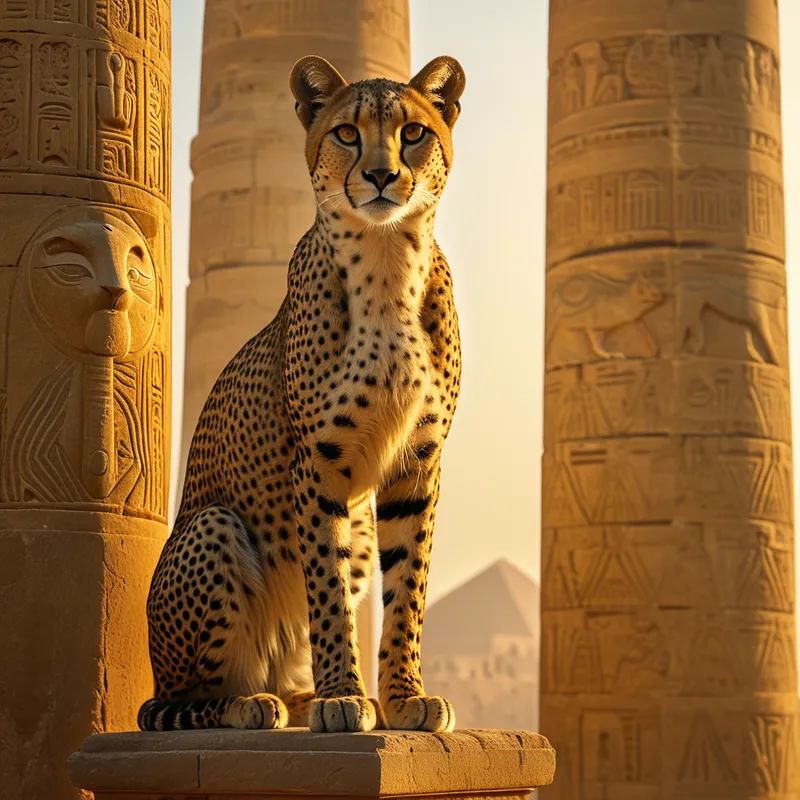
Then, from the silent places where the desert meets the fertile black earth, she came. Not with a roar, but with a silence more profound than the tomb. She was Mafdet. Her form was the essence of the predator: a sleek, powerful feline, sometimes a cheetah, sometimes a wild cat, sometimes a mongoose, yet always something more. Her eyes held the piercing clarity of the noonday sun, seeing through deceit and shadow. Her claws were not mere bone and keratin, but instruments of divine will, said to be fashioned from the obsidian heart of a fallen star—sharp enough to slice the soul from chaos.
She did not announce herself with fanfare. She simply was, a presence at the periphery of the sun-barque. When the first serpent of the day dared to rise, its scaled body gleaming with malice, there was only a blur of golden fur, a flash of darkness. Mafdet’s claws descended, not with brute force, but with a terrifying, surgical precision. They pierced the serpent’s head in a single, clean motion, a verdict delivered in an instant. The threat was severed, its poison rendered inert before it could even be spilled. She moved along the sun’s path, a swift, silent guardian. Scorpions were pinned and dispatched. The crawling, biting things of the unseen world fled before her scent, which was of frankincense and dry, clean sand.
By the time Ra’s barque reached its zenith, the path was clear. The light was pure, unsullied. Mafdet took her place, not on a throne, but on the pillar at the palace gate, her vigilant gaze sweeping the horizons. She became the living embodiment of the phrase “The Slayer of the Serpent.” Her claws, the instrument of her judgment, were immortalized in the hieroglyphs for “protection” and “to cut.” She was the first executioner, the first protector, the swift and terrible answer to the creeping chaos that sought to poison the world at its dawn.

Cultural Origins & Context
Mafdet’s origins are primal, rooted in the Predynastic and Early Dynastic periods of Egypt, long before the grand pantheon of Thebes or the complex philosophies of the Pyramid Texts solidified. She is a goddess of the threshold, emerging from a time when the primary human concerns were immediate and visceral: protection from venomous creatures, the administration of swift justice, and the defense of the royal and sacred space from unseen malevolence.
Her worship was intrinsically linked to kingship and the judicial system. In the pharaoh’s court, the “Hall of Ma’at,” Mafdet was the symbolic enforcer. The pharaoh, as the living embodiment of Horus, was the judge, but Mafdet was the executioner of divine will. Her swift, decisive action was the model for earthly justice. Texts and depictions show her emblem—the claw or the feline-headed pole—associated with the punishment of criminals, often those who had committed crimes against the cosmic order. She was the power behind the verdict, ensuring that the sentence was carried out, purging the community of its “poison.”
She was a goddess told of in the shadows of pillars and the quiet before the dawn, her myth less a sprawling epic and more a potent, recurring ritual assertion. Priests and royal scribes invoked her in protective spells. To speak her name was to summon a principle of active, purifying defense. While she was eventually syncretized and overshadowed by later feline deities like Sekhmet (of destructive power) and Bastet (of benevolent protection), Mafdet represents the original, undiluted archetype: protection through focused, lethal precision.
Symbolic Architecture
Mafdet is not a goddess of war or rage, but of necessary execution. Her symbolism forms a profound triad: the Feline, the Claw, and the Act of Piercing.
The Feline symbolizes acute perception, patience, and a predatory focus that operates outside human moral hesitation. It is the part of consciousness that can see in the dark, that moves on silent paws, attuned to the slightest rustle of threat. It represents instinctual intelligence in service of a higher order.
The Claw is the instrument of discrimination. It is not a blunt weapon but a precise tool.
The claw does not debate; it discerns. It separates the venom from the vein, the chaotic threat from the ordered whole, with a finality that allows for healing.
It symbolizes the often uncomfortable but necessary act of “cutting away”—severing toxic relationships, excising harmful thoughts, or delivering a firm, clear judgment where ambiguity is itself a poison.
The Act of Piercing is the core of her mythos. It is instantaneous, transformative justice. Psychologically, it represents the moment of profound insight or decisive action that neutralizes a long-festering “poison” in the psyche. This could be the realization that ends a period of self-deception, the courageous conversation that cuts through resentment, or the establishment of a firm boundary. Mafdet’s action is clean, surgical, and performed without malice. It is an act of protection, not of vengeance.
Together, she embodies the archetype of the Protector-Judge, a force that safeguards the integrity of the self (the “inner palace” or “solar barque”) by actively confronting and eliminating that which would secretly undermine it from within.

The Dreamer's Resonance
When the pattern of Mafdet stirs in the modern unconscious, it often manifests in dreams of sharp, decisive encounters with hidden threats. The dreamer may not see a feline goddess, but they will feel her function.
Common motifs include: discovering a venomous snake or insect in one’s bed or home (the poison in the personal sanctuary); wielding or being threatened by a sharp, piercing object like a needle, thorn, or claw (the instrument of judgment); or witnessing a swift, almost automatic action that neutralizes a danger (the execution of psychic defense). There is a somatic quality to these dreams—a feeling of adrenaline, of heightened alertness, of a tension that demands release.
Psychologically, this signals a process of shadow confrontation and integration. The “serpent” or “scorpion” represents a toxic element of the dreamer’s own psyche or life situation that has been lurking, poisoning their well-being. This could be a repressed resentment, a manipulative pattern, a secret guilt, or an enabling behavior. The dream is staging the necessity of the Mafdet function: the part of the self that can, and must, identify this poison with clarity and act to nullify it. The anxiety in the dream is the friction of this impending, necessary cut. The dreamer is preparing for a psychological act of purification that, while potentially difficult, is essential for restoring inner Ma’at.

Alchemical Translation
The individuation process, the alchemy of becoming whole, is not only about nurturing and creating; it is also about judicious destruction. Mafdet models the alchemical stage of Separatio—the crucial, often feared, operation of separation and purification.
In the psyche’s journey, we accumulate psychic “venoms”: compulsive thoughts, toxic identifications, outdated loyalties, and unresolved wounds that act like scorpions in our inner palace. They sting us repeatedly, injecting paralysis and chaos. The gentle caregiver or the wise sage may offer solace or understanding, but they cannot perform Mafdet’s operation.
To transmute lead into gold, one must first separate the pure metal from the dross. Mafdet is the archetypal force that performs this separation within the soul.
Integrating the Mafdet principle means developing the capacity for ruthless compassion. It is the courage to look directly at what is poisoning one’s life, to name it with the clarity of a feline’s gaze, and to execute a change—to cut the cord, to speak the hard truth, to end the enabling pattern. This is not an act of anger, but of supreme love for the integrity of one’s own being. It is protecting one’s inner sun—the core of vitality and consciousness—from the creeping chaos that would dim its light.
The modern individual must learn to be both the pharaoh in the Hall of Ma’at and the Mafdet who enforces its judgments. We must judge our own inner conflicts with fairness and then have the fearless resolve to carry the sentence out, to pierce the illusion and drain the poison. Only then can our personal barque sail on a purified river, its path clear from the reeds of hidden malice to the open horizon of a self-governed and protected wholeness.
Associated Symbols
Explore related symbols from the CaleaDream lexicon: