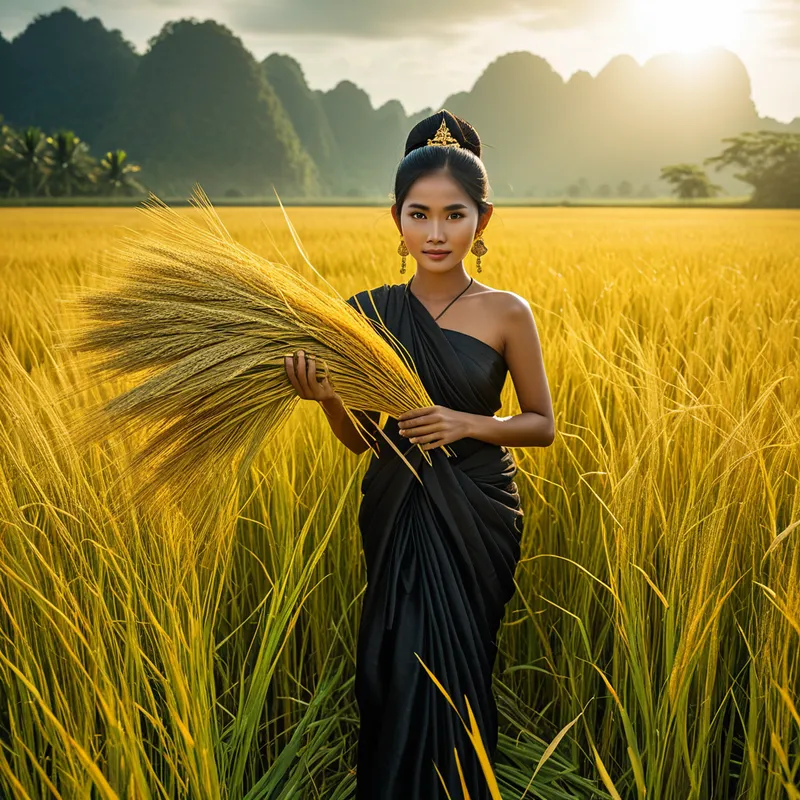
Mae Posop Myth Meaning & Symbolism
The myth of the Rice Goddess, a divine being who sacrifices her body to become the staple grain, embodying the sacred cycle of life, death, and rebirth.
The Tale of Mae Posop
Listen. Before the fields were green, before the baskets were full, there was only a great and aching hunger. The people wandered, their bellies hollow, their spirits thin as morning mist. They cried out to the heavens, but the sky was silent, a vast, indifferent bowl of blue.
Then, she came. She was not born of thunder or earthquake, but of a deep, answering compassion. They called her Mae Posop. Her skin was the warm brown of fertile earth after the first rain. Her hair flowed like the black, life-giving silt of the great river. Where she walked, the very air grew heavy with the promise of fullness. She moved among the people, and where her shadow fell, their hunger eased, replaced by a profound sense of peace. She was the embodiment of the mother they all longed for—the one who would never let her children starve.
For a time, it was enough. Her presence was a blessing. But the land remained barren. The hunger, held at bay by her spirit, began to gnaw once more. The people, in their desperation, grew fearful. Whispers turned to pleas. “We are grateful, Mother, but our bodies are weak. The soil is empty. What can we do?”
Mae Posop looked upon their gaunt faces, their hands outstretched not in demand, but in a hope so fragile it threatened to shatter. A great sorrow filled her, but it was a sorrow married to a terrible, loving resolve. She did not speak of her decision. There were no grand pronouncements.
She simply walked away from the village, out into the wide, open plain. The people watched from a distance, a silent, anxious congregation. She knelt on the hard ground. She began to sing—a low, resonant hum that vibrated in the chest of every living thing. It was a song of letting go, of becoming.
Then, she began to change. Her glorious form, the source of their comfort, began to dissolve. Her flesh softened, pale and then gold. Her flowing hair stiffened and bleached in the sun. Her very substance fragmented, breaking apart into thousands, millions of tiny, hard, golden pieces. She scattered herself across the barren earth. Where each fragment fell, the soil stirred. A tender green shoot pushed toward the sky, then another, and another, until the entire plain was a whispering, living sea of green. The people rushed forward, their hands now touching not a goddess, but her gift. The stalks grew tall, heavy with grain. They harvested the first rice, and when they cooked it, the steam carried her scent, and the taste was her final, sustaining embrace.
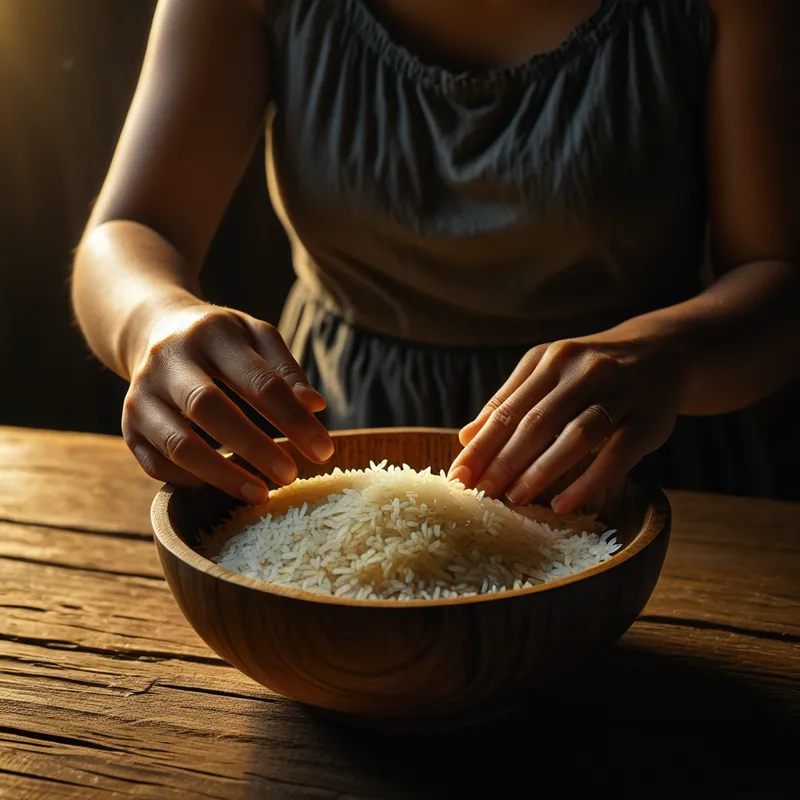
Cultural Origins & Context
The myth of Mae Posop is woven into the agrarian soul of mainland Southeast Asia, particularly within Thai, Lao, and Isan cultures. This is not a myth of distant Olympus, but one rooted in the mud of the paddy field, passed down not by priests in temples, but by grandmothers kneeling at the edge of the nursery bed, by fathers teaching their sons how to judge the ripeness of the panicle. It is an oral tradition, a story told during planting and harvest, a narrative that sanctifies the most fundamental act of survival: growing food.
Its societal function is profound and practical. The myth establishes rice not as a crop, but as a sacred, animate being. It encodes ritual etiquette: one must not waste rice, for each grain is a piece of the Mother. One must not speak harshly in the field, for she is listening. Specific ceremonies, like the Baci Su Kwan Khao, are performed to invite her spirit into the barn, to thank her for her sacrifice. The story transforms agriculture from an economic activity into a reciprocal relationship with a divine entity, fostering a deep-seated cultural ethos of gratitude, respect for nature, and communal responsibility.
Symbolic Architecture
At its core, the myth of Mae Posop is a supreme allegory of the archetypal Magna Mater. Her sacrifice represents the ultimate paradox of creation: that life is sustained only through death, that nourishment requires dissolution.
The goddess does not give food; she becomes food. This is the alchemy of the caregiver: the total transmutation of self into sustenance for the other.
Psychologically, Mae Posop symbolizes the source of all psychic and physical nourishment. She is the inner wellspring of creativity, the emotional "mother" that feeds our sense of security and growth. Her fragmentation into countless grains mirrors the way a single, profound source of love or inspiration (a parent, a teacher, an ideal) must be broken down and internalized in countless small, daily "meals" to truly sustain us. The hunger of the people is not merely physical; it is the hunger for meaning, for connection, for something to fill the existential void. Her transformation answers that hunger by becoming the very substance of daily life.

The Dreamer's Resonance
When this myth stirs in the modern unconscious, it rarely appears as a literal goddess in a rice paddy. Instead, it manifests in dreams of profound, often painful, generosity and depletion. One might dream of cooking an endless meal for strangers until one’s own body feels hollow. One might dream of a cherished, beautiful object—a vase, a book, a piece of jewelry—shattering, and from each fragment, a necessary, practical tool grows.
Somatically, this can correlate with feelings of being "spread too thin," of giving until there is nothing left of a coherent self. Psychologically, it signals a confrontation with the Shadow aspect of the caregiver archetype: the martyr. The dream asks: What in you is being sacrificed? Is it a creative spirit ground down to mere productivity? Is it your own needs dissolving to feed the demands of others? The dream of Mae Posop invites the dreamer to examine the quality of their nourishment—both what they give and what they receive—and to discern between life-giving sacrifice and soul-eroding depletion.

Alchemical Translation
The individuation process modeled by Mae Posop is not one of heroic conquest, but of sacred dissolution and purposeful reconstitution. It is the path of the nurturer who must learn that to truly feed another, one must first undergo a transformation oneself.
The modern individual faces this alchemy when a core identity—"the healer," "the provider," "the rock"—must be deconstructed to serve a higher function. This is the parent who must let their perfect image of parenthood fragment to meet the actual, messy needs of their child. It is the artist who must break down a grand, singular vision into the thousands of small, disciplined acts of craft. It is anyone who realizes that their love or their work must become incarnate, tangible, and consumable by the world.
The triumph is not in remaining whole, but in willingly undergoing a fragmentation that grants life to others, trusting that in this act, one achieves a different, more distributed kind of wholeness.
The final stage of this translation is the harvest: the moment of gathering what has grown from the sacrifice. It is the recognition that the fragmented self has not been lost, but has multiplied into a fertile field of influence, sustenance, and legacy. The individual learns to see themselves not as a solitary statue, but as a living, generative field, where the act of being consumed is, paradoxically, the act of becoming eternal. One becomes, like the rice, the humble, essential substance of continued life.
Associated Symbols
Explore related symbols from the CaleaDream lexicon: