Ma'at Myth Meaning & Symbolism
The story of the goddess who personifies cosmic truth, whose feather weighs the human heart against chaos in the ultimate judgment of the soul.
The Tale of Ma'at
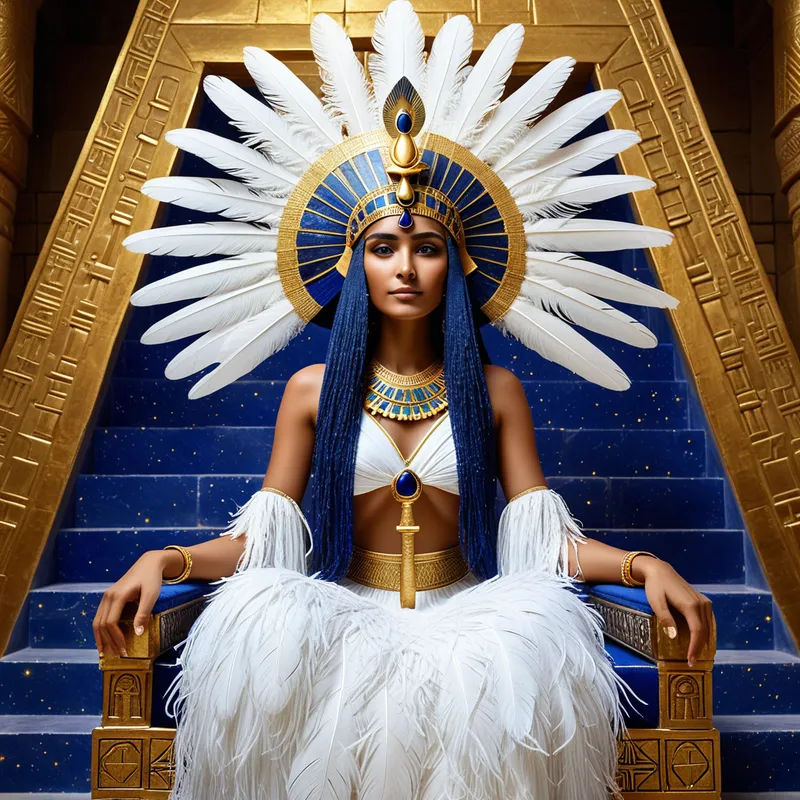
In the time before time, when the sun first pushed back the waters of Nun, a principle was born. Not with a cry, but with a silence so profound it shaped the heavens. Her name was Ma'at. She was the daughter of Ra, and her essence was the breath of creation itself—not the act, but the law that made the act possible.
She walked through the newly formed world, and where her feet touched the soil, the seasons learned their turns. Where her gaze fell upon the river, it remembered its banks. She whispered to the stars, and they charted their eternal courses. Ma'at was the harmony between sky and earth, the truth in a pharaoh’s decree, the balance in a merchant’s scales, the love in a family’s home. She was the single, perfect white ostrich feather, so light it could be held by a child, so heavy it could anchor the cosmos.
But her most sacred duty lay in the silent, breathless hall of Duat. This was the Hall of Two Truths, a chamber of black basalt lit by a cold, ethereal light. Here, the newly deceased, a shimmering ba-spirit, would stand before the lord of the underworld, Osiris, enthroned and majestic in his white wrappings. Around him, forty-two assessors watched with unblinking eyes.
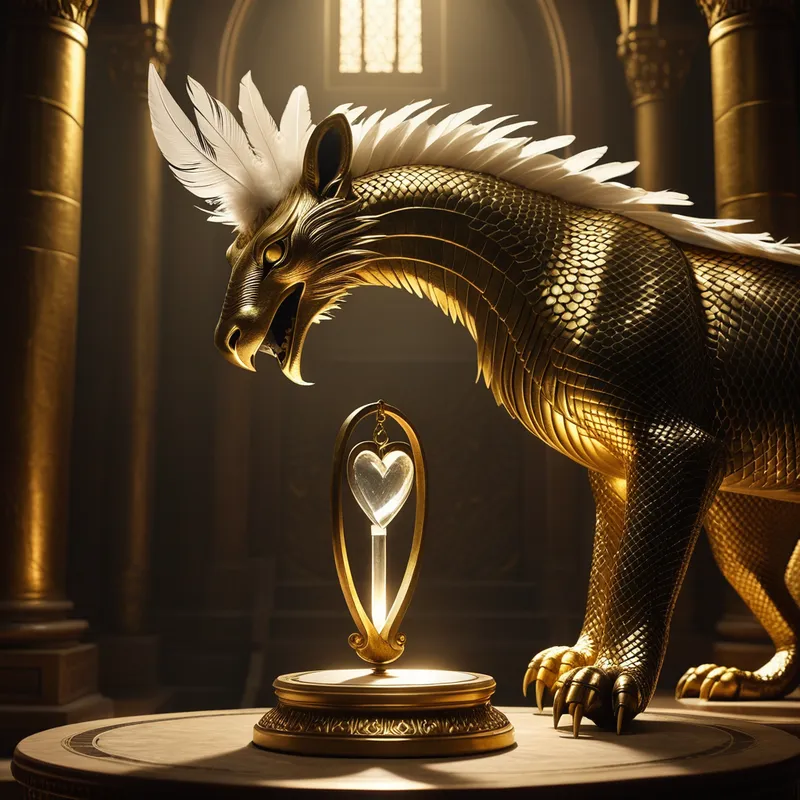
The air would grow still. The god of wisdom, Thoth, with the head of an ibis, would step forward, a scribe’s palette in his hands. Then, the heart of the deceased—not the physical organ, but the seat of memory, desire, and conscience—would be placed upon a great golden scale. Upon the other plate, Thoth would lay with infinite care the feather of Ma'at.
All would watch the tremble of the balance. If the heart, heavy with deceit, cruelty, and chaos, sank against the feather’s perfect truth, the scales would tip. A roar would echo as the Devourer, the fearsome Ammit—part lion, part hippopotamus, part crocodile—would lunge forward. The second death, the final unmaking, was swift and total.
But if the heart was light, if it matched the feather’s truth, the scales would find their perfect, holy equilibrium. Thoth would declare, “True of voice!” Osiris would nod, and a path would open to the Field of Reeds, a paradise of eternal harmony. Ma'at’s feather was the gatekeeper of eternity, the final, silent judge in a hall of gods. Her law was not punishment, but the inevitable echo of a life lived.
Cultural Origins & Context
The concept of Ma'at was not merely a story told at night; it was the foundational bedrock of ancient Egyptian civilization for over three millennia. It was a living, breathing ideology. The myth was enacted daily in temple rituals, where priests made offerings to “put Ma'at in her place,” a symbolic act of maintaining cosmic order against the ever-lurking chaos, Isfet.
The primary custodians and narrators of this myth were the elite scribes and priests. It was detailed in funerary texts like the Book of the Dead, which served as a guidebook for the deceased to navigate the judgment. However, its societal function permeated every level. The Pharaoh was the “Lord of Ma'at,” his primary duty to enact her principles on earth through just rule and proper ritual. For the common person, to “speak Ma'at” or “do Ma'at” meant to live a life of honesty, community responsibility, and respect for natural and divine laws. The myth provided a comprehensive ethical framework and a profound cosmology where individual morality was directly linked to the stability of the universe itself.
Symbolic Architecture
At its core, the myth of Ma'at is an archetypal drama of measurement, truth, and consequence. The symbolism is an elegant, terrifying, and ultimately hopeful architecture of the soul.
The heart is the record of a life, written in the ink of action and desire. The feather is the standard of a cosmos built on harmony. The judgment is not an external verdict, but the soul’s own confrontation with its intrinsic weight.
The Feather of Ma'at symbolizes transcendent, objective truth. It is not personal opinion or subjective belief, but the fundamental principle of right order—the way things ought to be in a harmonious universe. Its lightness represents purity, integrity, and alignment with this cosmic pattern.
The Heart (ib) is the totality of the individual psyche: our loves, hatreds, secrets, kindnesses, and betrayals. It is the accumulated substance of our character.
The Scales represent the moment of ultimate accountability, the interface between the personal and the cosmic. The Hall of Two Truths is the liminal space of this revelation—the truth of the cosmos versus the truth of the self.
Ammit represents the psychic dissolution that follows a life lived in denial of one’s own truth and the world’s fundamental laws. She is the embodiment of the terror of meaninglessness, the “second death” of the soul that has failed to cohere. Conversely, the Field of Reeds symbolizes the integrated Self—a state of psychic wholeness and peace achieved through alignment with this deeper order.
The Dreamer's Resonance
When this myth stirs in the modern unconscious, it rarely appears with ibis-headed gods. Instead, the dreamer may find themselves in a stark, official building (a courtroom, a sterile office, a laboratory) facing a test or evaluation for which they feel profoundly unprepared. The examiner is faceless or impossibly authoritative. The test is often absurdly simple yet terrifying: balancing a feather on a fingertip, writing a single perfect word, or standing on a scale that measures something other than weight.
The somatic experience is one of acute exposure and vulnerability—the “heart” of the dreamer feels visible, raw, and weighed. This is the psyche’s ritual of self-assessment. The dream is conducting its own Weighing of the Heart. The “feather” in the dream represents an inner, often neglected, standard of integrity. The anxiety arises from the unconscious knowledge that one’s actions, choices, or self-deceptions (“the heart”) are being held against this standard. The dream is a call to self-honesty, a signal that some aspect of life is out of balance, that the internal Isfet of chaos, deceit, or avoidance has grown too heavy.

Alchemical Translation
The alchemical process modeled here is the transmutation of the leaden, chaotic heart into one as light as a feather—the journey toward psychological integrity, or individuation. It is not about achieving moral perfection, but about achieving authentic congruence.
Individuation is the soul’s own Weighing of the Heart, performed daily. Each act of self-honesty is a grain of weight removed. Each acceptance of shadow is a polishing of the scale.
The first stage is Confessionio—the bringing of the “heart” to the scales. This is the difficult, conscious work of shadow integration: acknowledging one’s pettiness, envy, cowardice, and deceit not to be punished, but to be seen and metabolized. The modern “Hall of Two Truths” is the therapist’s office, the journal page, or the silent moment of ruthless self-reflection.
The second stage is Comparatio—the weighing itself. This is the practice of holding one’s complex, contradictory self against the simple, unwavering standard of one’s own deepest truth. “Does this action align with who I profess to be? Does this relationship create harmony or chaos? Does this path feel true?” This is not about external morality, but internal consistency.
The third stage is Transmutatio—the result. If the heart is found heavy, the “Ammit” that threatens is not damnation, but the continued inner fragmentation, anxiety, and meaninglessness that comes from a life out of alignment. The work is to lighten the heart through atonement (at-one-ment), making amends, changing behaviors, and forgiving oneself and others. When the scales balance, the “Field of Reeds” attained is a state of inner peace. It is the feeling of being undivided, of walking through one’s life with a sense of rightness and belonging, because one’s inner world finally reflects the fundamental, feather-light law of one’s own being.
To live by Ma'at today is to build an inner sanctuary where the scales are always present, not as a threat, but as the most sacred tool of becoming. It is to understand that every choice, every word, every silent thought adds a weight or subtracts one, moving us eternally closer to chaos or to the sublime, feather-light peace of a heart at home in its own truth.
Associated Symbols
Explore related symbols from the CaleaDream lexicon:
- Department
- Result
- Government
- Fairly
- Superior
- Correct
- Principal
- Mean
- Lawyer
- Law
- Balance
- African
- Judge
- Receptionist
- Scale
- Authorities
- Feather Duster
- Feathered Headdress
- Chic Blazer
- Balancing Acts
- Celestial Balance
- Celestial Guardian
- Lapis Lazuli Tile
- Judge's Gavel
- Seesaw
- Abraham Lincoln's Hat
- Guillotine
- Poetic Justice
- Neat Pantry Shelves
- Kitchen Scale
- Feather Earring
- Calculating Scale
- Balanced Scale
- Balancing Scales
- Scale of Justice
- Cosmic Balance
- Ephemeral Feather
- Feather
- Haetae Guardian
- Feather Fan
- Rhythm
- The Authority
- Legal System
- Justice
- Subpoena
- Power Structure
- Authority Symbol
- The Principle
- Enforcement
- Procedural
- Equity
- Right
- Aligning
- Symmetrical
- Accuracy
- Straight