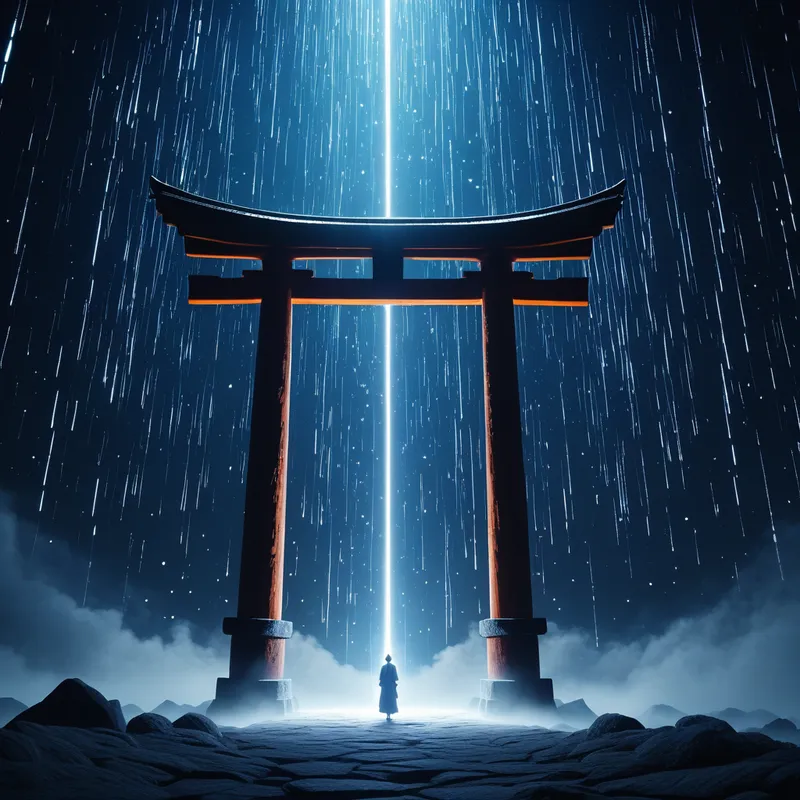
Ma Myth Meaning & Symbolism
The myth of Ma is the story of the world born from the pause between the divine breaths, teaching that meaning is woven in the spaces between things.
The Tale of Ma
In the time before time, when all was a murmuring sea of unformed potential, there existed only the First Breath. It was not a thing, but a rhythm. The great kami of sound, Ame-no-Uzume, and the great kami of silence, Tsukuyomi, existed not as separate beings, but as the inhale and the exhale of a single, sleeping consciousness.
The world was formless because the breath was constant—a never-ending stream of vibration. There was no distinction, no thing to perceive another thing. Ame-no-Uzume’s eternal song was beautiful, but it was everything, and therefore it was nothing. Tsukuyomi’s profound stillness was deep, but it was absolute, and therefore it was empty.
Then came the first hesitation. In the endless exhalation of song, a flicker of fatigue. In the endless inhalation of silence, a tremor of longing. For a single, eternal instant—which was both no time at all and all of time—the breath held.
In that suspension, the universe cracked open.
It was not a crack of sound, but of perception. In the pause between Uzume’s note and Tsukuyomi’s stillness, a space emerged. It was not emptiness, but a charged emptiness. Within it, the lingering echo of the last note met the anticipatory pull of the next silence, and in that meeting, something new was born: relationship. The echo was now distinct from the anticipation. The “here” of the sound was suddenly aware of the “there” of the coming quiet.
From this primordial Ma, all things unfolded. The space between breaths became the sky vaulting over the earth. The pause between heartbeats of the divine became the rhythm of the seasons. The interval between the strike of a hammer and its ring became the space where a temple could be imagined, and then built. The kami themselves gained form and identity, not in their continuous essence, but in the resonant spaces between each other. Amaterasu was defined by the night that was not her, and Susanoo by the calm he disrupted.
The myth tells that creation was not the first word, but the first meaningful silence between two words. The world is not the ink, but the white page that holds it; not the pillar, but the space it creates for movement; not the sound of the bell, but the resonant silence that carries its meaning into the heart. Ma was the first artist, and the universe its masterpiece of interval and relation.
Cultural Origins & Context
The concept of Ma is not a single, codified myth from a specific text like the Kojiki or Nihon Shoki. It is a foundational aesthetic and philosophical principle woven into the very fabric of Japanese culture, passed down not through a single bardic tale, but through the practices of artisans, poets, monks, and architects. Its origins are as diffuse and essential as the air.
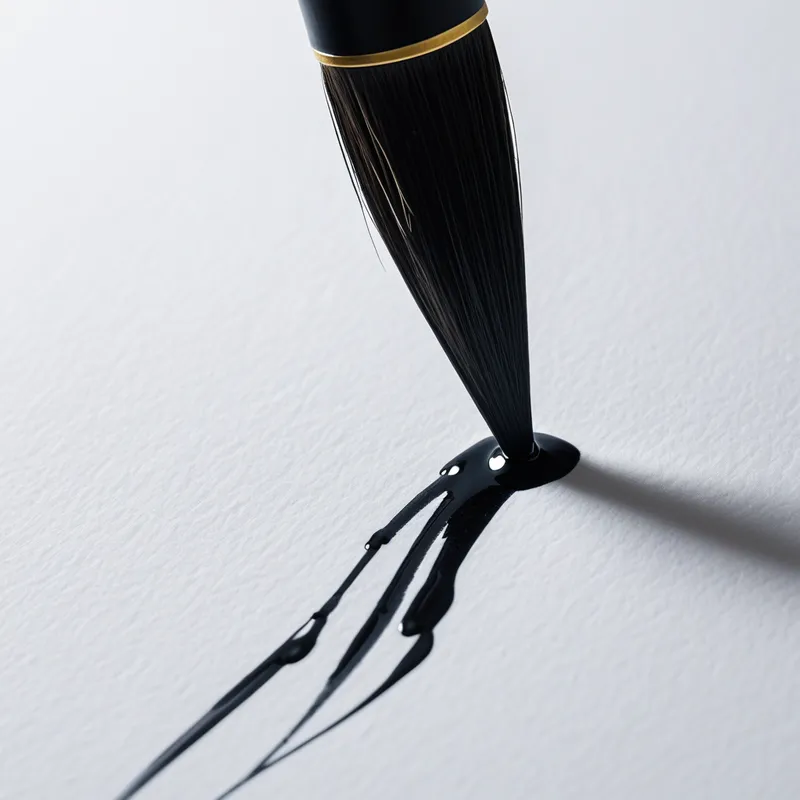
It is the governing principle in sumi-e, where the unpainted space is as active and intentional as the brushstroke. It is the heartbeat of haiku, where the cutting word (kireji) creates a deliberate rupture, a space for the reader’s mind to leap and make its own connection. It is the essence of chanoyu, where the ritualized movements are punctuated by pauses of profound significance—the moment of regarding the utensil, the silence after sipping. In washitsu architecture, Ma is the modular space defined by tatami, flexible and flowing, where walls are sliding screens (shoji) that redefine the relationship between inside and outside.
Societally, Ma functioned as a grammar of perception. It taught a people living on crowded islands how to cultivate psychological and spiritual space. It encoded respect—the respectful pause before speaking, the space left between individuals. It was a cultural container for the appreciation of ephemerality (mono no aware) and the beauty of asymmetry and imperfection (wabi-sabi). To understand Ma was to understand how to listen to what is not said, to see the form in the formless, and to find the whole in the interplay of parts.
Symbolic Architecture
Psychologically, Ma represents the generative void. It is not mere absence, but the fertile ground of potential from which consciousness and differentiation arise. It symbolizes the interval where transformation occurs.
Ma is the suspension bridge of the psyche, spanning the chasm between one state of being and another. It is not the thought, but the consciousness that observes the thought arising and passing.
It represents the space between stimulus and response, the crucial moment of freedom where choice and awareness reside. In the myth, the continuous breath is undifferentiated consciousness—a state of psychic inflation where one is identical with one’s emotions or thoughts. The pause, the birth of Ma, is the dawn of self-reflection. It is the ego’s first emergence from the unconscious sea, creating a space where the “I” can observe the “it.”
The two kami, Ame-no-Uzume (sound/movement/expression) and Tsukuyomi (silence/stillness/reception), symbolize the fundamental polarities of existence: action and rest, expression and introspection, extraversion and introversion. Ma is the third, transcendent element that allows these opposites to relate without collapsing into one another. It is the principle of relationship itself.
Furthermore, Ma symbolizes the necessary gaps in our knowing, the mysteries that make understanding possible. A completely filled page is a blot. A life with no pauses is noise. The psyche requires these intervals to digest, integrate, and create meaning.
The Dreamer's Resonance
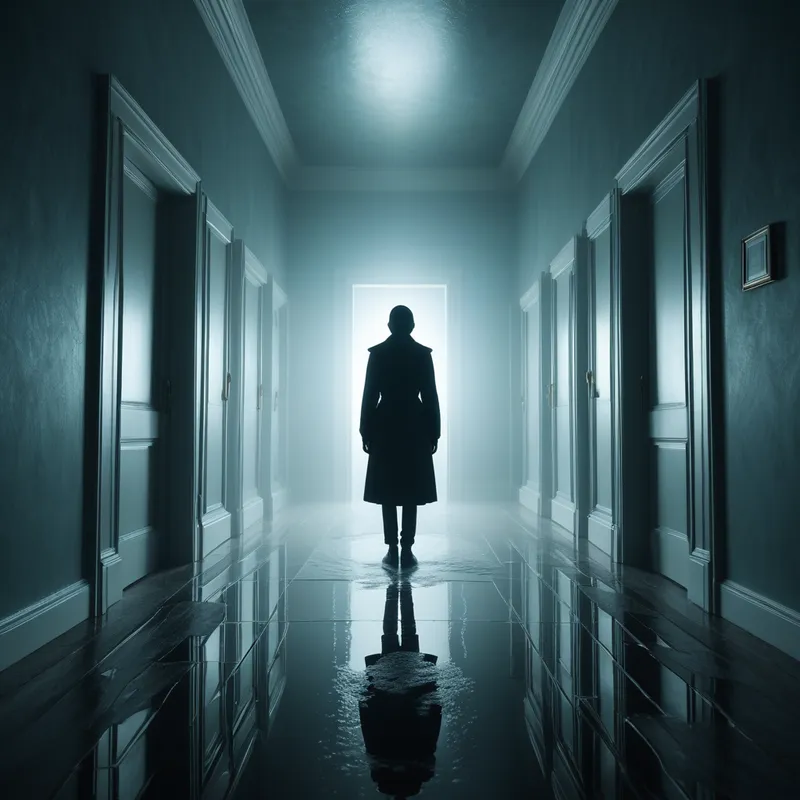
When the archetype of Ma stirs in the modern unconscious, it often manifests in dreams of potent emptiness and pregnant pauses. The dreamer may find themselves in vast, silent halls where the architecture is defined by soaring negative spaces. They may dream of a crucial conversation where the most important communication happens in a shared, wordless glance that stretches into eternity. They may hear a beautiful piece of music where the notes fade, leaving a silence that feels more profound and loaded than the sound itself.
Somatically, this can correlate with a feeling of being “on the threshold”—a physical sensation of suspension, of breath held, of muscles poised between tension and release. Psychologically, it signals a process of incubation. The conscious mind has been laboring on a problem, a relationship, or an identity crisis, and the Self is enforcing a necessary pause. It is the psyche’s way of saying, “Stop doing. Start being. Listen to the space between your thoughts.”
This dream pattern often appears during life transitions: between jobs, after a relationship ends, before a creative breakthrough, or in the wake of a loss. The emptiness dreamed is not a warning of lack, but an invitation. It is the unconscious creating the very Ma needed for the next phase of the personality to coalesce. The discomfort of the “gap” is the growing pain of the new form taking shape in the void.
Alchemical Translation
The myth of Ma models the alchemical process of psychic transmutation, or individuation, as a sacred discipline of creating and honoring interval. The hero’s journey here is not one of slaying dragons, but of cultivating the silent, fertile ground within which the dragon can be transformed.
The initial state—the continuous, undifferentiated breath—is akin to psychological identification. We are our job, our role, our trauma, our thoughts. There is no space for the observing Self. The first act of alchemy is the introduction of the pause. In therapy, this is the reflective question that interrupts the narrative. In meditation, it is the observation of the breath. It is the conscious creation of a Ma between oneself and one’s compulsive patterns.
Individuation is the art of becoming an architect of inner space. It is learning to build sacred intervals between impulse and action, between memory and identity, between the persona and the shadow.
The work involves holding the tension of the opposites (Uzume and Tsukuyomi within us—our drive for expression and our need for quiet) without rushing to collapse them into a premature solution. This “holding” is the Ma. In this space, something new, a tertium non datur (the third that is not given), can emerge. It might be a creative insight, a deeper compassion, or a more authentic way of being.
The ultimate alchemical translation is the realization that the Self is not a solid, continuous entity, but a dynamic pattern of relationships held in the container of awareness—the ultimate Ma. The goal is not to fill all the gaps, but to become so at home in the intervals that one recognizes them as the source of connection, meaning, and continuous creation. We learn to see the void not as a threat, but as the womb of the world, and in doing so, we participate in the ongoing myth of Ma, breathing a more conscious world into being with every sacred pause we honor.
Associated Symbols
Explore related symbols from the CaleaDream lexicon: