Lutung Kasarung Myth Meaning & Symbolism
A Sundanese myth where a princess sees the true divine nature within a lowly black monkey, revealing that essence precedes and defines form.
The Tale of Lutung Kasarung
Listen, and let the mists of Pasundan part. In a kingdom cradled by volcanic mountains and whispering bamboo, there lived a king with seven daughters. The youngest, Purbasari, was a soul of such gentleness that flowers seemed to bow as she passed. Her elder sister, Purbalarang, was a storm contained in silk, her heart a knot of envy tightened by her father’s evident love for his youngest child.
Through dark arts and whispered lies, Purbalarang conjured a dreadful affliction upon Purbasari—a skin disease that marred her famed beauty, turning her skin to a rough, discolored canvas of suffering. Declared unfit for the throne, the innocent princess was cast out, exiled to the deep, murmuring heart of the alas larangan, the forbidden forest. There, amidst the sigh of ancient trees and the watchful eyes of unseen spirits, she was left to her fate.
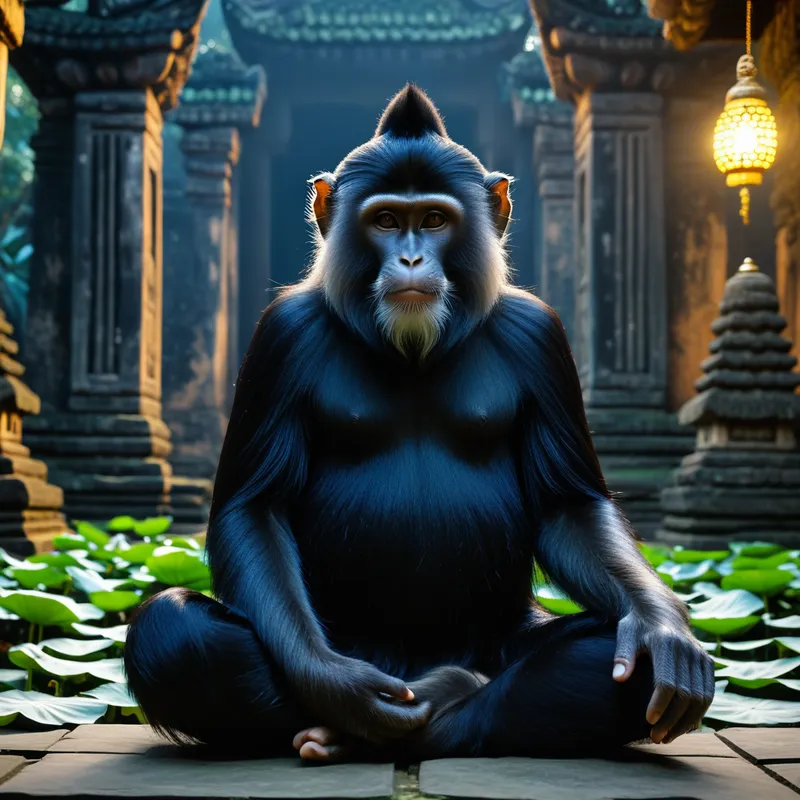
Her only companion in this green exile was a creature as unexpected as her downfall: a Lutung, a large, black, long-tailed monkey. This was no ordinary beast. In his eyes glimmered a profound intelligence, a deep, unspoken sorrow. He became her guardian, her humble servant, fetching her food, building her shelter, offering a silent, furry solace. The villagers, seeing this strange pair, named him Lutung Kasarung.
Back in the kingdom, Purbalarang’s rule was as harsh as her heart. A contest was decreed: to prove her superiority and secure her reign, she would compare the length of her hair with her exiled sister’s. Messengers found Purbasari in the forest, her skin still marked by her ordeal. In despair, she turned to her faithful Lutung. The creature gestured to the heavens, then to the earth, and began a slow, deliberate dance. He prayed. The sky darkened, and from the clouds, a bidadari descended, washing Purbasari in waters from a sacred vessel. The affliction melted away, revealing skin more radiant than before, and her hair grew long and lustrous, flowing like a midnight river, surpassing her sister’s.
Enraged and cunning, Purbalarang devised a final test: they must present their future husbands. Purbalarang presented a handsome, powerful noble. Purbasari, with only her Lutung by her side, in a moment of pure-hearted loyalty declared, “This is my companion.” The court erupted in cruel laughter. But Purbasari stood firm. Then, the Lutung Kasarung asked for a sacred space to pray. He built a great bale overnight, a task of impossible scale. Inside, he began his prayers once more.
As the people watched, a miracle unfolded. The coarse black fur receded. The simian form stretched and transformed. Where the lowly monkey once knelt now stood a man of breathtaking beauty and divine bearing—Batara Guru, or in other tellings, the god Guru Minda. He had taken the form of the Lutung to test the hearts of mortals, to find one who could see beyond form to essence. Purbasari, who loved the soul within the beast, had passed the ultimate test. The true king was revealed, Purbalarang’s falsehood was undone, and Purbasari ruled with wisdom and compassion beside her divine consort, her perception having healed the kingdom itself.

Cultural Origins & Context
The myth of Lutung Kasarung is a foundational narrative of the Sundanese people, preserved through oral tradition in the form of pantun and later recorded in manuscripts. It is more than a folktale; it is a cosmogonic myth for the Sundanese kingdom of Pajajaran, serving to legitimize rulership through divine connection and moral authority. The story was not merely entertainment but a pedagogical tool, transmitted by elders and storytellers to impart core societal values: the primacy of inner virtue (budi) over outer appearance, the dangers of envy (iri hati), and the belief that true sovereignty is granted by the divine to those with a pure heart.
The narrative seamlessly blends indigenous Sunda Wiwitan conceptions of sacred power with later influences from Hindu epics, evident in the figure of the god taking animal form—a theme echoing the awatara of Vishnu. This syncretism reflects the historical layers of cultural and religious exchange in the Indonesian archipelago, making the myth a living tapestry of Sundanese identity.
Symbolic Architecture
At its core, Lutung Kasarung is a profound allegory of perception and essence. The Lutung is the ultimate veil, the divine in disguise, the sacred hidden within the profane, the king within the beggar, the whole within the broken.
The greatest test is not to endure suffering, but to recognize the sacred hidden within the vessel of suffering.
Purbasari’s exile represents the necessary descent from the collective order (the kingdom) into the chaotic, untamed realm of the psyche (the forest). Her skin disease is not a punishment but a stripping away of her former, socially-defined identity. It is only when her royal surface is marred that she can develop the interior depth required to perceive true value. The Lutung is her own shadow made manifest—the rejected, animalistic, "ugly" part of existence that, when embraced with compassion, reveals itself as the carrier of divinity.
The myth presents a radical hierarchy: Essence precedes and defines Form. Purbalarang is trapped in the world of Form—beauty, hair length, handsome suitors. Purbasari, through her ordeal, learns to perceive Essence—loyalty, kindness, the soul within. Her declaration that the monkey is her companion is the climax of her initiation; she chooses essence, and in doing so, she compels the form to change.
The Dreamer's Resonance
When this myth stirs in the modern psyche, it often manifests in dreams of hidden guardians, shameful companions, or transformative relationships with animals or "monstrous" figures. To dream of caring for a wounded, ugly, or socially unacceptable creature signifies the psyche’s readiness to engage in a profound act of reclamation.
The somatic experience might be one of initial revulsion or deep shame, giving way to a stubborn, inexplicable compassion. This is the Purbasari process: the ego, itself in a state of exile (feeling flawed, rejected, or ill), is tasked with tending to an even more rejected aspect of the self. The dream is an invitation to stop trying to "cure" or expel our personal "Lutung"—our raw emotions, our primal needs, our perceived flaws—and instead to offer it sanctuary. The healing of the dreamer’s own "skin disease" (anxiety, depression, a sense of inadequacy) is not achieved by focusing on the cure, but by first fully accepting the guardian that arrives in the guise of the wound.

Alchemical Translation
The individuation journey modeled by Lutung Kasarung is the nigredo and albedo in one continuous motion. The exile (nigredo) is not a mistake but the necessary precondition. The ego must be humbled, its identifying marks (status, beauty, certainty) dissolved, so that it can develop a new faculty: the perception of the anima mundi, the world soul, in its most disguised form.
The god does not descend to rescue you from the forest; the god has been waiting for you in the forest all along, wearing the face of your exile.
Purbasari’s active choice to claim the Lutung is the critical turning point—the rubicon of consciousness. This is the alchemical "union of opposites": the beautiful princess and the black monkey, consciousness and the unconscious, human and animal, mortal and divine. By embracing the lowly, she activates the latent high. Her loyalty to essence performs the ritual that transmutes form.
For the modern individual, this translates to a sacred practice: identify the "Lutung" in your life. What or who have you dismissed as ugly, embarrassing, primitive, or unworthy of your throne-room? A forgotten talent, a "childish" emotion, a relationship that doesn't look impressive, a part of your body you despise? The myth instructs us to not just tolerate this Lutung, but to formally declare it our betrothed, our destined companion. We must build a bale—a sacred inner space—for this union to be consecrated. In that act of unwavering recognition, the transmutation begins. The outer world may laugh, but the inner kingdom is realigned with its divine sovereign.
Associated Symbols
Explore related symbols from the CaleaDream lexicon:
- Forest — The chaotic, untamed realm of the unconscious psyche where the ego is exiled and stripped of its social identity, forcing a confrontation with raw, essential truths.
- Monkey — The trickster-guardian, representing the instinctual, playful, and seemingly inferior aspect of the self that is, in reality, the disguised carrier of divine consciousness.
- Mirror — The test of perception; Purbalarang sees only surface reflection, while Purbasari’s compassion allows her to see the true reflection of essence within the distorted form.
- Transformation — The core alchemical process of the myth, where embracing the lowly (the prima materia) activates a divine revelation, changing both the self and one’s reality.
- Shadow — The Lutung embodies the personal and collective shadow—all that is rejected, animalistic, or deemed unworthy, which holds the key to wholeness when integrated.
- God — The ultimate essence hidden within form, representing the transcendent Self that can only be accessed through the acceptance of its contrary, embodied manifestation.
- Beauty — Not a fixed attribute but a dynamic revelation; true beauty is the radiance of essence that shines forth when inner virtue aligns with perception.
- Water — The cleansing, healing element brought by the bidadari, symbolizing the grace that follows the act of acceptance, purifying the scars of the old identity.
- Heart — The organ of true perception in the myth; Purbasari’s compassionate heart sees what the eyes cannot, guiding her to the sacred choice that defines her destiny.
- Ritual — The Lutung’s prayer and construction of the bale, representing the deliberate, sacred inner work required to create a container for profound psychic transformation.