Lughnasadh Myth Meaning & Symbolism
A myth where the god Lugh establishes a funeral feast for his foster-mother, transforming personal grief into a communal covenant with the land.
The Tale of Lughnasadh
Hear now the tale of the gathering, of the first fruits and the final farewell. It begins not in joy, but in the heavy silence of a king’s grief.
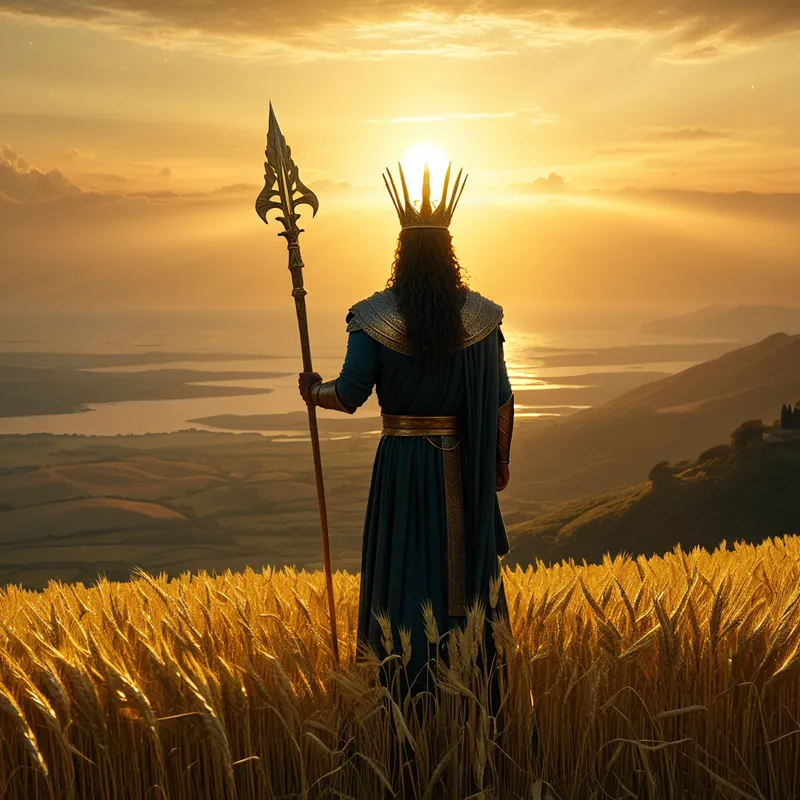
The sun was a molten coin in the high summer sky, but for Lugh Lámhfhada, Lugh of the Long Arm, its light felt cold. He stood upon the green crown of Tlachta, the wind whispering through the grasses like a forgotten song. His eyes, which could see the smallest detail in a craftsman’s work or the distant movement of an army, were clouded. They were fixed on the earth, on the memory of a woman who was not his mother by blood, but by every bond that matters: Tailtiu.
She had found him, the strange, shining child, and raised him in secret. She had taught him the strength of the oak and the patience of the root. And when the time came for the people to claim this land, it was Tailtiu who took a mighty axe in her own hands. For a year and a day, they say, she labored. She cleared the vast plain of Brega, felling the ancient forests so her people could plant and prosper. But the effort was a sacrifice. She poured her strength into the soil until there was nothing left for her body. She lay down upon the cleared earth, the scent of turned loam and crushed greenery around her, and spoke her final decree to her foster-son.
“Lugh,” her voice was the rustle of dry leaves, “let games be held in my name here, upon this land I have given my life to make fertile. Let there be contests of strength and skill, of horsemanship and poetry. Let my people gather, and in their assembly, in their joyful strife, let them remember the covenant. The land gives, but it must first receive.”
Then she was gone. Her body became one with the plain she had carved from the wilderness.
Lugh felt the loss like a hollow in the world. But he was a king of the Tuatha Dé Danann, a master of turning raw material into art, conflict into resolution, grief into purpose. He would not let her passing be a silent, private sorrow. He would make it a public vow, a turning point in the year’s wheel. He declared a óenach, a great assembly. He called every tribe from every corner of Ireland to gather on the feast day that would bear his name: Lughnasadh.
They came in their multitudes. On that high hill, the air thickened with the dust of racing chariots, the grunt of wrestlers, the melodic clash of bardic verses, and the laughter of young people meeting under the August sun. Lugh presided, his radiant presence now tempered with a solemn grace. He oversaw the forging of alliances, the settling of disputes, the marriages that wove new threads into the social fabric. And at the heart of it all, as the sun began its descent, the first sheaves of ripe grain were cut with reverence. The first loaves, made from the new flour, were broken and shared.
Lugh took the first piece. He did not eat it himself. He knelt and placed it gently back onto the rich, dark soil of Tailtiu’s plain. A libation of fresh ale followed. It was not a gift to the dead, but a payment of a debt, a recognition. The games were the celebration of life she enabled; the offering was the acknowledgment of the life she gave. The grief was not gone, but it was now woven into the golden tapestry of the harvest, a necessary thread in the pattern of survival and community.
Cultural Origins & Context
Lughnasadh (pronounced LOO-nə-sə), held around August 1st, marked the beginning of the harvest season in the Gaelic calendar, situated between the summer solstice and the autumn equinox. Unlike the other three great Celtic festivals (Imbolc, Bealtaine, and Samhain), Lughnasadh is unique in being explicitly attributed to a specific god’s founding act. The myth was the sacred charter for the óenach, a central political, economic, and social institution.
These gatherings were not mere fairs. They were where tribal kings affirmed their sovereignty—a concept deeply tied to the fertility of the land, embodied by the goddess like Tailtiu. The games tested the physical and artistic prowess of the community, ensuring its vitality. Marriages contracted at this time (Teltown marriages) reinforced social bonds. The ritual cutting of the first grain and the communal feast enacted the myth in real time, transforming the abstract concept of sacrifice into a tangible, somatic experience of reciprocity. The story was kept alive not just by bards, but by the very actions of the people—the strain of the race, the taste of the new bread, the feel of the earth underfoot during the assembly.
Symbolic Architecture
At its core, the myth of Lughnasadh is an alchemical formula for processing profound loss. It maps the journey from personal, paralyzing grief to communal, life-affirming ritual.
Tailtiu represents the Great Mother in her most foundational aspect: the very soil of existence that must be cleared, worked, and ultimately sacrificed for culture (agriculture) to emerge. Her death is not a tragedy of violence, but a necessary exhaustion, a pouring of self into a project larger than the individual. Lugh represents the conscious, skilled ego. He is the brilliant son who inherits the cleared field—the potential—but also inherits the debt and the sorrow.
The harvest is not a gift, but a settled account. The first fruits belong not to us, but to the ground from which they and we sprang.
The key symbolic act is Lugh’s refusal to internalize the grief or let it vanish. He externalizes it. He builds a container for it—the festival. The games symbolize the redirected, celebratory energy of life that continues because of the sacrifice. The offering of the first fruits back to the earth is the critical completion of the circuit. It acknowledges that what we call “our” bounty is, in truth, a loan from a source that has paid a price.

The Dreamer's Resonance
When this myth stirs in the modern psyche, it often surfaces in dreams of arduous preparation yielding to ambiguous loss. One might dream of tirelessly building or cleaning a vast, beautiful structure (a home, a garden, a community hall), only to collapse at the moment of completion, watching others enjoy it. There is a somatic sense of deep exhaustion mixed with a quiet, proud detachment.
Alternatively, dreams may feature potent gatherings—conferences, weddings, festivals—where the dreamer feels both central and strangely peripheral, like a host ensuring everyone is fed but not partaking. The psychological process at work is the confrontation with the parental complex, specifically the realization of the debts owed to those who cleared the path for our lives. It is the dawning awareness that our individuality, our “harvest,” was seeded in another’s sacrifice. The dream-work is initiating a move from unconscious entitlement to conscious obligation.
Alchemical Translation
For the individual, the Lughnasadh myth models the stage of individuation where one must metabolize the legacy of their inheritance—both genetic and psychic. The “clearing of the plain” is the internal work of confronting familial patterns, cultural conditioning, and personal trauma to make space for one’s own life to grow.
The foster-mother Tailtiu symbolizes those foundational influences that nurtured us but may also have depleted themselves in the process. The alchemical task, as performed by Lugh, is threefold. First, to fully feel the grief of that recognition—the cost paid by others for our existence. Second, to refuse to let that grief become a silent, neurotic weight. Instead, we must consciously “institute games”—that is, create personal rituals, practices, or creative acts that honor that legacy by living well. This transforms the inherited energy from a passive debt into an active, living tradition.
Individuation is not about claiming your harvest and leaving the field barren. It is about becoming a conscious steward of the fertility you inherited, ensuring the cycle continues.
Finally, we must make the “first fruits offering.” Psychically, this is the act of gratitude and reciprocity. It is dedicating a portion of our hard-won consciousness, our creativity, or our success back to its source—whether through healing family relationships, contributing to community, or simply holding a respectful, mindful awareness of the chain of being that supports us. In this alchemy, personal grief is transmuted into a sense of sacred responsibility, and the individual ego becomes a sovereign who rules in partnership with the nourishing earth of the soul.
Associated Symbols
Explore related symbols from the CaleaDream lexicon: