Lugalbanda Myth Meaning & Symbolism
A Sumerian king, left for dead, finds divine favor in the wilderness, transforming weakness into a sacred bond that empowers his people.
The Tale of Lugalbanda
Hear now the tale of Lugalbanda, the king who was forged not in the fire of battle, but in the cold, silent kiln of the wilderness.
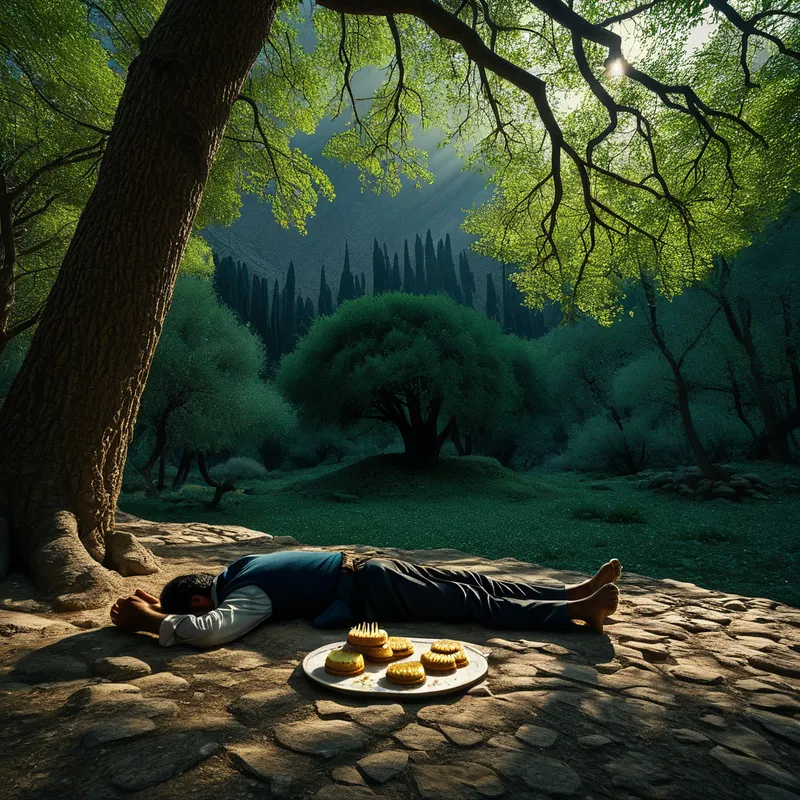
The great army of Uruk marched, a river of bronze and purpose, flowing east towards the rebellious mountains of Aratta. Among them strode Lugalbanda, a warrior-king. But a shadow fell upon him. A wasting sickness, a fire in the blood and a chill in the bone, gripped him. He could not take another step. His brothers, the seven other warrior-kings, gathered in sorrow. To carry him would slow the host, a fatal delay. With heavy hearts, they did what was necessary for the many. They built him a shelter in a grove of sacred huluppu trees, at the mouth of a mountain pass. They left him with water, weapons, and a portion of food—a king’s ransom of solitude. They marched on, their banners fading into the dust, leaving their brother to the mercy of the wild and the gods.
Alone, Lugalbanda burned with fever. The world narrowed to the pounding in his skull and the vast, indifferent sky. In his weakness, a strange clarity dawned. He was no longer the leader of men, but a supplicant of the earth. With trembling hands, he took the last of his flour and sweet wild honey. He did not eat it. Instead, he baked small cakes. Not for himself. He placed them as an offering on a flat stone—for Utu, the sun god, and for the nameless spirits of the place. He poured libations of water. He prayed not for rescue, but for favor, for a sign in his utter vulnerability.
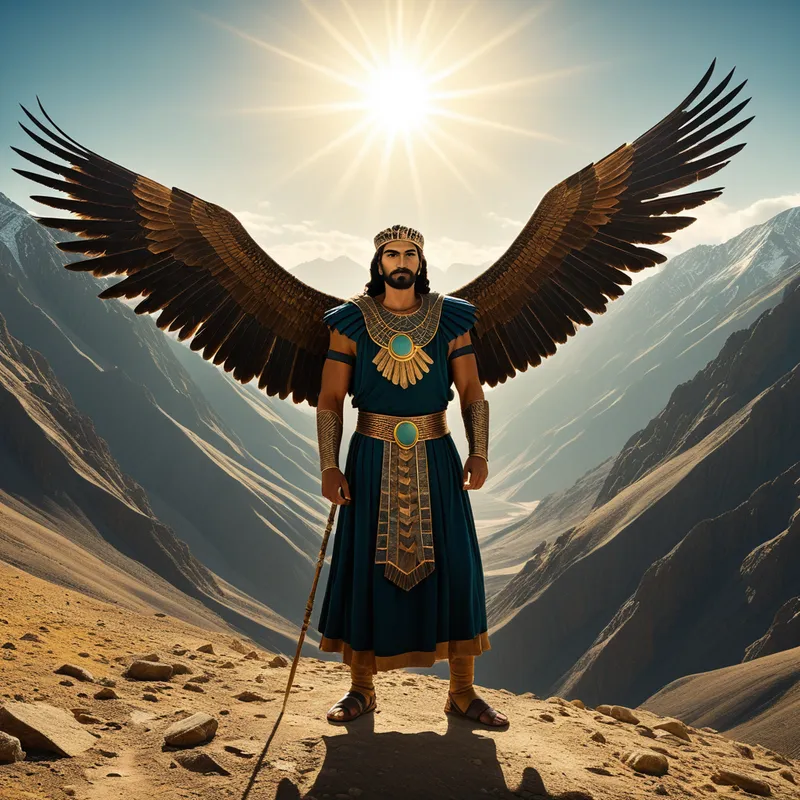
The wilderness, which seemed so hostile, began to speak. The sickness passed, leaving him hollowed out but clear. In this state of sacred emptiness, he witnessed a wonder. A mighty Anzu bird landed in the high crags, its chick in its nest. Lugalbanda watched, motionless. When the great bird flew to hunt, he acted. Not with a warrior’s aggression, but with a healer’s care. He gently adorned the chick with fragrant herbs and salves. He placed before it the finest of his remaining offerings. When the Anzu returned, it found its offspring not threatened, but honored. The divine beast, recognizing a soul attuned to the subtle laws of reciprocity, was pleased.
The Anzu bestowed upon Lugalbanda its gifts: the speed of the wind, the power to traverse mountains in a single stride. But more than that, it gave him a bond—a covenant with the wild, divine order itself. Transformed, Lugalbanda raced across the land, a blur of purpose. He rejoined the army, not as the sick man they left behind, but as a luminous intermediary. He used his new gifts to secure victory for Uruk, not through brute force, but through cunning, speed, and his hard-won connection to the powers that govern the world from beyond the city walls.
Cultural Origins & Context
The stories of Lugalbanda are part of a cycle of Sumerian narratives concerning the early kings of Uruk, preserved on cracked clay tablets in the intricate script of cuneiform. These were not mere folktales but foundational literature, recited by court scribes and perhaps in temple contexts, linking the historical institution of kingship to a mythical, heroic age. Lugalbanda is a pivotal bridge figure: a legendary king of the distant past who is also recorded in the Sumerian King List, and most famously, the divine father of the quintessential hero, Gilgamesh.
His myth served a profound societal function. In the world’s first urban civilizations, the tension between the ordered, irrigated city (the Ki) and the chaotic, powerful wilderness (the Edin) was a fundamental psychological reality. Lugalbanda’s journey modeled the ideal king not just as a warrior or administrator, but as one who could successfully navigate and integrate the wild, numinous power of the Edin. His illness and recovery symbolized the necessary trials of leadership, and his gained abilities justified royal authority as something earned through sacred ordeal and divine favor, not merely inherited.
Symbolic Architecture
At its core, Lugalbanda’s myth is a masterful map of transformation through enforced introversion. The hero’s journey begins not with a call to adventure, but with a brutal ejection from the collective. His sickness is the symbolic death of his old identity as a king among men.
The true temple is often first encountered as a prison of solitude. It is there, stripped of all social rank, that one hears the whisper of the gods.
The Edin represents the unconscious itself—vast, unknown, and potentially lethal. His act of baking offering cakes is the critical pivot. In his absolute weakness, he engages in a ritual of creative surrender. He transforms his last sustenance (ego resources) into a gift for the transcendent (the Self). This is not a transaction but an act of faith, planting a seed in the barren soil of his despair.
The Anzu bird is the archetypal symbol of the spirit, a connector between the high, solar realm of Anu and the earthly world. Lugalbanda’s tender care for its chick signifies a nurturing relationship with the nascent, vulnerable spirit within himself. He does not steal its power; he earns its alliance through reverence and care. The gifts he receives—supernatural speed and strength—are metaphors for the psychic energy and directed purpose that flood into an individual when the ego aligns itself with the deeper, transpersonal Self.

The Dreamer's Resonance
When this mythic pattern stirs in the modern dreamscape, it often manifests as dreams of being left behind, abandoned on a journey, or struck by a debilitating illness in a foreign landscape. The somatic feeling is one of profound lassitude, a crushing weight. You are forced to stop.
This is the psyche’s necessary intervention. The conscious, striving identity—the one that keeps marching with the “army” of daily duties, ambitions, and social personas—has been pushed too far, ignoring a deeper malaise. The dream-illness is a call to a healing crisis. The dream-wilderness, whether a vast desert, a deep forest, or an empty city, is the inner space you must now occupy. To dream of making an offering in such a place, or of encountering a majestic, terrifying animal, signals the beginning of the Lugalbanda process. The psyche is initiating a ritual of reconnection with its own innate, instinctual wisdom, separate from the collective’s demands. The feeling upon waking may be one of eerie peace amidst the anxiety, a hint that in the surrender lies the germ of a new strength.

Alchemical Translation
The alchemy of Lugalbanda is the transmutation of passive suffering into active ritual, and ultimately, into a renewed covenant with life. For the modern individual, the myth models the journey of individuation when faced with a crisis that isolates.
The first stage, Separatio, is brutal and involuntary: the job loss, the illness, the depression, the failure that severs you from your familiar role and community. You are left in your own “mountain pass.” The second stage, Mortificatio, is the sickness, the dissolution of the old ego-structure. This is the dark night where all former identities seem meaningless.
The offering made from your last measure is the first act of the new soul. It is the ego’s capitulation that becomes the Self’s inauguration.
The pivotal act is the baking of the cakes—the Coniunctio with the divine through small, deliberate acts of meaning. In psychological terms, this is beginning a journal, taking a solitary walk with true presence, creating art without an audience, or simply practicing gratitude when you feel you have nothing. It is directing attention inward with an attitude of devotion, not despair.
Caring for the “Anzu chick” symbolizes tending the first, fragile insights from this inner space—the dream image, the creative idea, the spark of self-compassion. Protecting it from the cynical, dismissive voice of the old mindset. When this nascent spirit is honored, the full power of the Anzu—the aligned energy of the unconscious—is granted. The final stage, Multiplicatio, is the return. You re-engage with the world, but now powered by a source deeper than personal will. Your “speed” is clarity of purpose. Your “strength” is resilience rooted in a sacred pact with your own depths. You are no longer just a participant in the collective march; you become a guide who knows the terrain of the wilderness within.
Associated Symbols
Explore related symbols from the CaleaDream lexicon:
- Journey — The forced march and the solitary sojourn represent the dual aspects of the life path: the collective endeavor and the essential, isolating pilgrimage toward the self.
- Mountain — Symbolizes the great obstacle, the place of trial and elevation, where one is cut off from the lowland world and brought closer to the realm of the gods.
- Sickness — Represents the necessary dissolution of an outdated ego-structure, a crisis that forces a halt and creates the fertile ground for profound transformation.
- Offering — The critical act of surrender and reciprocity, where one gives up their last personal resource in faith, initiating a sacred dialogue with the transpersonal.
- Bird — The Anzu eagle embodies the spirit, divine messenger, and the soaring perspective that comes from aligning with forces greater than the individual human will.
- Wilderness — The Edin, or untamed steppe, symbolizes the raw, unorganized unconscious, a place of both terrifying danger and immense, numinous power.
- Healing — Not merely the cessation of illness, but the integration of a new, more resilient wholeness forged in solitude and born from a covenant with the divine.
- King — Represents the ego in its ruling, conscious function, which must undergo a humbling and rebirth to rule wisely, in harmony with deeper, archetypal powers.
- Speed — The gift of the Anzu symbolizes the unlocked psychic energy and swift, intuitive action available when the ego surrenders its rigid control.
- Sumerian Tablet — The physical medium of the myth, representing the enduring cultural encoding of psychological truth and the preservation of deep ancestral wisdom.
- Gift — The divine boon received not through conquest but through reverence and right relationship, highlighting that true power is granted, not taken.
- Solitude — The essential, terrifying, and fertile ground for all transformation, where the chatter of the collective falls away and the voice of the Self can be heard.