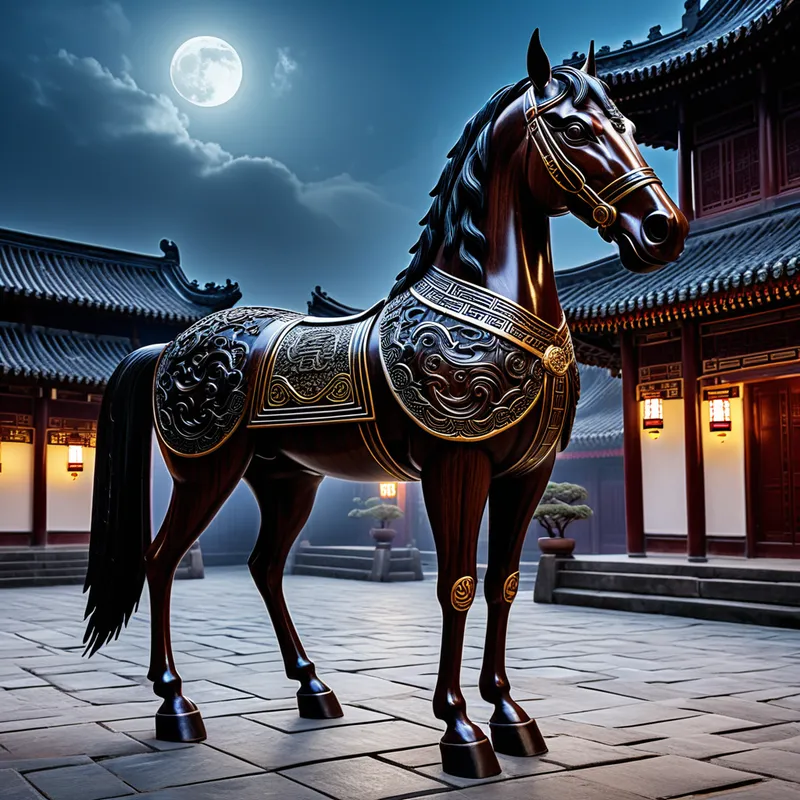
Lu Ban's Wooden Horse Myth Meaning & Symbolism
A master carpenter's creation of a magical wooden horse leads to a celestial journey, testing the boundaries between human ingenuity and divine order.
The Tale of Lu Ban's Wooden Horse
Hear now the tale that is whispered by the wind through the cypress trees, a story not of emperors and battles, but of grain and spirit, of a hand that touched the veil between the made and the born.
In the time when legends walked the earth as men, there lived Lu Ban. His name was not merely spoken, but breathed with reverence by every carpenter, mason, and wheelwright from the misty southern rivers to the dusty northern plains. His saw knew the secret song of the tree’s growth rings; his plane could shave a curl of wood so thin it would float on a sigh. He built palaces that defied gravity and bridges that laughed at torrents. Yet, in his heart’s deepest chamber, a quiet ember glowed: a longing to create not just a thing of use, but a thing of life.
For years, in the sanctum of his workshop fragrant with cedar and lacquer, he labored on a work beyond commission or king. He sought the heartwood of a thousand-year-old nanmu, wood that had drunk centuries of moonlight. His tools, extensions of his very will, carved not just shape, but intention. He fashioned sinew from interlocking joinery, muscle from cunningly layered laminations, and a hide from countless pieces of polished wood fitted together without nail or glue—a feat known only as the “mortise and tenon of the phoenix.”
On the night of the full moon, when the boundary between realms grows thin, he placed the final piece—an eye of polished jet. He stepped back, his breath held in his throat. And the horse… shivered. Not a creak of wood, but a living tremor. It tossed its wooden mane, which now seemed to flow like dark water. It stamped a hoof, and the sound was not a knock, but a solid clop upon the earth. Lu Ban had done it. He had poured his qi, his skill, his very soul into the timber, and had given it the semblance of life.
He mounted his creation. With a thought, not a rein, the wooden horse surged forward. It did not run on the road, but above it, its hooves skimming the tops of the rice paddies, then the misty crowns of the mountains. They ascended into the star-dusted vault of the heavens, racing alongside the River of Stars—the Tianhe. Lu Ban, the master of the earthly realm, was now a traveler in the celestial one, his heart swelling with a pride as vast as the sky itself.
But the heavens have their own laws. His audacious flight, this mortal artifice trespassing in the domain of the gods, stirred a celestial guardian. A great dragon, its scales the color of a stormy dawn, uncoiled from behind a cloud. With a roar that shook the constellations, it breathed not fire, but a gale of pure, disruptive wind—the hundun.
The magical bindings that held the horse’s spirit to its wooden form unraveled. The seamless joints groaned and parted. Lu Ban felt his glorious creation disintegrate beneath him, not into splinters, but into a shower of separate, perfect components—leg, neck, torso—all tumbling through the empty, cold silence of space. The master craftsman fell, not as a hero, but as a man who had flown too close to the sun on wings of his own making. He survived the fall, legend says, landing in a distant land, but his greatest creation was lost, scattered between heaven and earth. The horse was never made whole again, its perfect form forever dissolved, leaving only a story of sublime ambition and its celestial price.
Cultural Origins & Context
The myth of Lu Ban’s Wooden Horse is a folktale that accreted around the historical-mythical figure of Lu Ban (c. 507–444 BCE), a real master carpenter and engineer from the State of Lu. Over centuries, his unparalleled skill transformed in the popular imagination from technical prowess to near-supernatural ability. This story belongs not to the classical canon of philosophers or dynastic histories, but to the vibrant oral tradition of artisans and common people. It was told in workshops, at building sites, and by hearths, passed from master to apprentice.
Its function was multifaceted. For craftsmen, it was a sacred parable of the pinnacle of their art, a reminder that true mastery borders on the magical. It served as both an inspiration and a cautionary tale. It celebrated human ingenuity and the divine potential within skilled labor, while simultaneously reinforcing a fundamental cosmic order. The myth taught that there is a boundary even for genius, a line where human creation must not challenge the natural and celestial hierarchy. It is a deeply Daoist narrative at its core, warning against excessive striving (wu wei’s opposite) and the hubris of attempting to replicate the true, spontaneous life-force of the Tao.
Symbolic Architecture
At its heart, the myth is a profound allegory of the creative act itself and the psyche of the creator. The Wooden Horse is not a tool, but an opus—the ultimate masterpiece into which the artist pours their entire identity.
The creator’s greatest work is always a vessel for their own soul, sent out into the world to navigate realms they themselves cannot fully enter.
Lu Ban represents the ego at the height of its powers, the conscious mind that believes it can engineer reality, even life itself, through will, technique, and intelligence. The horse is his psychic libido made manifest, a magnificent, powerful, but ultimately synthetic construct of his own genius. The journey to the heavens is the inflation of the ego, the intoxicating belief that one’s creation has elevated oneself to a god-like status.
The celestial dragon is the necessary, devastating intervention of the Self (in a Jungian sense) or the Tao (in a Daoist sense). It represents the objective, transpersonal reality that shatters subjective inflation. The dragon does not destroy out of malice, but to restore balance. It dismantles the false life—the animated artifact—to protect the true, organic order of the psyche and the cosmos. The horse’s disintegration is not a punishment, but a painful, necessary return to components, to potential, to the raw materials of the soul.
The Dreamer's Resonance
When this myth appears in the modern dreamer’s psyche, it often signals a critical juncture in a process of creation or self-invention. To dream of building or discovering a complex, intricate machine or creature (like the wooden horse) that seems to work perfectly reflects a period of intense, focused ego-construction. The dreamer may be building a “perfect” career, identity, relationship, or artistic project with immense personal investment.
The subsequent flight in the dream—the exhilarating, transcendent ride—mirrors the inflation that follows initial success. It feels like “having it all figured out,” a sense of soaring above ordinary concerns. This is often a prelude to the fall. The dream may then introduce a disruptive, chaotic force (a storm, a system failure, a dismantling) that scatters this carefully constructed self or project. The somatic experience is often one of terrifying dissolution, a loss of control, and a plunge.
This dream pattern indicates the psyche’s attempt to correct a course. It is the unconscious initiating a necessary “deconstruction” because the conscious, constructed identity, however magnificent, has become too rigid, too self-contained, and has lost touch with the organic, unpredictable flow of the authentic Self.
Alchemical Translation
The myth models the alchemical process of solve et coagula—dissolve and coagulate—applied to the psyche. Lu Ban’s lifelong skill represents the initial coagula: the formation of a powerful, competent, and celebrated conscious personality (the lead turned to skilled iron). The creation of the horse is the pinnacle of this, the attempt to create the philosopher’s stone—a perfect, eternal, self-animated entity—through ego-consciousness alone.
The true alchemical gold is not a thing we construct, but a wholeness we discover when our constructions fall apart.
The dragon’s breath is the essential, brutal solve stage. It is the nigredo, the dark night of the soul, where the brilliant, synthetic creation is broken down into its constituent parts. Lu Ban’s fall and survival are crucial. He does not die. He is humbled and returned to earth, to a “distant land”—a metaphor for a new, unknown psychic territory.
This is the beginning of true individuation. The scattered components of the horse—the leg of skill, the neck of vision, the torso of ambition—are not lost. They are now freed from their rigid, ego-bound configuration. The task for the modern individual undergoing this process is not to rebuild the same horse, but to gather these components again in a new way, not as a monument to the ego’s glory, but as an integrated part of a Self that includes both the craftsman and the dragon, both creation and the void that makes creation possible. The ultimate “wooden horse” that can truly ride the heavens is not a single artifact, but the resilient, adaptable, and humble psyche that has survived its own dismantling and learned to create in harmony with the transcendent forces it can never fully own.
Associated Symbols
Explore related symbols from the CaleaDream lexicon: