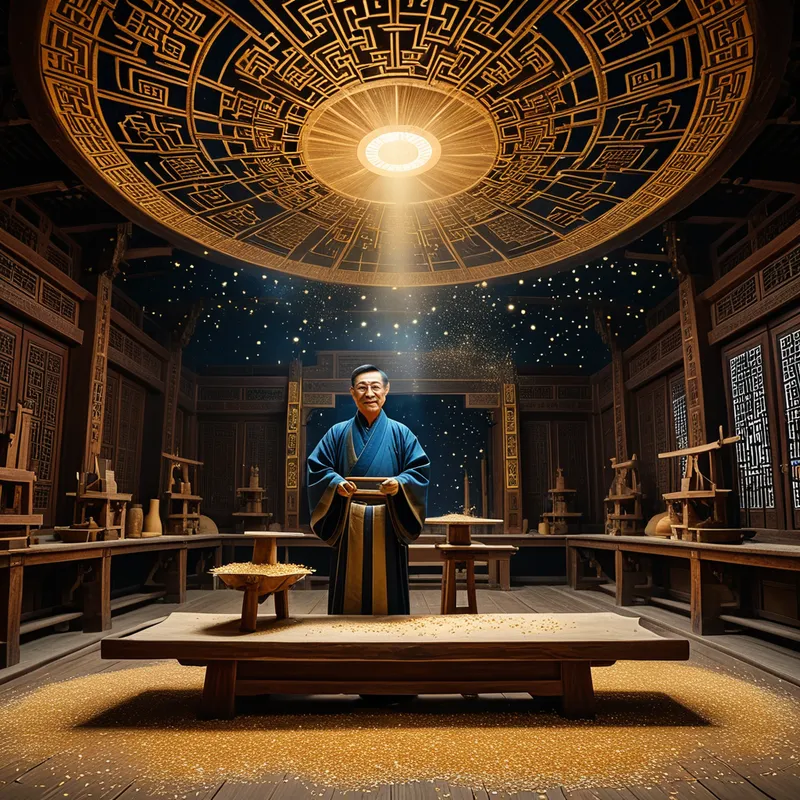
Lu Ban Myth Meaning & Symbolism
The myth of Lu Ban, the divine architect and patron of craftsmen, whose genius bridges heaven and earth through sacred wood and cosmic order.
The Tale of Lu Ban
Listen, and hear the whisper of the grain. In a time when the world was still being shaped, when the boundary between the human realm and the celestial was as thin as a shaving of fragrant cedar, there lived a man whose soul was carved from the heartwood of creation itself. His name was Lu Ban.
He was no ordinary man. It was said he was born under a constellation shaped like a square and a compass, his first cry the sound of a well-struck chisel. From his youth, wood spoke to him. He could hear the song of a thousand-year-old cypress, feel the ambition in a straight young pine. With his tools—the plane that sang, the saw that hummed, the ink line that snapped with the authority of fate—he did not merely build. He listened, and then he revealed. He revealed the palace hidden within the log, the bridge sleeping in the forest, the dragon coiled in the grain.
His fame became a living thing, traveling on the wind, crossing rivers and mountains. Emperors sought him to raise towers that scratched the belly of heaven. Common folk sought him for a beam that would never sag, a door that would sing in the wind. He built a wooden magpie that could fly for three days without landing, and a wooden horse that could gallop, its hooves drumming a rhythm of pure potential. He crafted a ladder so cunning and strong it was said to have scaled the clouds themselves.
But his greatest test came not from an emperor, but from the cosmos. A celestial palace was to be built, a structure of such perfection it would harmonize the music of the spheres. The gods themselves summoned Lu Ban. The task was impossible for mortal hands: to create a central pillar that was both infinitely strong and infinitely graceful, a axis mundi for the heavens. Lu Ban worked in a realm of swirling stardust and echoes of creation. He selected a beam of golden nanmu, its scent the memory of the first dawn.
He planed it until its surface held the reflection of entire galaxies. He joined it with joints so seamless they were not connections, but continuations. Yet, as he set the final, crucial tenon, he saw the truth. The pillar was perfect, but it was still of the earth. To anchor the celestial palace, it needed a spark of the divine—a spark that could only come from a sacrifice of equal measure.
Without a word, Lu Ban laid his hand upon the finished pillar. He closed his eyes and did not carve, but offered. He poured the essence of his own craft, his lifetime of striving, his very shen—his spirit—into the wood. The golden beam drank it in, and where his hand had been, the grain pulsed with a soft, eternal light. The pillar was complete. It rose, and the palace settled upon it with a chord that resonated through all levels of existence. Lu Ban descended, his mortal work done, his name forever etched not in wood, but in the very principle of making. He left behind his tools, his books of secret geometries, and a world that now understood that to build is to bridge, and to create is to converse with the gods.

Cultural Origins & Context
The figure of Lu Ban is a fascinating alchemy of history and myth. He is based on a historical personage, a renowned engineer and carpenter named Gongshu Ban from the Spring and Autumn period (c. 770–476 BCE). His legendary status grew over centuries, transforming him from a skilled artisan into a culture hero and patron deity of carpenters, builders, and artisans.
His myths were not preserved in a single, canonical text but were woven into the oral traditions of guilds and craftsmen. Master carpenters would tell stories of Lu Ban to their apprentices not merely as entertainment, but as sacred text—encoding technical secrets, ethical codes, and the spiritual dimensions of their craft within the narratives. Temples were dedicated to him, and builders would make offerings before beginning a project, seeking his blessing for straight lines and strong joints. The myth served a vital societal function: it sacralized manual labor and technical skill, elevating the carpenter from a mere worker to a mediator between the chaotic raw material of nature and the ordered, human world. He represented the Confucian ideal of harmony through correct form and the Daoist principle of working with, not against, the intrinsic nature of the material.
Symbolic Architecture
At its core, the myth of Lu Ban is a profound exploration of the psychology of the Creator. He is the archetypal principle that transforms potential into actuality, chaos into cosmos. His tools are not just physical instruments; they are extensions of consciousness itself. The plane smooths rough projections of the ego; the square ensures moral and structural integrity; the ink line defines the boundary between idea and manifestation.
The true creator does not impose a form upon the world, but liberates the form dreaming within the material.
The central drama—the sacrifice of his own spirit into the celestial pillar—is the ultimate symbolic act. It represents the moment when skilled craft transcends into sacred art. It is the realization that the most perfect creation requires a piece of the creator’s own soul. The pillar becomes an axis mundi, a psychological symbol for the integrated Self. Lu Ban’s sacrifice signifies that the establishment of a stable, centered psyche (the inner palace) is not an act of arrogant construction, but of humble, devotional offering. The wood, a living, growing substance, symbolizes the organic, instinctual base of the psyche, which must be honored and shaped—not dominated—by the conscious mind (the craftsman) to achieve wholeness.
The Dreamer's Resonance
When the pattern of Lu Ban stirs in the modern dreamer, it often signals a profound engagement with the process of making something of one’s life. This is not necessarily about literal construction. One might dream of meticulously assembling a complex but beautiful structure from disparate, found pieces. Or of possessing a magical tool that can fix anything, yet feeling a deep anxiety about using it correctly. The somatic sensation is often one of focused pressure in the hands and third eye—a feeling of tangible potential.
Psychologically, this myth activates when the individual is in a phase of intense synthesis. They are gathering the raw materials of experience, talent, and relationship, and are attempting to join them into a coherent, functional, and beautiful whole—a career, a family, an identity, a work of art. The conflict in the dream may mirror Lu Ban’s final test: a sense that the project, however technically perfect, lacks soul or meaning. The dream asks, What are you willing to sacrifice of your mere cleverness to invest your true essence? It points to the transition from being a competent technician of one’s life to becoming its authentic architect.
Alchemical Translation
The individuation journey modeled by Lu Ban is the path of the conscious creator. It begins with the discovery of one’s innate "tools"—one’s unique capacities and talents. The first stage is mastering them, learning to "hear the song of the wood," which translates to understanding one’s own nature, instincts, and the raw material of one’s psyche and life circumstances.
The middle stage is the ambitious application: building the "flying magpies" and "scaling ladders" of one’s aspirations. This is necessary, but it risks inflation—the belief that one’s skill alone can build a heaven. The crisis comes when one confronts the ultimate project: the construction of a lasting, meaningful Self. Here, technical proficiency reaches its limit.
The alchemical gold is not found in the perfection of the craft, but in the craftsman’s willingness to become part of the creation.
The final, transformative act is Lu Ban’s sacrifice. In psychological terms, this is the surrender of the ego’s claim to sole authorship. It is the moment one stops trying to "build a personality" and instead allows a deeper, transpersonal spirit—the Self—to flow into the structure. One invests not just time and skill, but vulnerability, love, and essence. The "celestial pillar" that results is the core of the individuated personality: no longer a mere assemblage of traits, but a living, anchored column that connects the personal to the universal. The individual becomes a bridge between the earthly and the numinous, not by reaching upward, but by rooting their highest creation in the sacred offering of their own soul-stuff. The tools are left behind for others, for the work is complete; the creator has become inseparable from the creation.
Associated Symbols
Explore related symbols from the CaleaDream lexicon: