Lourdes Water Myth Meaning & Symbolism
A peasant girl's visions of a radiant lady reveal a hidden spring, birthing a global myth of miraculous healing and divine grace.
The Tale of Lourdes Water
In the shadow of the Pyrenees, where the Gave de Pau river carves its cold path, there lay a town named Lourdes. It was a place of stone, of hunger, of simple toil. And in this place lived a child, Bernadette Soubirous. Her world was one of poverty, asthma, and the damp chill of a former prison cell her family called home.
One brittle Thursday in 1858, when winter still gripped the land, Bernadette went with her sister and a friend to gather firewood by the riverbank, near a grotto of Massabielle—a forgotten place of rock and wild bramble. As her companions crossed the icy stream, Bernadette hesitated, her breath shallow. Then, a sound like a great gust of wind, though the poplar leaves were still. In the dark recess of the rock, a golden light coalesced.
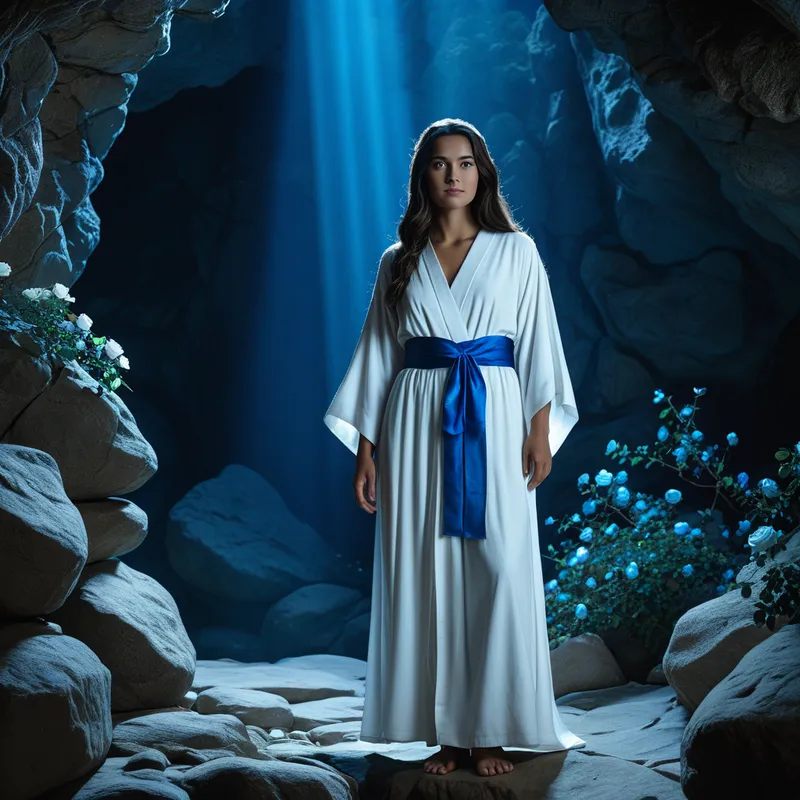
And within the light, a Lady appeared. She was young, clothed in a white robe of a purity that hurt the eyes, a blue sash at her waist, a yellow rose upon each foot. She did not speak, but smiled, and made the sign of the cross with a rosary of pearl and gold. Bernadette fell to her knees, her own wooden beads in hand, transfixed. The vision faded, leaving only the echo of the river and the pounding of her heart.
The Lady returned. Seventeen more times she came to the grotto, witnessed only by the asthmatic girl. The town whispered—of madness, of trickery, of demonic illusion. Authorities threatened Bernadette, priests questioned her, crowds gathered to mock or to hope. The Lady asked for prayer, for penance, for a chapel to be built. And then, on a day in late February, she gave a strange command: “Go drink at the spring and wash yourself there.”
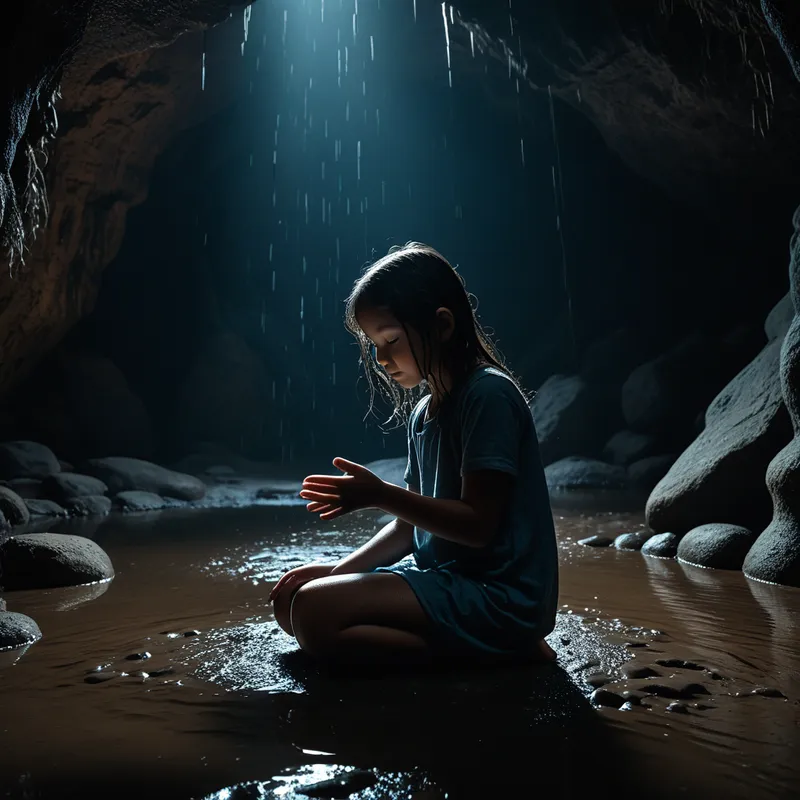
Bernadette saw no spring. Only the dry, dusty earth of the grotto. Driven by the vision, she began to scrape at the ground. A trickle of muddy water appeared. She drank it. She smeared the mud on her face. The crowd recoiled in disgust, certain of her madness. But the trickle did not stop. It grew. It became a clear, steady stream flowing from the heart of the rock where no water had been before.
The final apparition was the revelation of a name. When Bernadette, for the last time, asked “Who are you?” the Lady, her hands joined and eyes lifted, replied, “Que soy era Immaculada Councepciou.” The spring continued to flow. Soon, the first miracles were whispered—a stonecutter’s blinded eye washed clean, a dying woman revived. The grotto of mud and bramble was transformed. The hidden water, revealed through the most unlikely of vessels, had been unleashed upon the world.
Cultural Origins & Context
The events at Lourdes occurred in 1858, in a France deeply fractured by the Revolution, scientific materialism, and rising secularism. The Catholic Church itself was defensive, having recently formally defined the dogma of the Immaculate Conception in 1854. The apparitions landed not in a medieval age of universal faith, but in a modern world of doubt, newspapers, and official inquiry.
The myth was born not from scripture or clerical decree, but from the testimony of a poor, uneducated, and sickly girl. Its transmission was immediate and populist, spread by word of mouth, sensationalist press, and the rapid pilgrimage of the curious and the desperate. The Church, initially skeptical, conducted rigorous investigations, ultimately affirming the “supernatural character” of the apparitions in 1862. The myth’s societal function was multifaceted: for the faithful, it was a divine reaffirmation in an age of doubt; for the sick and marginalized, it offered a tangible locus for hope beyond medicine; for the region and the Church, it became a powerful center of spiritual and physical economy. It transformed a personal mystical experience into a collective, institutionalized narrative of healing and grace.
Symbolic Architecture
At its core, the myth of Lourdes Water is an archetypal drama of revelation through the rejected stone. The sacred does not appear in the cathedral, but in a rubbish-strewn grotto. The divine messenger chooses not a scholar or a ruler, but a child from the literal margins of society—a sickly girl living in a discarded prison. The spring itself is not a majestic river, but a trickle from the mud, discovered through an act that appeared foolish and undignified.
The healing principle does not announce itself with fanfare; it whispers from the forgotten, wounded, and unclean places of both the world and the soul.
The Water is the central symbol. It is not merely water, but water from the rock—a classic biblical motif of life springing from barrenness (Moses striking the rock at Horeb). It represents the unexpected eruption of the numinous, the unconscious, or the healing function into a parched and rational conscious world. The act of drinking and washing is a ritual of total receptivity and humble participation, requiring one to kneel in the mud to receive grace. The Lady herself symbolizes the Anima in its most transcendent form—the immaculate, mediating principle that connects the human to the divine, and specifically reveals the source of healing buried in one’s own earthly, psychological "grotto."
The Dreamer's Resonance
When this myth pattern surfaces in modern dreams, it often signals a profound somatic or psychological process of seeking healing from a deep, forgotten source. To dream of a hidden spring or fountain in a basement, a cave, or a derelict urban space points to the psyche’s intelligence directing the dreamer toward an inner resource that has been overlooked or deemed insignificant.
Dreams of drinking from a strange, possibly dirty source, or washing a wound with unexpected water, mirror Bernadette’s act. This is the psyche advocating for a receptivity to solutions that the conscious, prideful ego may reject as "beneath it" or "irrational." The figure of a luminous, silent, or gently instructing woman in such a dream can represent the emergence of the guiding Self or the healing archetype of the caregiver from within. The dreamer is often in a state of feeling "sick" or stuck—spiritually, emotionally, or creatively parched. The dream presents the mythic blueprint: go to the humblest, darkest part of your experience (the personal Massabielle), and there, through an act of faithful, perhaps foolish-seeming engagement, you may activate a flow of life that was always present, but sealed.

Alchemical Translation
The alchemical process modeled here is the solve et coagula—the dissolving and reconstituting—applied to the concepts of illness and wholeness. The first stage is the nigredo, the blackening: Bernadette’s poverty, illness, and the dark, muddy grotto. This is the necessary descent into the base matter of one’s suffering, without which no transformation can begin.
The apparition is the flash of the albedo, the whitening—a moment of luminous insight that illuminates the darkness but does not yet erase it. The command to "drink and wash" is the critical operation. It demands that the conscious ego (Bernadette) actively engage with the base, muddy prima materia of its own condition. This engagement—this humble, embodied participation with the wound—is what catalyzes the transformation. The mud becomes clear water; the rejected becomes the sacred.
Individuation often requires us to perform the ritual that looks like madness to the crowd, to honor the insight that comes from our most infirm and ignored part.
For the modern individual, the "Lourdes Water" is the psychic resource that emerges when we stop seeking healing only from external, authoritative sources (doctors, gurus, perfect solutions) and instead, guided by an inner voice (the Anima/Self), consent to engage directly with the shameful, painful, or "primitive" aspects of our history or personality. The "miracle" is not the magical eradication of symptoms, but the transmutation of one’s relationship to suffering. The wound, once a site of isolation and shame (the dirty grotto), through this process, becomes the very source of meaning, connection, and a flow of life that can, in turn, serve others. The individual becomes, like Bernadette, not the possessor of the water, but its witness and conduit—the archetypal Caregiver born from the wounded child.
Associated Symbols
Explore related symbols from the CaleaDream lexicon: