Longwang Myth Meaning & Symbolism
The myth of the Dragon King, a celestial sovereign ruling the waters, embodying the raw power of nature and the psyche's need for sacred order.
The Tale of Longwang
Listen, and hear the tale whispered by the river and roared by the typhoon. In the time before time, when the world was a canvas of primal forces, the waters held no master. They rose in fury, drowning fields; they retreated in spite, leaving earth to crack and thirst. The heavens wept, and the earth flooded, and in the chaos, humanity cowered, their prayers lost in the deluge.
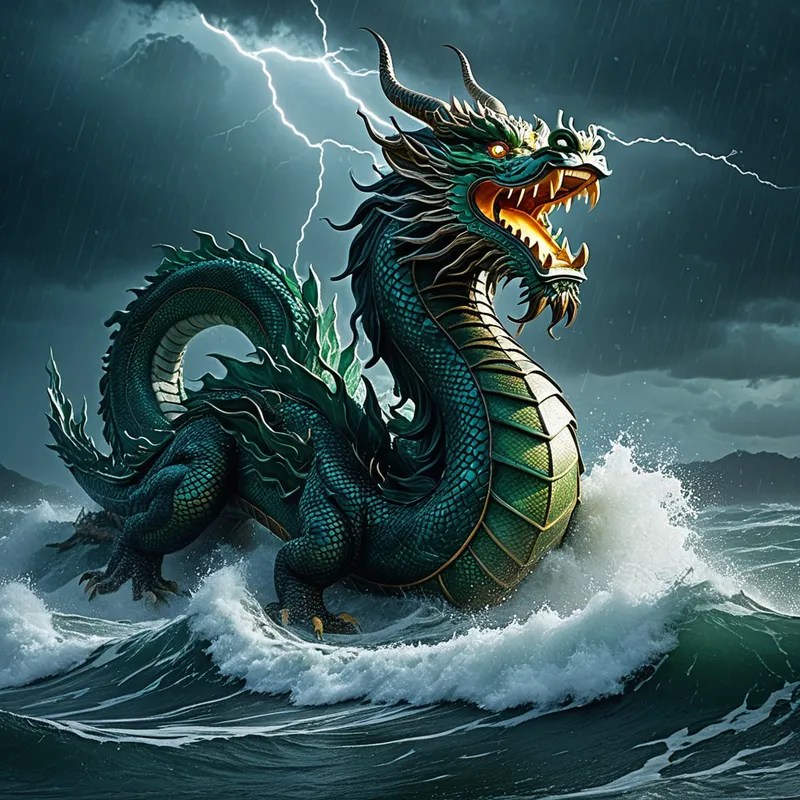
But from the deepest abyss, where light fears to tread, a consciousness stirred. It was not born but coalesced, from the very essence of the waters—their memory, their power, their latent will. This was Longwang, the Dragon King. His form was the storm given shape: scales of jade and lapis that shimmered like a rain-swept sky, a mane of sea-foam and cloud, eyes holding the calm of the deepest trench and the fury of the highest wave. He did not conquer the waters; he was their sovereign soul.
His palace, the Longgong, lay in the heart of the ocean, a realm of coral spires and pearl-lit halls, where currents danced to an unseen harmony. Here, he ruled with his kin—the dragon kings of the four seas: Ao Guang, Ao Qin, Ao Run, and Ao Shun. Yet, sovereignty is not merely command; it is relationship.
The conflict was not of rebellion, but of disconnection. The people on the shore, in their fear, saw only a capricious monster. They offered nothing but terror. The land suffered, caught between neglect and wrath. The rising action was a great drought, a silence of the skies so profound it was a scream. The earth turned to dust, and the rivers became graves for fish.
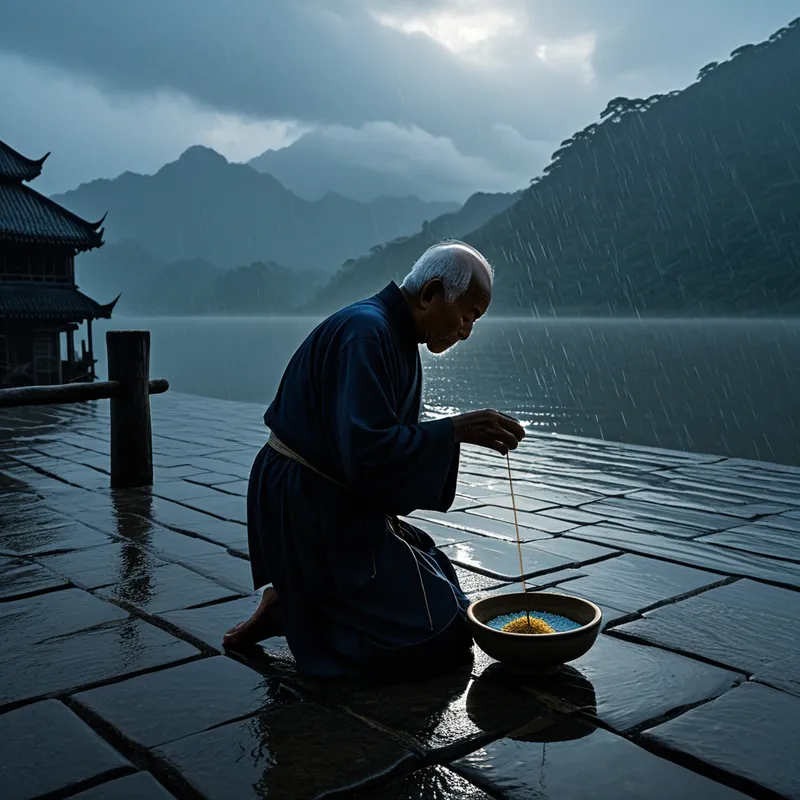
Then came a humble village elder, not with a warrior’s sword, but with a bowl of the last grains of rice and a heart heavy with respect, not fear. He journeyed to the shore, and with a voice cracked by thirst, he did not beg. He addressed the sovereign. He acknowledged the King’s power, his rightful dominion, and the people’s place within the great order of sky, land, and sea. He offered the rice, a symbol of shared life, and bowed.
From the still waters, a ripple became a wave, and the majestic head of Longwang emerged. His gaze was not of anger, but of solemn recognition. He had been waiting not for submission, but for recognition—for the conscious bridge to be built. In his claw, he held the Longzhu, the Dragon Pearl, which glowed with the essence of all waters. He touched it to the elder’s offering bowl. The resolution was not a conquest, but a covenant. Clouds gathered, not as invaders, but as honored guests. Rain fell, gentle and nourishing. The waters returned to their courses, not as prisoners, but as willing participants in a sacred balance. The Dragon King had been seen, and in being seen, he could truly rule.
Cultural Origins & Context
The myth of Longwang is not a single story but a vast, fluid tradition woven into the fabric of Chinese spiritual and imperial life for millennia. Its origins predate unified textual records, emerging from ancient animistic beliefs where every river, lake, and spring housed a potent spirit. These water spirits, over time and through the lens of emerging dragon symbolism—which itself evolved from ancient totems representing fertility, power, and celestial authority—coalesced into the figure of the dragon king.
The myth was passed down through oral folklore by fishermen and farmers whose lives depended on the water's mercy, through Daoist liturgical texts that formalized the celestial bureaucracy, and through Buddhist sutras that incorporated Longwang as a protector of the Dharma. His societal function was multifaceted: he was a theological explanation for weather and hydrological cycles, a psychological container for the terror and awe of natural forces, and a political metaphor. The emperor, the Tianzi, was the terrestrial counterpart to Longwang’s celestial-aquatic rule; just as the Dragon King maintained harmony in the waters, the emperor was to maintain harmony in the Middle Kingdom. Temples were built at river sources and coastal ports, and rituals performed to honor Longwang were acts of statecraft as much as devotion, reinforcing the cosmic and social order.
Symbolic Architecture
At its core, Longwang symbolizes the archetypal principle of Sovereignty over the Unconscious. The waters he rules are the primordial, undifferentiated psyche—the deep, emotional, instinctual, and often chaotic realm within us all.
To encounter the Dragon King is to confront the need for a conscious, respectful authority within one's own inner chaos. He represents the ego's necessary dialogue with the much greater, non-personal powers of the soul.
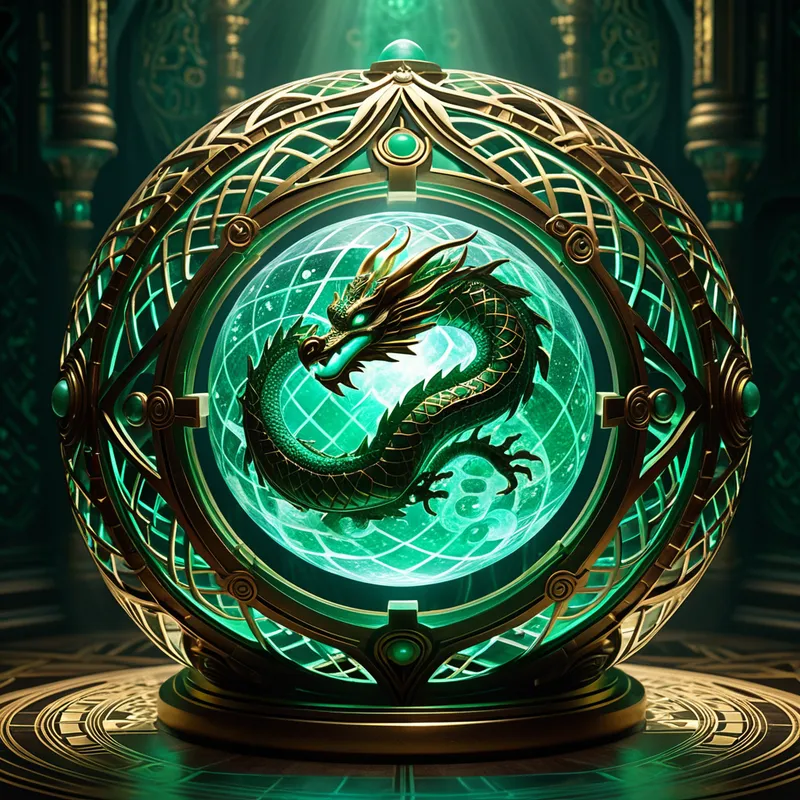
The Longgong is the ordered, structured center within this chaos—the nascent self that can form amidst the swirl of complexes and drives. The Longzhu, or Dragon Pearl, is the ultimate symbol of integrated psychic value. It is the treasure hard to attain, the crystallized essence of life force, wisdom, and wholeness (the Self in Jungian terms) that is guarded by the dragon—our own resistance, fear, or ignorance. The myth teaches that this pearl cannot be stolen by force; it must be received through acknowledgment and right relationship.
The Dreamer's Resonance
When Longwang surfaces in modern dreams, he rarely appears as a literal dragon. He manifests as overwhelming emotional floods—a sudden wave of grief, a torrent of rage that feels alien and powerful. He is the boss who is inexplicably furious, the tidal wave in a city street, the feeling of being dragged into deep, dark water. He is the profound, impersonal force that disrupts our carefully controlled lives.
To dream of him is to experience a somatic and psychological process of confrontation with autonomous psychic content. The body may feel heavy, pressurized, or chilled. Psychologically, the dreamer is facing an aspect of their own nature that feels royal in its power and terrifying in its autonomy. It is a part of the psyche that demands recognition, not as a problem to be solved, but as a presence to be related to. The dream is an invitation to stop running from the flood and instead, like the village elder, to turn and address it with respect.

Alchemical Translation
The myth of Longwang models the alchemical process of coagulatio—the bringing of fluid, unconscious material into a solid, conscious form. The individual's journey begins in a state of psychic drought or flood, where life feels either barren and lifeless or overwhelming and destructive. The ego is the village, suffering and disconnected.
The first step is the courageous descent—the elder's journey to the shore. This is the act of turning attention inward, toward the emotional turmoil, however frightening. The offering is crucial; it is the sacrifice of the ego's arrogance, the admission that one does not control these depths. It is an act of humility and respect toward the power of the unconscious.
The transformation occurs not when the dragon is slain, but when it is acknowledged as king. The psychic energy bound up in chaos (the unruly waters) is then made available for life (the nourishing rain).
The resolution is the establishment of an inner covenant. The Dragon King, once recognized, becomes an internal authority—not the tyrannical super-ego, but the guiding principle of the Self. The Longzhu is integrated; what was a terrifying, alien force becomes a source of deep wisdom, emotional fluidity, and creative power. The individual no longer fears their own depths but learns to consult them. They achieve a sovereignty where consciousness does not repress the unconscious, but engages it in a sacred, balancing dialogue, bringing fertility to the arid lands of daily life.
Associated Symbols
Explore related symbols from the CaleaDream lexicon: