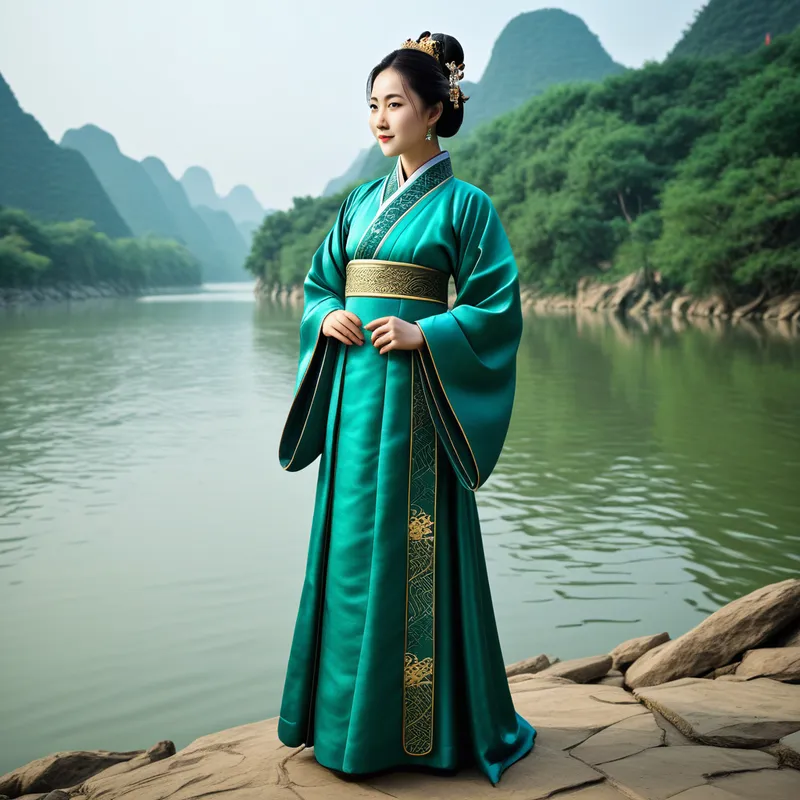
Longmu Myth Meaning & Symbolism
A woman's boundless compassion for orphaned creatures transforms her into a divine mother of dragons, a myth of love transcending the boundaries of form.
The Tale of Longmu
In the mist-shrouded days of the Qin dynasty, where the Xi River carved its silver path through the green heart of Guangdong, there lived a woman named Wen Shi. She was a woman of the river, her life a quiet rhythm of washing, fishing, and tending to a small plot of land. Her hands were strong from work, but her heart was a deep, still pool of a different kind of strength.
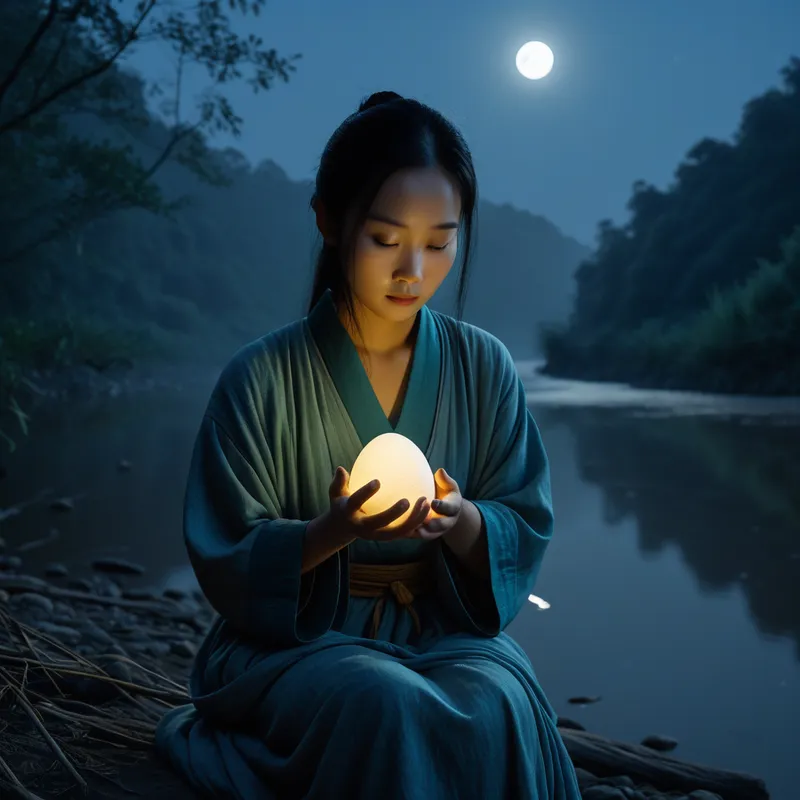
One day, while drawing water from the river’s edge, her fingers brushed against a cluster of smooth, cool stones. But one was not like the others. It was larger, paler, and held a warmth that seemed to pulse from within. Compelled by a feeling she could not name, Wen Shi gathered the strange stone and carried it home, placing it in a sunlit corner of her humble dwelling. She tended to it not as a curiosity, but as one would tend to a fragile, sleeping thing—wiping its surface, speaking softly to it.
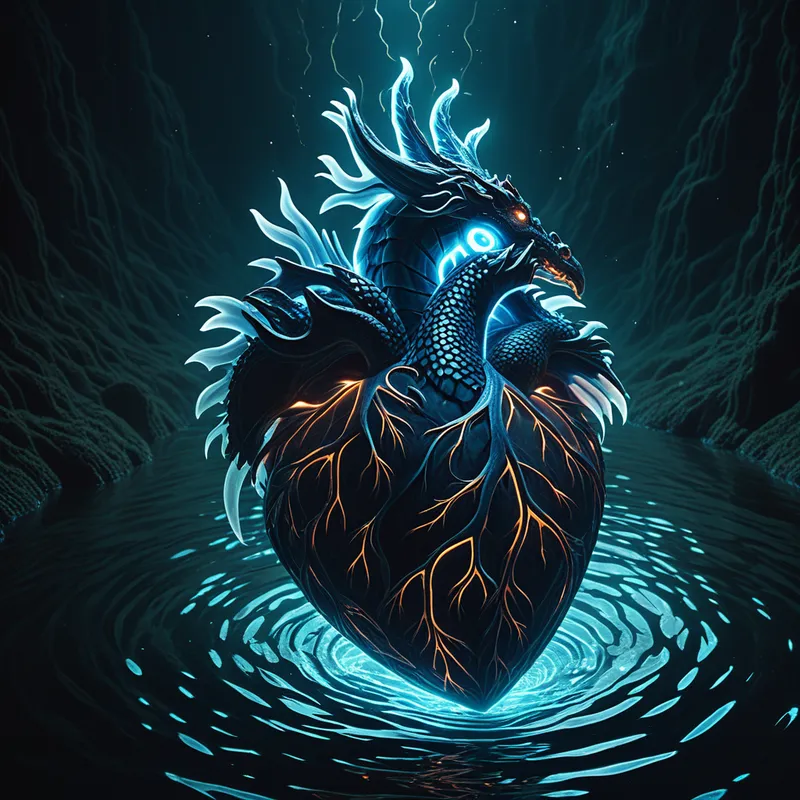
In time, the stone revealed its secret. It was no stone, but an egg. From it hatched not a bird, but a creature of water and myth: a small, serpentine jiao. Its scales were the color of wet slate, and its eyes held an ancient intelligence. Where others would have fled in terror, Wen Shi felt only a surge of protective love. The creature was alone in the world, as she was. She named it, fed it scraps of fish from her own meager meals, and let it curl beside her hearth.
The pattern repeated. She found four more of these luminous eggs along her beloved river. Each hatched, and each hatchling imprinted upon her gentle presence. Her home became a sanctuary for these five wondrous orphans. As they grew from playful river-serpents into magnificent, powerful long, their needs became immense. They required great quantities of fish. Wen Shi, undaunted, would stand in the shallows, and her dragon-children, understanding her devotion, would churn the waters, driving fish toward her nets. A silent, sacred pact existed between them: her boundless nurture for their fierce, loyal protection.
Years flowed like the river. A great drought descended upon the land. The earth cracked, crops withered, and the Xi River dwindled to a muddy trickle. The people despaired. Wen Shi, her heart aching for her suffering neighbors and her thirsty children, went to the parched riverbank. She knelt in the dust, her tears falling onto the cracked earth. Her five dragons, sensing her profound sorrow, gathered around her. They raised their great heads to the searing sky and began to dance—a coiling, sinuous, celestial dance of supplication.
They were not merely beasts; they were creatures of water and cloud. As they moved, the very air thickened. Humidity gathered, then condensed. From a sky that had been brass for months, the first fat drops of rain began to fall. It was a gentle rain at first, then a torrential, life-giving deluge. The river swelled, the land drank deeply, and the people wept with joy. In that moment, they saw not just a woman and five dragons, but a divine tableau: a mother and her celestial children, whose bond had summoned salvation from the heavens.
When Wen Shi’s mortal life finally ebbed, the legend says her five dragon-sons could not bear the separation. As her body was prepared for burial on the river’s eastern bank, a sudden storm arose—not of fury, but of grief. The five long descended from the clouds, transformed themselves into five humble, grieving scholars, and carried her coffin to its final resting place. Thereafter, they were venerated as the Dragon Kings, and she was remembered no longer as Wen Shi, but as Longmu, the Divine Mother of Dragons.
Cultural Origins & Context
The myth of Longmu is rooted in the local folklore of the Zhaoqing region in Guangdong, with its earliest recorded versions appearing during the Tang and Song dynasties. Unlike the grand, state-sanctioned myths of the Yellow Emperor or Nüwa, Longmu’s story is fundamentally local and vernacular. It was told by river-dwellers, farmers, and villagers, passed down not in imperial courts but by the hearthside and the riverbank.
This origin is crucial. The myth functioned as a way to explain and sanctify the intimate, reciprocal relationship between a community and its life-giving river. The Xi River was not just a resource; it was a personality, a capricious force that could nurture or destroy. Longmu’s story humanized—or rather, divinized—this relationship. It presented an ideal: if one approaches the wild, potentially dangerous forces of nature (the dragon-serpents) with sincere, selfless care, those forces can be transformed into benevolent, protective guardians (the rain-bringing Dragon Kings). The temples built for Longmu, often situated near water, served as centers for prayers for rain, safe passage, and familial harmony, cementing her role as a grassroots goddess of maternal protection and ecological balance.
Symbolic Architecture
At its core, the myth of Longmu is a profound allegory for the transformative power of unconditional nurture. Every symbol is a facet of this alchemy.
The River represents the flow of life, the unconscious, and the source of all potential. From its depths emerge the strange "stones"—the unformed, latent possibilities of the psyche, which to the untrained eye appear inert or worthless.
The Stone Eggs are the ultimate symbols of potential. They are the orphaned parts of the Self, the wild, instinctual, or "monstrous" energies that we find on the shores of our experience. They are our raw creativity, our untamed emotions, our latent power, abandoned by consciousness.
The true caregiver does not distinguish between the human child and the dragon-egg; she sees the latent life in all things and offers the warmth of attention.
Wen Shi’s act of gathering and warming the eggs is the essential human gesture of psychic integration. It is the conscious ego choosing to attend to, rather than reject, the strange and frightening contents of the unconscious. Her feeding of the dragons symbolizes the sustained investment of psychic energy (libido) into these complexes. She does not try to dominate or chain them; she nurtures their nature.
The final, glorious transformation—from orphaned river-serpents to rain-bringing Dragon Kings—illustrates the miraculous result of this nurture. What was once a feared, chaotic instinct (the water-dragon) becomes a structured, cultural, and life-sustaining force (the rain-god). The dragon, a symbol of immense power, is not slain or subdued; it is parented. Its power is integrated and directed for the benefit of the whole community—the integrated psyche.
The Dreamer's Resonance
When the pattern of Longmu stirs in the modern dreamer, it often signals a profound process of re-parenting the inner orphan. The dreams are seldom literal. One may not dream of a Chinese woman and dragons, but the symbolic architecture will be unmistakable.
You might dream of finding a cold, forgotten object in a basement or river—a locket, a book, a peculiar gem—and feeling an overwhelming urge to care for it, to warm it. This is the ego encountering a dormant complex. Alternatively, you might dream of feeding wild, potentially dangerous animals that slowly become docile and protective. The somatic experience is key: there is often an initial tremor of fear or revulsion, followed by a deep, calming wave of compassionate responsibility. The dreamer may feel their chest expand with a fierce, warm protectiveness.
These dreams mark a critical shift from seeing the "otherness" within (anger, grief, wild creativity, sensual appetite) as a threat to be eliminated, to recognizing it as an orphaned part of the Self, hungry for acknowledgment and integration. The process is one of moving from fear to stewardship.
Alchemical Translation
The individuation journey modeled by Longmu is not one of heroic conquest, but of devoted cultivation. It is the path of the Caregiver archetype realizing its most divine potential: the alchemy of love that transmutes the base, instinctual self into the spiritualized, contributing self.
The first stage is Inveni (Finding). The conscious mind (Wen Shi) must go to the riverbank of the unconscious and be willing to pick up the "strange stones" it finds—those traits, memories, or impulses we have cast aside as worthless or shameful.
The crucial second stage is Fovere (Warming). This is the sustained, patient work of analysis and acceptance. It is bringing the cold, hard complex into the warmth of conscious attention, not with judgment, but with curiosity and care. We "feed" it by allowing it expression in journaling, active imagination, or art.
The ultimate goal of psychic integration is not to have power over the unconscious, but to have a relationship with it, where its raw power is transformed into nourishing rain for the entire psyche.
The final stage is Transmutare (Transmuting). This is the drought-breaking rain. As the nurtured complex transforms, its energy is no longer disruptive. The dragon of rage becomes the capacity for righteous boundaries. The serpent of grief becomes deep empathy. The orphaned child of neglect becomes a wellspring of self-nurture. These transformed "Dragon Kings" now serve the sovereignty of the whole Self, bringing fertility to arid inner landscapes and protecting the psyche from external or internal blight.
Longmu’s myth teaches that divinity is not found by escaping nature, but by loving its most mysterious and powerful manifestations into their highest form. Our deepest, most "monstrous" potentials await only the consistent warmth of a compassionate heart to hatch, grow, and reveal themselves as the celestial guardians they were always meant to be.
Associated Symbols
Explore related symbols from the CaleaDream lexicon: