Longmen Myth Meaning & Symbolism
A myth where carp undertake an impossible leap over a waterfall, transforming into dragons upon success, symbolizing ultimate perseverance and metamorphosis.
The Tale of Longmen
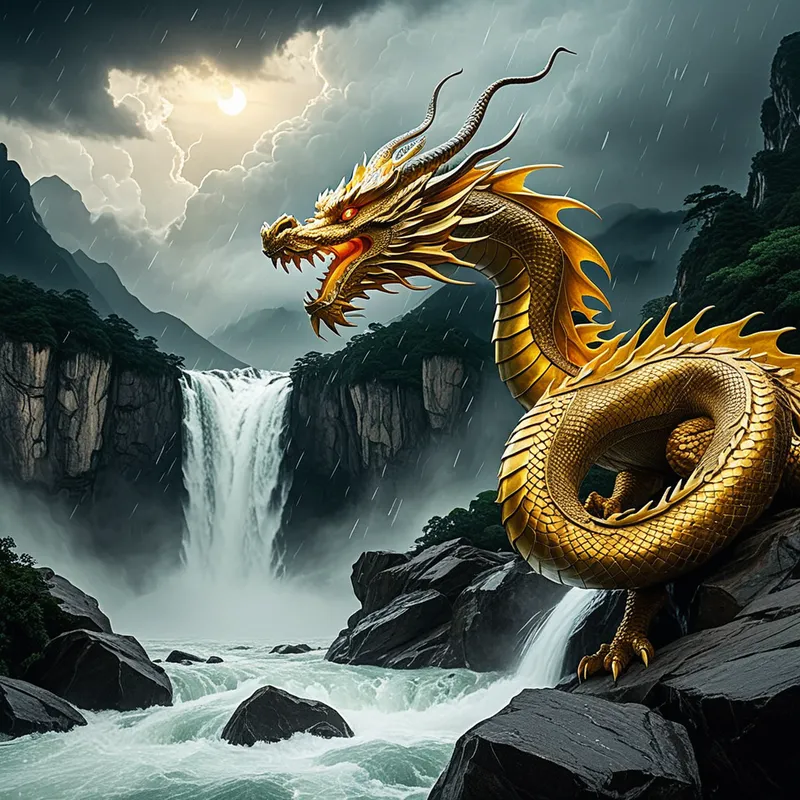
Listen, and hear the tale whispered by the rushing waters. Far to the west, where the mountains claw at the heavens, there lies a place of thunder and mist—the Longmen. Its waters do not merely fall; they crash from a height so great that the spray becomes a perpetual cloud, and the roar drowns out the world. This is no ordinary river. This is a boundary, a veil between one state of being and another.
In the deep, patient pools below, swim the liyu, the carp. They are silver and gold, flashes of ambition in the shadowed water. For generations untold, they have felt the call—not a sound, but a vibration in their very bones, a pull from the torrent above. It is a call to ordeal. The elders tell of it: any carp that can gather the strength, the courage, the sheer, undying will to swim against that crushing descent, to leap from the boiling foam at the base and ascend the very column of the waterfall itself, will be transformed. Upon reaching the summit, a bolt of celestial fire will strike. Scales will melt and reforge, fins will stretch into claws, and the humble fish will emerge as a long, a dragon, sovereign of rain and cloud.
Most carp circle in the deep, dreaming but never daring. The current is too strong, the cliff too high, the outcome too uncertain. But every season, a few feel the call become a command. You can see them gather their strength, their bodies tense. Then, with a powerful thrust of their tails, they abandon the safe, known darkness of the pool. They enter the chaos.
The water is a hammer. It beats them back, dashes them against rocks, threatens to snap their spirit. They are battered, exhausted, mere inches into an impossible journey. Yet, the ones who are chosen—or who choose themselves—do not relent. They find a hidden current, a momentary eddy, and push again. Scale by agonizing scale, they ascend. The world narrows to the next inch of ascent, the next surge of will against the weight of the world. Many fall back, spent. Their silver bodies are lost to the churn.
But for one… for one in ten thousand… there comes a moment where the roar changes. The pressure lessens. The light from above grows from a distant rumor to a dazzling reality. With a final, convulsive effort born of nothing but pure intent, the carp breaches the summit. It hangs in the air for a suspended heartbeat, water streaming from its body like a shedding skin.
Then, the sky answers. Not with mere lightning, but with a column of swirling, golden energy—the breath of heaven itself. It envelops the carp. There is a sound like a thousand bells and a single, profound silence. Where the fish was, now coils a dragon, its new form crackling with power, its eyes holding the storm and the calm. With a roar that echoes the waterfall it has conquered, the dragon spirals into the waiting clouds, its journey from the depths to the heavens complete.
Cultural Origins & Context
The myth of Longmen is deeply woven into the fabric of Chinese thought, appearing in classic texts like the Shanhaijing (Classic of Mountains and Seas) and later reiterated in folklore and popular proverb. It was never merely a children's fable; it was a societal metaphor of immense potency. Historically, it became inextricably linked to the Keju examination system. For over a millennium, this system was the sole path for a scholar, often from a humble background (the liyu in the pool), to attain high office and bring honor to his family (becoming the long).
The myth was told by parents to children, by teachers to students, and by elders to the community. Its function was multifaceted: to inculcate the virtues of relentless effort (nuli) and perseverance (hengxin), to provide a narrative of hope for social mobility, and to frame monumental life challenges as initiatory gateways. The waterfall was not just a physical barrier but a symbol of the immense, structured difficulty of the examinations, the favor of the imperial court, or any great societal hurdle. The transformation was not fantasy, but a promise—that dedicated effort could fundamentally alter one's nature and destiny.
Symbolic Architecture
At its heart, Longmen is a perfect map of alchemical transformation. The carp represents latent potential, the unactualized self content in the "pool" of the familiar, the unconscious, or a lower social station. The waterfall is the ordeal, the necessary friction that forces a crystallization of will. It is the nigredo of the alchemical process—the crushing, blackening stage where the old form is broken down.
The gate does not exist to be passed; it exists to be chosen. The leap is not an action, but a declaration of being.
The act of leaping is the critical psychological turn from passive potential to active striving. It is the ego committing to a journey that promises death of the current identity. The dragon is the lapis philosophorum, the gold—the fully realized, individuated Self. It integrates the earthly (the fish from the waters) with the celestial (the dragon of the skies). The transformation is not an external reward, but an internal revelation triggered by supreme effort. One does not become a dragon to then be powerful; the power is the becoming itself.
The Dreamer's Resonance
When the pattern of Longmen arises in modern dreams, it signals a profound somatic and psychological tipping point. The dreamer may be dreaming of struggling against a powerful current, of trying to climb an impossibly steep, wet cliff, or of being a fish out of water, gasping for air. The somatic feeling is one of immense pressure, of being tested to the absolute limit of one's resources.
Psychologically, this indicates the psyche is in the throes of a major transition—a career change, the end of a relationship, a creative breakthrough, or a deep spiritual crisis. The "pool" is the comfortable but limiting identity or situation one is preparing to leave. The "waterfall" is the terrifying, chaotic process of that leaving. The dream is not a prophecy of success, but a reflection of the inner ordeal. The body and psyche are rehearsing the perseverance required. To dream of breaching the top and feeling a change in form speaks to a nascent, hard-won confidence in this transformative process. To dream of falling back is not failure, but a necessary consolidation of strength for the next attempt.
Alchemical Translation
For the modern individual, the Longmen myth models the complete arc of individuation—the process of becoming who one fundamentally is. We all inhabit our "pool": the persona, the family expectations, the social script. The call to leap is the stirring of the Self, a deep, often uncomfortable knowing that there is a higher, more integrated state of being, but it lies beyond a terrifying barrier of effort and potential failure.
The alchemical work is in the leaping itself. It is the daily practice, the therapy session, the difficult conversation, the act of creating when uninspired, the commitment to a path with no guaranteed outcome. This is the psychic transmutation. Each effort against the "current" of inertia, fear, or old patterns burns away a little more of the "carp" consciousness.
The dragon is not waiting at the top. It is forged in the ascent.
The moment of "transformation" is not a singular event, but a realization. It is the moment one looks back and sees that the struggle itself has remade them. The integrated Self (the dragon) was always the potential within the striving individual (the carp). The myth teaches that transcendence is not an escape from the world (leaving the water), but a mastery born of engaging with its most difficult elements (the waterfall). One becomes sovereign of one's own inner skies by courageously navigating the torrents of the unconscious and the world. The gate is passed not when you arrive, but from the moment you choose to swim upward.
Associated Symbols
Explore related symbols from the CaleaDream lexicon: