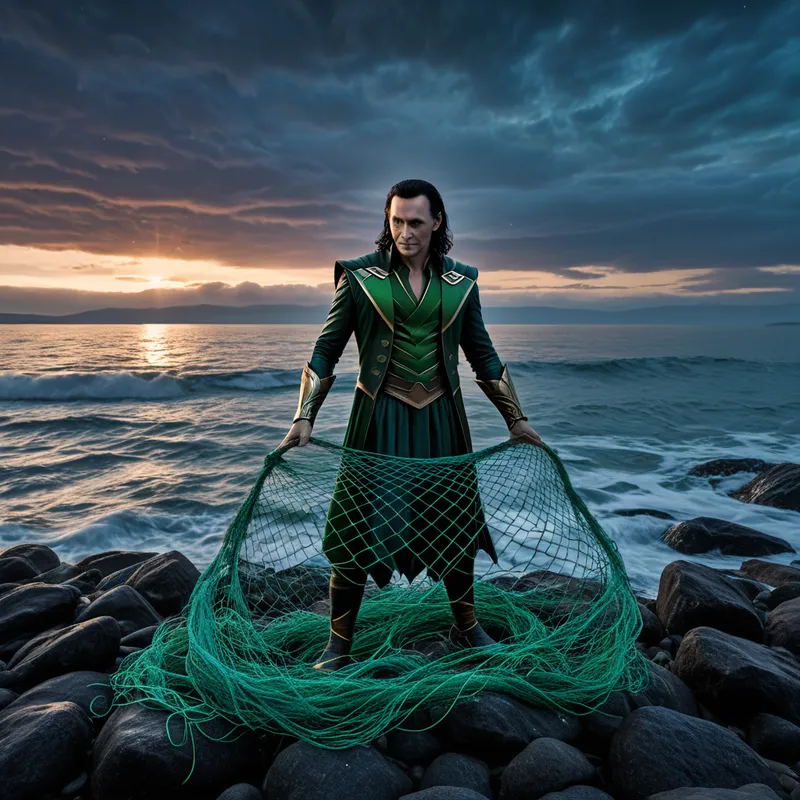
Loki's Fishing Net Myth Meaning & Symbolism
A myth where Loki, to escape punishment, crafts a magical net that ensnares the gods' enemies, weaving his own fate into its knots.
The Tale of Loki's Fishing Net
The mead-hall was silent, a cold tomb of accusation. The air, thick with the scent of damp stone and dying hearth-fire, crackled with a rage older than the mountains. Odin’s single eye burned like a dying star, fixed upon the one who had brought ruin to Baldr the Beloved. Loki, the shape-shifter, the blood-brother, the architect of grief, stood cornered. He had shed his form of the gentle maid, his laughter now a hollow echo in the hall of the betrayed.
He fled. Not in pride, but in the primal terror of a hunted thing. Out from the gates of Asgard, across the trembling bridge of Bifröst, and into the raw, untamed belly of the world. He came to a river that fed a mountain lake, its waters black and deep, hiding a secret. Here, he built a house with four doors, so he could watch every horizon for pursuit. And here, his mind, ever churning like the river’s current, turned to escape. Not just flight, but transformation.
By day, he was a salmon, a silver slip of thought in the cold, forgiving dark of the water. He learned the river’s moods, the dance of current and stone. In the safety of his hut, he returned to his own form and pondered the art of the catch. With clever fingers, he began to weave. He took the sinew of a cat, the breath of a spider, the suppleness of a willow root. He wove a mesh, a lattice of intention, a net. He studied it, this invention of capture, tracing its potential with a mind that saw traps as others saw sunsets. What could catch a fish? What could catch a god?
But the Æsir were not idle. Thor’s wrath was a storm that could find any hiding place. Vidar, the silent, stepped with fateful purpose. They found the empty house by the lake, its four doors speaking of a paranoid mind. Inside, they found the ashes of a fire, and in the ashes, the ghost of an idea—the burnt remains of a net.
Kvasir, wisest among them, whose wisdom was brewed from the blood of gods, knelt. He studied the charred pattern. “See,” he whispered, his voice like wind over reeds. “This is a device for ensnaring. What flees in water? What does Loki fear?” Understanding dawned, cold and clear. They took the pattern from the ashes and wove it anew, a net of their own, a thought made physical to catch a thought made flesh.
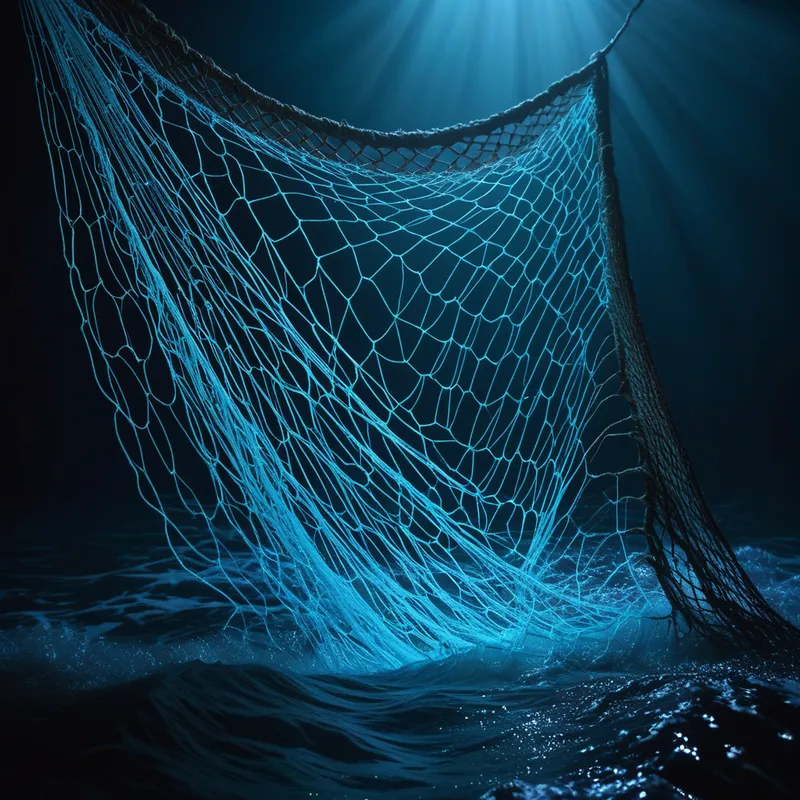
They came to the waterfall. The net, vast and grim, was cast into the frothing pool. On the first drag, it found nothing. On the second, a weight, a struggle. Loki the salmon, the escape artist, darted forward in terror—but saw the net’s mesh before him. In a flash of piscine genius, he leaped, a silver arc over the looming threat. He did not see the hand waiting. Thor’s grasp, mighty and inevitable, closed around the slick, fleeing form mid-leap. The creator was caught by his own creation.
Cultural Origins & Context
This myth reaches us from the rich tapestry of the Poetic Edda, specifically from the Lokasenna and its prose aftermath in the Prose Edda. It is a story told not at the beginning of things, but in the grim twilight that precedes Ragnarök. It functions as a pivotal narrative of consequence, following Loki’s role in Baldr’s death and preceding his brutal binding.
In the Norse worldview, where fate (ørlög) was woven by the Norns, this myth served a crucial societal function. It illustrated a core tenet: no action, however clever, exists in a vacuum. The net is a physical manifestation of the web of cause and effect. For a culture of warriors, farmers, and explorers living in a harsh, interconnected world, the story reinforced that ingenuity could save you, but the consequences of your deeds would always find a shape to hold you. Loki, for all his godlike power, is subject to the same inescapable logic he seeks to manipulate.
Symbolic Architecture
The net is the central symbol, an artifact of profound duality. It is an instrument of creation and capture, of problem-solving and self-entrapment. Loki does not merely flee; he innovates. He uses his quintessential cunning—the same energy that fuels riddles, stories, and technological breakthroughs—to devise a means of survival. Yet, in the act of crafting the tool of his escape, he literally weaves the pattern of his own doom.
The trap you build for the world will always, first, outline the contours of your own soul.
Loki as the salmon represents the elusive psyche, the fluid intelligence that seeks to slip through the nets of consequence, responsibility, and collective morality. The salmon’s leap is a moment of brilliant, instinctual transcendence—a flash of insight that sees the pattern of the trap. But it is also an act of fatal exposure. Thor’s catch is not one of cunning, but of raw, anticipatory force. It signifies the moment when the consequences embodied by the community (the Æsir) can no longer be out-thought; they must be grasped and held, however violently.
The myth presents a complete cycle: thought (Loki’s plan) leads to creation (the net), which leads to recognition (the gods finding the pattern), which leads to enactment (the new net), culminating in capture. It is a closed loop of cause and effect, intelligence and counter-intelligence.
The Dreamer's Resonance
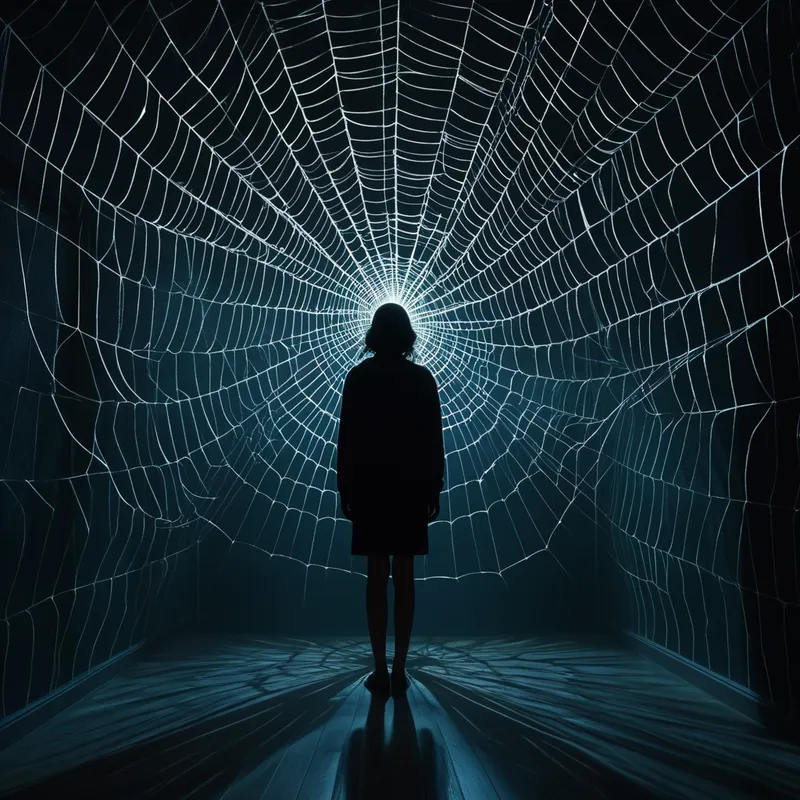
When this myth stirs in the modern unconscious, it often manifests in dreams of being ensnared by one’s own inventions. One may dream of being trapped in a labyrinth they designed, caught in a web of their own lies that has taken on a physical form, or being pursued by a monstrous version of a project or idea they once nurtured. The somatic feeling is one of tightening, of constriction that is eerily familiar, as if the bonds are made from one’s own substance.
Psychologically, this signals a confrontation with the shadow aspect of one’s creativity and intellect. The dreamer is facing the boomerang effect of their actions, strategies, or manipulations. It is the moment when the clever excuse fails, when the shortcut reveals its hidden cost, when the persona crafted to navigate the world becomes a prison. The dream is an invitation to stop leaping over the net—to stop seeking ever-more clever evasions—and to turn and face the weave of one’s own making. It is a call to accountability, not as a moral punishment, but as a necessary integration.
Alchemical Translation
The alchemical journey modeled here is the transmutation of cunning into conscious responsibility. Loki begins as prima materia—the chaotic, mercurial trickster spirit, all potential and no fixed form. His creation of the net is the first coagulation, a giving of form to his fluid nature. But it is a form born of fear and separation.
The gods’ replication of the net represents the intervention of the Self (the archetypal totality of the psyche) upon the rogue complex. The pattern, once realized, cannot be unrealized. The conscious ego (the Æsir as the ruling psychic order) must take up the tools forged in the shadow and use them to enact a necessary, if brutal, integration.
To be caught is to be defined; to be bound is to be given a locus where transformation can begin.
For the modern individual, the “Fishing Net” process occurs when we are finally apprehended by the consequences of our own patterns—our habits of avoidance, our self-serving narratives, our ingenious defenses. The initial capture is a crisis, a painful loss of freedom. Yet, it is also the beginning of the opus. Loki’s subsequent binding on the rocks with the serpent’s venom is the next stage: the sustained, painful contemplation of one’s own toxic creations. The alchemical goal is not to destroy the trickster, but to integrate his boundless creativity into the psychic whole, so that it serves connection rather than chaos, and wisdom rather than mere escape. The net, then, becomes not just a trap, but the very loom on which a more complete self is woven.
Associated Symbols
Explore related symbols from the CaleaDream lexicon: