Loki's Children Myth Meaning & Symbolism
The prophecy of Loki's monstrous offspring, bound by the gods, whose inevitable escape heralds the world's destruction and rebirth at Ragnarök.
The Tale of Loki's Children
Hear now a tale spun from the loom of fate, a story not of creation, but of a dread that took root in the heart of the world. It begins not with a roar, but with a whisper in the halls of Asgard. The air, usually thick with the scent of mead and boasting, grew cold. A seeress, her eyes clouded with visions of mist and blood, spoke a prophecy that turned the laughter of the gods to stone.
She spoke of three seeds of chaos, born from the trickster-fire of Loki and the giantess Angrboða. They grew not in the sunlit fields of Idavollr, but in the iron woods of Jötunheimr, a place where shadows had weight and the trees whispered of endings.
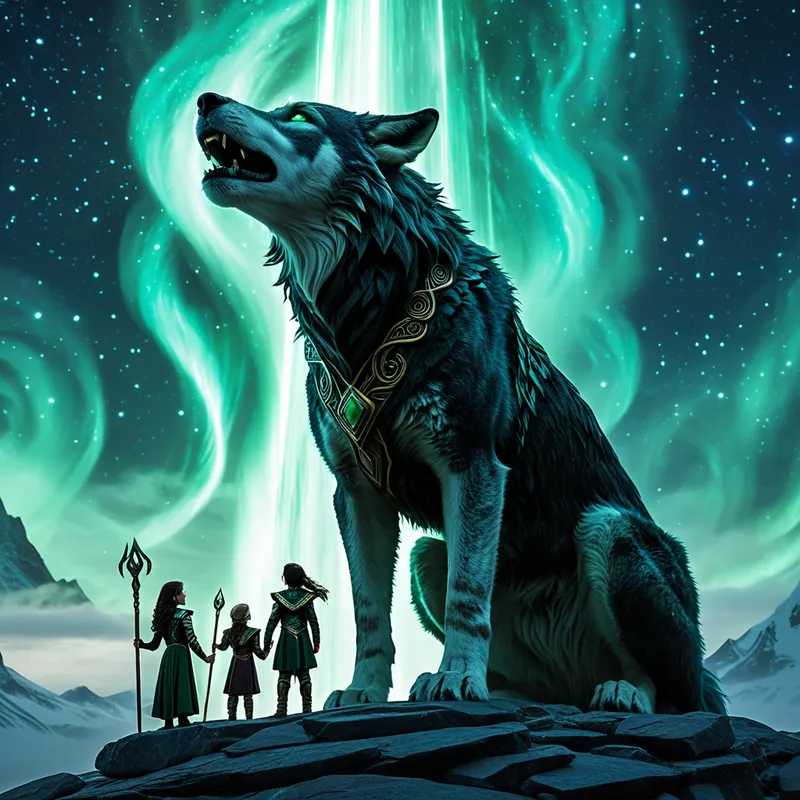
The first was a wolf pup, Fenrir. But he was no ordinary beast. He grew each day, not by inches, but by spans, his fur the color of a starless midnight, his eyes twin pits of hungry intelligence. The gods, in their gleaming hall, felt his growth as a tremor in the floor, a tightening in their chests.
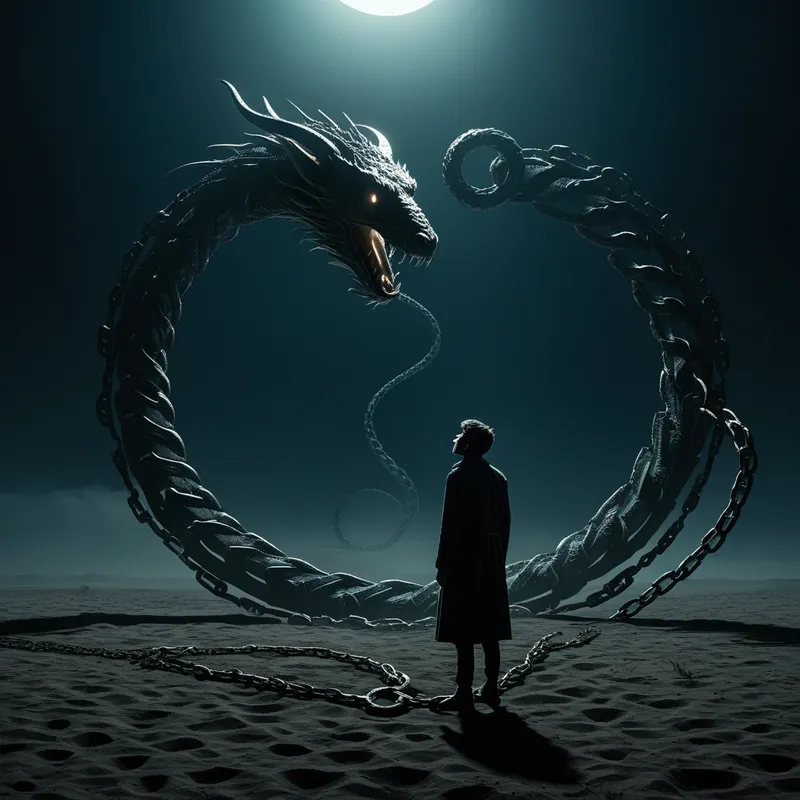
The second was a serpent, Jörmungandr. Odin, the All-Father, in a moment of desperate foresight, cast it into the great ocean that encircles Midgard. There, in the lightless deep, it did not die. It grew, and grew, until its own tail filled its mouth, forming a perfect, terrible circle around all lands, its scales grinding continents.
The third was a girl, Hel. She emerged into the world half-alive, her skin and form radiant and beautiful on one side, and on the other, necrotic and blue-black, the flesh of a long-dead corpse. Her gaze was a door into a place without sun.
Fear, cold and sharp, settled over Asgard. These were not enemies to be fought in glorious battle; they were destinies made flesh. So, the gods chose not war, but binding. They brought the young Fenrir to them, speaking with false friendship. "Let us test your strength, great one," they said, and presented fetters. Twice he broke them with ease. But the third fetter, Gleipnir, was a deception made real—crafted from the sound of a cat's footfall, the beard of a woman, the roots of a mountain, the sinews of a bear, the breath of a fish, and the spittle of a bird. It was a chain of impossibilities, thin as a silken ribbon but stronger than any iron.
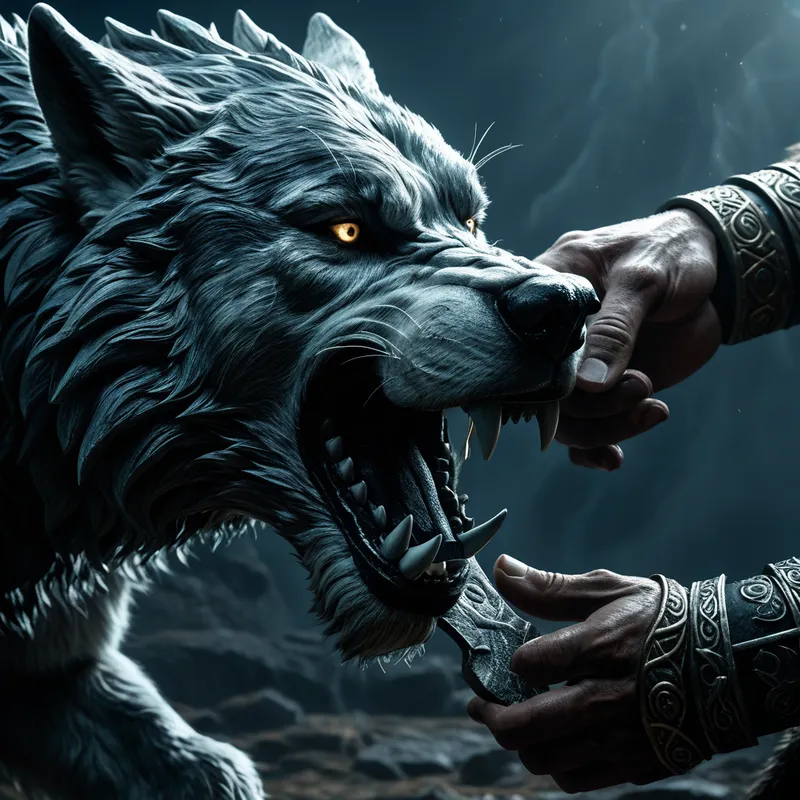
Fenrir, wise to their deceit, would only submit if one of the gods placed a hand in his jaws as a pledge of good faith. The god Tyr, whose honor was his essence, stepped forward. As the ribbon tightened, Fenrir struggled, his might shaking the nine worlds. But Gleipnir held. And in his rage and betrayal, the wolf closed his jaws, severing Tyr's hand. The god's sacrifice sealed the beast's prison, and Fenrir was bound to a rock deep in the earth, a sword placed in his mouth to hold it agape, his howls becoming the wind that scours barren places.
Jörmungandr lay in the deep, a sleeping tension around the world's waist. And Hel was given a realm of her own, a land of mist and echoing halls named for her, where those who did not die in battle went. There she ruled, her half-living face impassive, waiting.
And so the children were contained, but not destroyed. They were woven into the fabric of the world itself: a bound rage, a encircling dread, a silent kingdom of the departed. The gods had bought time, but the prophecy remained, etched in the bark of Yggdrasil. For at the final twilight, Ragnarök, the bonds would break. The wolf would swallow the sun, the serpent would rise from the sea to poison the sky, and the dead would sail from Hel's shore. Their release was the price of their containment, the inevitable return of all that had been cast out.
Cultural Origins & Context
This myth survives primarily in the Poetic Edda and the later Prose Edda by Snorri Sturluson. These texts are our window into a worldview that did not shy away from darkness. For the Norse, mythology was not a simple morality tale but a complex map of cosmic forces. The story of Loki's children was likely told in hall and hearth, a foundational narrative explaining the presence of inevitable suffering, loss, and cataclysm within a structured cosmos.
Its societal function was profound. It validated a world where threat was omnipresent—from the harsh winters to the sudden raid—and where even the gods were not omnipotent, but bound by fate. The myth taught that some forces are too vast to destroy; they must be managed, contained, and their eventual eruption accepted as part of the natural order. It framed the gods' actions not as triumphant heroics, but as necessary, tragic compromises to maintain cosmic balance, a reflection of the difficult choices leaders and communities must make to survive in a precarious world.
Symbolic Architecture
The three children are not mere monsters; they are a triune embodiment of the unconscious, shadowy forces that the conscious order (the Æsir) must acknowledge and attempt to control.
Fenrir is untamed instinct, ravenous hunger, and the raw, destructive power of rage. He is the part of the self that cannot be reasoned with, only bound at great personal cost. His binding represents civilization's repression of primal nature, a repression that creates a ticking clock of future psychological explosion.
To bind the wolf is to leash a storm; the silence that follows is not peace, but the gathering of thunder.
Jörmungandr is the archetype of the Ouroboros, the self-devouring cycle. It represents existential dread, the vast, encircling problems that feel too large to confront (climate, time, mortality), and the shadow of totality—a system so complete it becomes its own prison. Cast into the "deep," it symbolizes knowledge or fear so profound we relegate it to the unconscious depths, where it only grows larger.
Hel is the ultimate integration of opposites: life and death, beauty and decay, acceptance and denial. She is not evil, but impartial. Her realm is where unheroic, unprocessed aspects of the self go—the regrets, the quiet failures, the parts that did not "die in battle" for our ideals. She represents the necessity of acknowledging our whole, mortal, flawed self, not just the shining, heroic persona.
Together, they form a complete shadow complex: the aggressive impulse (Fenrir), the enveloping anxiety (Jörmungandr), and the repressed, mortal reality (Hel).
The Dreamer's Resonance
When this myth stirs in the modern psyche, it often manifests in dreams of overwhelming, inescapable forces. To dream of a chained beast struggling in a basement is to feel Fenrir—a rage or a passionate drive that has been imprisoned for too long, threatening to break loose and destroy the structures of one's life. The somatic sensation is often a tightness in the jaw, chest, or fists.
Dreams of being encircled by a vast serpent, or of a tidal wave on the horizon, speak to Jörmungandr's resonance. This is the anxiety of systemic overwhelm—financial debt, a toxic work culture, a global crisis—that feels like a constricting loop around one's world. The body may feel heavy, restricted, or nauseous.
Encountering a figure that is half vibrant, half decayed, or finding oneself in a muted, grey landscape of forgotten things, is the call of Hel. This dream points to a neglected aspect of the self, a grief unmourned, a talent left to rot, or a simple refusal to accept one's own mortality or flaws. The somatic signature is often a cold numbness, a hollow feeling in the gut, or a profound sense of inertia.
Alchemical Translation
The myth of Loki's children is not a story of victory, but of necessary engagement with the shadow. Its alchemical translation for individuation is a threefold process: Confrontation, Containment, and Catalytic Release.
First, we must confront our personal Fenrir, Jörmungandr, and Hel. What untamed hunger drives us? What cyclical anxiety traps us? What parts of our life have we sent to a silent, grey exile? This is the "prophecy" of our own unconscious, which we often try to ignore until it grows too large to deny.
Second, we practice containment. This is not repression, but the conscious, ethical binding of chaotic forces. We create our own Gleipnir—not from deception, but from awareness, ritual, discipline, and creative expression—to hold our destructive impulses without letting them rule us. Like Tyr, this requires a sacrifice: the "hand" of an old, one-sided identity, a simplistic self-image that must be given up to integrate our shadow.
The alchemical vessel is not a prison, but a crucible. What is bound within it is not destroyed, but transformed by the heat of conscious attention.
Finally, we must accept the catalytic release. In the psyche's Ragnarök, the bound forces must break free. The old ego-structure (the "gods") must fall. This is not literal destruction, but the death of an outworn attitude. The rage, when integrated, becomes fierce protectiveness and passionate will. The encircling dread, when faced, reveals itself as the natural cycle of death and rebirth. The exiled, "dead" parts of ourselves, when welcomed back, become sources of profound depth and humility. The myth teaches that true wholeness is only achieved by allowing the destined end of our partial self, so a more complete consciousness can be born from the ashes.
Associated Symbols
Explore related symbols from the CaleaDream lexicon: