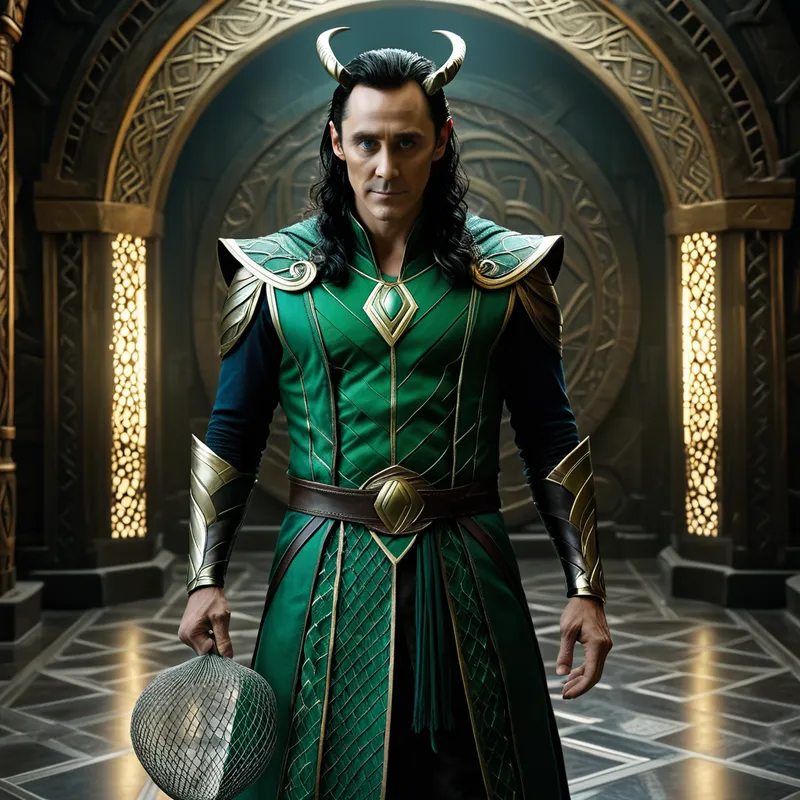
Loki Myth Meaning & Symbolism
The story of the shape-shifting god of mischief, whose cunning creates and destroys, embodying the necessary chaos that forges destiny.
The Tale of Loki
Listen, and hear the tale of the one who walks between. In the dawn of the world, when the breath of the giant Ymir first misted into frost, there was a promise of fire. Not the wholesome hearth-fire, but the wildfire that licks at foundations. This is Loki.
He came to the golden halls of Asgard not as a conqueror, but as a blood-brother. Odin himself clasped hands with him, sealing a bond that would both bless and curse the gods. Loki was beautiful and terrible, his tongue a silver blade, his mind a labyrinth. He was the architect of their greatest treasures and the architect of their doom.
He walked with them, this son of a Jotunn, laughing at their feasts. When the master builder threatened to steal the sun and moon, it was Loki’s cunning that saved them, transforming into a mare to distract the builder’s stallion. From that strange union was born Sleipnir, the greatest of horses. He gave the gods Mjolnir, he gave Freyja her necklace Brisingamen. He was the necessary solution, the fixer, the one who could slip the bonds of the possible.
But a wildfire cannot be contained forever. The game turned cruel. His lies led to the death of the beloved Balder, the shining one. In a hall draped in grief, the gods’ laughter turned to ash. They hunted the trickster. He fled, transforming into a salmon in a mountain stream, but the net he himself had invented was cast, and he was caught.
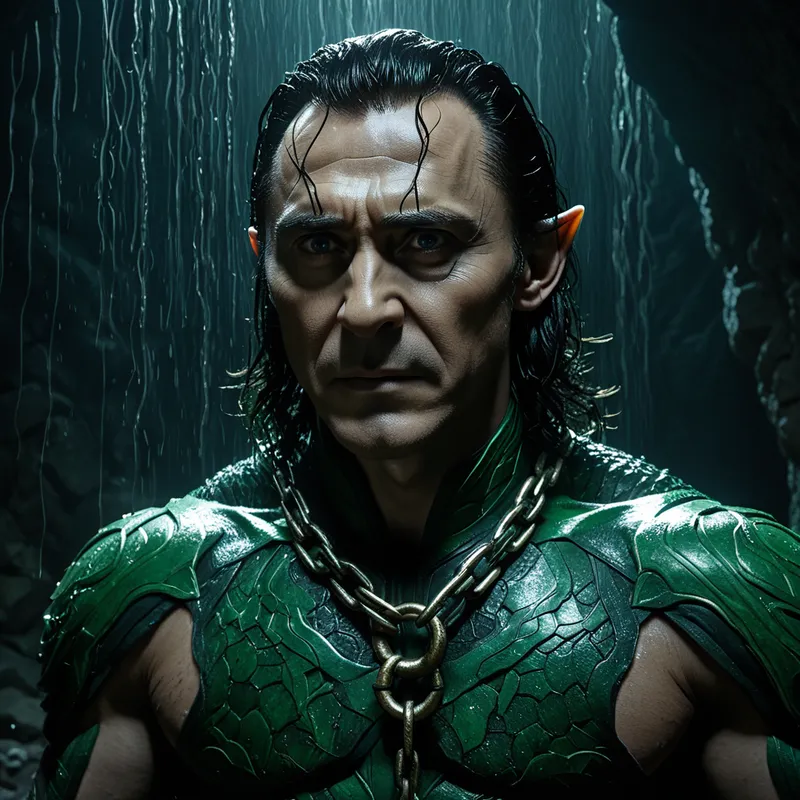
Then came the binding. In a cavern deep and cold, they took his sons. One, Fenrir, was already chained with a ribbon woven from impossible things. Another, Jormungandr, was cast into the sea. The third, they transformed into a wolf that tore out the entrails of his brother. With those steaming cords, the gods bound Loki to three sharp stones.
Above him, they placed a serpent, its venom dripping, drip by eternal drip, onto his face. His wife, Sigyn, stays with him, catching the poison in a bowl. But when she turns to empty it, the acid burns him, and his convulsions shake the very roots of Yggdrasil. There he lies, bound by his own kin’s viscera, until the final day. For it is written that when the horn sounds for Ragnarok, the bonds will snap. Loki will steer the ship of the dead, and his children will run free, to meet the gods in one last, glorious, and terrible dance of fire and ice.
Cultural Origins & Context
The figure of Loki is a complex artifact of the Norse worldview, preserved primarily in the Poetic Edda and the later Prose Edda. These texts, compiled in 13th-century Iceland, are our window into a much older oral tradition. The myths were not mere stories for entertainment; they were the operating system of a culture living on the edge of a formidable world. In this context, Loki is not a simple "evil" figure, but a narrative embodiment of necessary chaos, unpredictable change, and the ambiguous outsider.
He functioned as the mythic catalyst. In a society bound by strict codes of honor and fate, Loki represents the loophole, the wild card, the creative-destructive impulse that both saves and damns. He was likely a figure of caution and fascination, told of in halls during the long winters—a reminder that even the gods are not immune to betrayal, that brilliance and danger are often two sides of the same coin, and that the bonds of community are constantly tested by the disruptive forces within and without.
Symbolic Architecture
Loki is the archetypal trickster, but his symbolism cuts deeper than mere mischief. He is the psychological shadow of the Aesir pantheon. The gods of Asgard represent order, law, courage, and fertility—the conscious ideals of a society. Loki is everything they must repress to maintain that order: deceit, cunning, fluidity, and pure, amoral creativity.
He is the fire of intellect untethered from conscience, the shape-shifting capacity of the psyche that refuses to be defined.
His binding is a profound symbol. He is not destroyed, but contained by the consequences of his own actions (the entrails of his son). The dripping venom represents the perpetual, corrosive price of repressed chaos—the psychic tension that, while agonizing, is necessary to hold the current world-order together. His writhing causes earthquakes, symbolizing how repressed aspects of the self or society inevitably manifest as disruptive symptoms.
The Dreamer's Resonance
To dream of Loki is to encounter one's own inner trickster and shadow in a time of profound psychic upheaval. It is rarely a comforting dream. You may dream of a charming, persuasive figure who offers a deceptive shortcut, or of a shapeshifter whose face you cannot pin down. You may find yourself in a dream where you are the one weaving clever lies, feeling a thrilling, guilty power.
Somatically, this can feel like a buzzing restlessness, a knot of anxiety mixed with mischievous energy in the solar plexus. Psychologically, it signals a confrontation with a part of the self that feels alien, cunning, or "unacceptable." The dreamer is grappling with repressed creativity, ambivalent motives, or a feeling of being an outsider within their own life. The Loki pattern emerges when the psyche's rigid structures are being challenged by a fluid, transformative, and potentially destructive energy that demands integration, not further exile.

Alchemical Translation
The individuation process, the journey toward psychic wholeness, is not a path of light alone. It requires a conscious engagement with the shadow, and Loki is a masterful map of this dangerous, essential work. His myth models the alchemical stage of nigredo—the blackening, the dissolution of old, rigid forms.
The first step is to acknowledge the blood-brotherhood with your own inner Loki—to recognize that your cunning, your chaos, your capacity for betrayal and brilliant solution is part of your totality, sworn to you by Odin-like consciousness itself.
We initially use this energy in service of the ego (solving the gods' problems), but unchecked, it acts out autonomously and destroys what we hold dear (Balder, our inner innocence). The subsequent "binding" is not a failure, but a critical phase. It is the conscious containment and suffering (the dripping venom) that comes from facing the consequences of these shadow aspects. We must, like Sigyn, hold the bowl—attend to the pain of this integration with steadfast patience.
The promise of Ragnarok is the ultimate alchemical translation. The bound tension cannot be eternal. The full integration of the shadow—the snapping of the bonds—leads to a psychic revolution, the death of an old, unsustainable conscious attitude and the birth of a new, more complete self. The fire that Loki brings is not only destructive; it is the fire of transformation necessary for rebirth. To become whole, one must, in a sense, steer the ship of one's own dead illusions, facing the final battle with the full complexity of one's nature unleashed and acknowledged.
Associated Symbols
Explore related symbols from the CaleaDream lexicon:
- Funny
- Joke
- Playground
- Amusement
- Fake
- Shift
- Tennis
- Trick
- Silly
- Casino
- Terrorist
- Surprised
- Lie
- Murderer
- Thief
- Jerk
- Lizard Tongue
- Lynx Shadow
- Juggling Jellybeans
- Mismatched Socks
- Ripped Leggings
- Brightly Colored Socks
- Costume Mask
- Wacky Headband
- Graphic Tee
- Twisted Elbow
- Veiled Intentions
- Shifting Shadows
- Devilish Joker
- Rogue
- Imp
- Shapeshifter
- Rebellious Teenager
- Snapdragon Surprise
- Weevil Deception
- Harmonious Biting Fly
- Clever Aphid
- Crafty Ant
- Gnat
- Energetic Ferret
- Silvery Fox
- Witty Kinkajou
- Inventive Tasmanian Devil
- Shapeshifter's Form
- Hobgoblin Prank
- Gremlin Mischief
- Wavy Piccolo Trumpet
- Illuminated Kazoo
- Twisted Melodica
- Joyful Kazoo
- Billiard Table
- Role-Playing Game
- Pinball
- Nerf Blaster
- Graffiti Wall
- Rogue's Dagger
- Julius Caesar's Dagger
- Bizarre Narrative
- Shattered Typo
- Layered Plot Twist
- Studded Wristband
- Patterned Socks
- Patterned Leg Warmers
- Go-Kart
- Chaotic Software Update
- Jack-in-the-Box
- Handheld Game
- Silly String
- Nerf Gun
- Fuzzy Dice
- Kazoo
- Crowded Casino
- Vulgar Graffiti
- Camouflage Patterns
- Zigzag Line
- Decoys of Clay Birds
- Decoy Animals
- Tanning Hide
- Kitsune Fox
- Dokkaebi Goblin
- Coyote Trickster
- Static Buzz
- Trickster
- Trickster Energy
- Pixelated Face
- Online Identity
- Online Harassment
- Emoji Cascade
- Cybersecurity Threat
- Tech Glitch
- Identity Theft
- Pixel Glitch
- Static
- Distortion
- Orbital Drift
- Wind Shear
- Atmospheric Turbulence
- Atmospheric Distortion
- Idiom
- Homonym
- Transitivity
- Clipping
- Irregular
- Arbitrary
- Ambiguity
- Glitch
- Nerf
- Cheat
- Twist
- Impulse
- Irony
- Parody
- Antagonist
- Leverage
- Cartel
- Tangential
- Slipping
- Quantum
- Sleetfall
- Flurry
- Agitation
- Glee
- Resentment
- Villain
- Fool
- Flicker
- Bluff
- Distorting
- Warping
- Phasing
- Nutty
- Exploring Puffin
- Gay