
Ling Lun Myth Meaning & Symbolism
The tale of the Yellow Emperor's minister who journeyed to a mystical mountain to capture the sacred songs of phoenixes, establishing the foundation of all music and cosmic order.
The Tale of Ling Lun
In the dawn of the world, when the land was still raw and the patterns of heaven were yet to be mirrored on earth, the Yellow Emperor ruled. He was a king of profound vision, who saw that the people moved in discord, their hearts out of rhythm with the seasons and their spirits silent to the music of the cosmos. A great disharmony lay upon the land, a silent chaos.
The Emperor summoned his most gifted minister, a man named Ling Lun. "The world is out of tune," the Emperor said, his voice like distant thunder. "The winds howl without melody, the rivers rush without rhythm, and human speech is a cacophony. You must find the source of true pitch. You must bring back the law of sound, so that our rites may please the heavens and our people may find their place in the great pattern."
Ling Lun accepted this impossible task. He turned his back on the court and walked westward, towards the mythical Kunlun Mountains, the axis of the world where earth met sky. For days and nights he journeyed, through valleys where echoes died unborn and across plains where the only sound was the beating of his own anxious heart. Finally, he came to the foothills of a solitary, majestic peak—the Mountain of Mysterious Caves.
Here, the air itself seemed to vibrate with a latent song. Ling Lun climbed, his senses straining. And then he heard it. Not a melody, but a call—a cry of such piercing purity and sorrowful joy that it seemed to cut through the veil of the world. It was the song of the Fenghuang, the male and female phoenix. He found them, resplendent beyond description, perched upon a sacred paulownia tree. Their six notes—the male's six and the female's six—wove together in a celestial dialogue, the very template of harmonic law.
Trembling with awe, Ling Lun took out his knife. He cut twelve lengths of bamboo from a nearby grove, each pipe uniform in thickness. As the male phoenix sang, he tuned one set of six pipes to match its calls. As the female answered, he tuned the other six. The bamboo, touched by the phoenix's breath captured in sound, ceased to be mere plant; it became a vessel of cosmic principle. He had captured the Twelve Lü.
His journey back was a procession of order. Where he blew the first pipe, the yellow bell note, the winds settled into a gentle breeze. Where he blew another, the chaotic waters began to flow with purposeful rhythm. He returned to the Yellow Emperor not just with pipes, but with the secret scaffolding of reality itself. From these twelve absolute pitches, all music, all ritual chant, and the very framework for ordering the calendar, the state, and the human soul could be derived. The silent chaos was broken. The world had found its voice.

Cultural Origins & Context
The myth of Ling Lun is not a folktale but a foundational narrative of order, recorded in early texts like the Shuowen Jiezi and the Records of the Grand Historian. It belongs to the corpus of myths surrounding the Yellow Emperor, a culture hero credited with inventing the pillars of civilization. This story functioned as an etiological myth, explaining the divine, non-human origin of the Chinese musical and tonal system.
In imperial China, music (yue) was never mere entertainment; it was a cosmological and political technology. Correct music harmonized the state with the Dao. The court music bureau was a vital institution, and the precise calibration of pitch pipes was a matter of statecraft, believed to influence the seasons and the moral character of the people. Ling Lun’s myth provided the sacred provenance for this entire system. It was told by scholars and ritualists to underscore that true law and harmony do not originate from human whim, but from attentive listening to the patterns of nature itself—here, embodied in the most auspicious of creatures.
Symbolic Architecture
At its core, Ling Lun’s journey is an archetypal quest for the logos—the fundamental ordering principle. The chaotic world before his journey represents the undifferentiated psyche, a state of potential without form. The Yellow Emperor, the ruling consciousness, senses this inner disarray and dispatches the creative function (Ling Lun) to find the source of structure.
The phoenixes are not just birds; they are symbols of the transcendent union of opposites (male/female, solar/lunar) and the embodiment of cosmic virtue. Their song is the unheard music of the spheres, the perfect pattern that exists beyond human perception.
The hero’s task is not to invent, but to discover; not to compose a new song, but to faithfully transcribe the eternal one that already exists.
The bamboo pipes are crucial. Bamboo is hollow, a receptive vessel. It symbolizes the human medium—our body, our mind, our culture—which must be emptied of ego and cut to the correct length (cultivated) to accurately resonate with the transcendent pattern. Ling Lun does not create the notes; he tunes himself and his instruments to them. The act establishes music as a technology of alignment, a bridge between the human realm and the celestial blueprint.

The Dreamer's Resonance
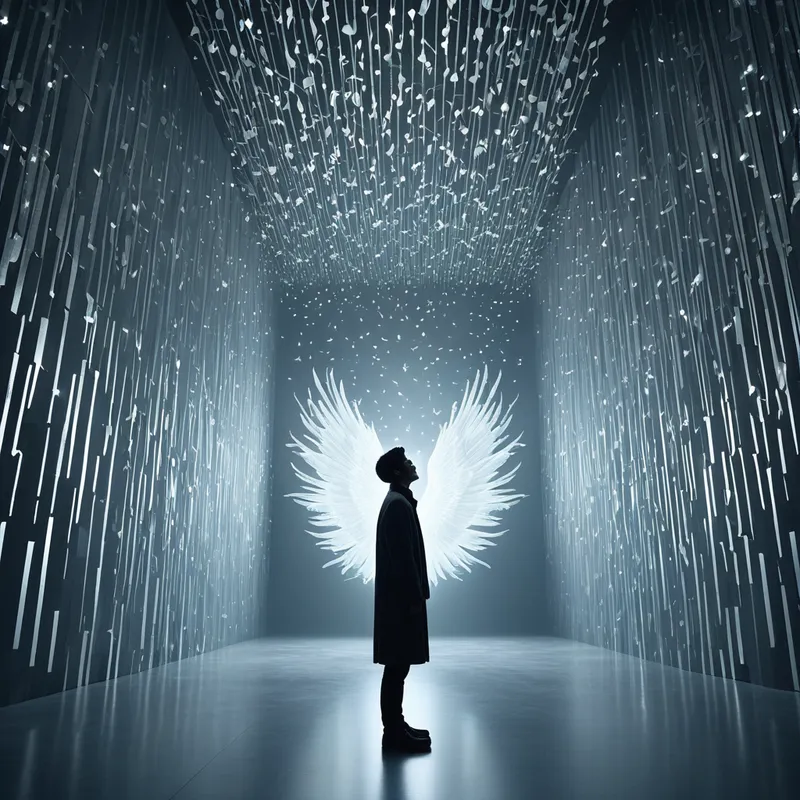
When this myth stirs in the modern unconscious, it often manifests in dreams of searching for a lost frequency or a foundational tone. One might dream of tuning a radio through static to find a single, clear, beautiful station. Or of being in a chaotic, noisy environment and suddenly hearing a pure, isolated sound that brings instant calm and focus.
Somatically, this can correlate with a felt sense of being "out of tune"—a persistent anxiety, a feeling of life being slightly off-key, or a creative blockage where ideas are present but lack a coherent structure. The dream is pointing to a deep psychological need to journey inward (the west, the mountain) to listen past the internal cacophony of worries, personas, and distractions. It calls the dreamer to identify their own "phoenix song"—the core, authentic pattern of their unique being—which may be obscured by the demands of the external world. The process is one of deep listening, of receptivity, and of distinguishing the essential signal from the existential noise.
Alchemical Translation
The individuation process modeled by Ling Lun is one of attunement rather than conquest. The modern ego, like the Yellow Emperor, often tries to impose order through force of will, creating rigid structures that eventually crack under pressure. Ling Lun’s path is different. It begins with the acknowledgment of inner chaos and the humble commission to seek an order that exists beyond the self.
The journey to the west is the descent into the unconscious, away from the bright consciousness of the "imperial court." The phoenixes represent the Self, the central archetype of wholeness, whose nature can only be perceived indirectly, through its harmonious expression (its song). The laborious tuning of the bamboo pipes is the painstaking work of psychological differentiation—adjusting one’s habits, thoughts, and emotional responses until they resonate with this deeper, more authentic pattern.
Individuation is not about becoming someone new, but about cutting away what is false so that one’s inherent, unique pitch can sound clear and true.
The return with the Twelve Lü symbolizes the integration of this discovered order into daily life. The newly tuned individual does not create harmony from scratch; they become a conduit for it, allowing it to organize their perceptions, relationships, and creative outputs. The chaos of the personal world begins to settle, not because it is controlled, but because it is finally in resonance with a law more profound than the ego. One becomes, like Ling Lun, a master musician of the soul, whose primary art is listening.
Associated Symbols
Explore related symbols from the CaleaDream lexicon: