Liminal deities Myth Meaning & Symbolism
The myth of deities who dwell at boundaries, governing transitions, crossroads, and the spaces between worlds, guiding souls through change.
The Tale of Liminal deities
Listen, and hear of the ones who are never truly here nor there. They are the whisper in the doorway, the chill at the threshold, the sudden knowing at the fork in the path. They are the gods of the in-between.
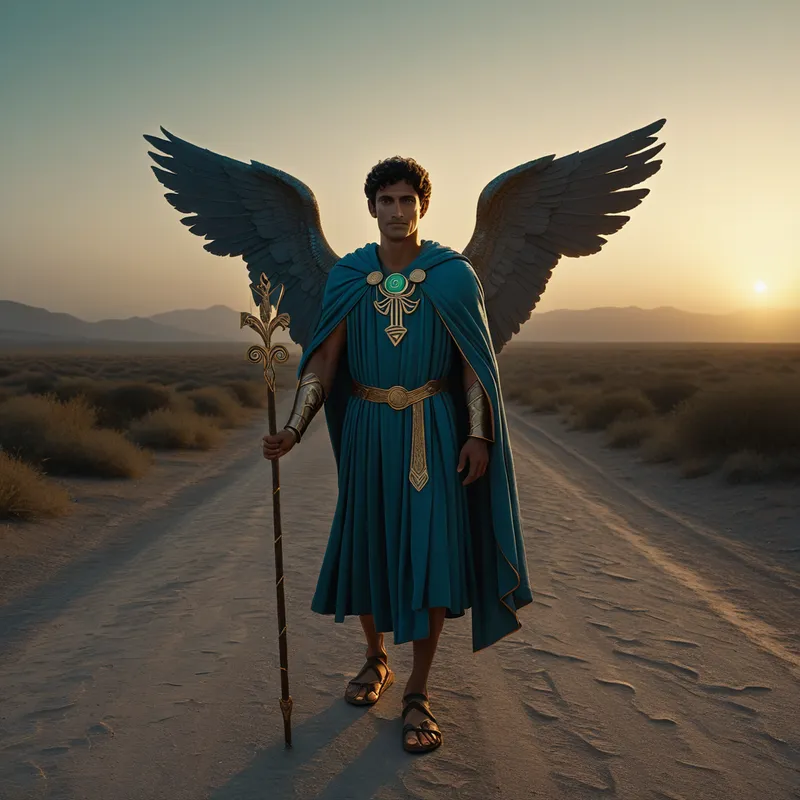
Before you stands the road. It is not the bustling agora, nor the quiet hearth. It is the dust, the stone, the open sky. And upon this road walks a figure who is not quite a man. His feet, shod in sandals with wings, barely kiss the earth. He is Hermes, born at dawn. Before the sun reached its zenith, he had slipped from his cradle, stolen the cattle of his brother Apollo, and invented the lyre from a tortoise shell. He moves with the speed of thought, from the highest peak of Olympus to the deepest shadow of the mortal world. He is the one who carries words between realms, the divine herald whose voice traverses impossible distances. He guides not just messages, but the very souls of the departed, leading them down to the misty shores of the Styx. He is present at every beginning, every transaction, every departure.
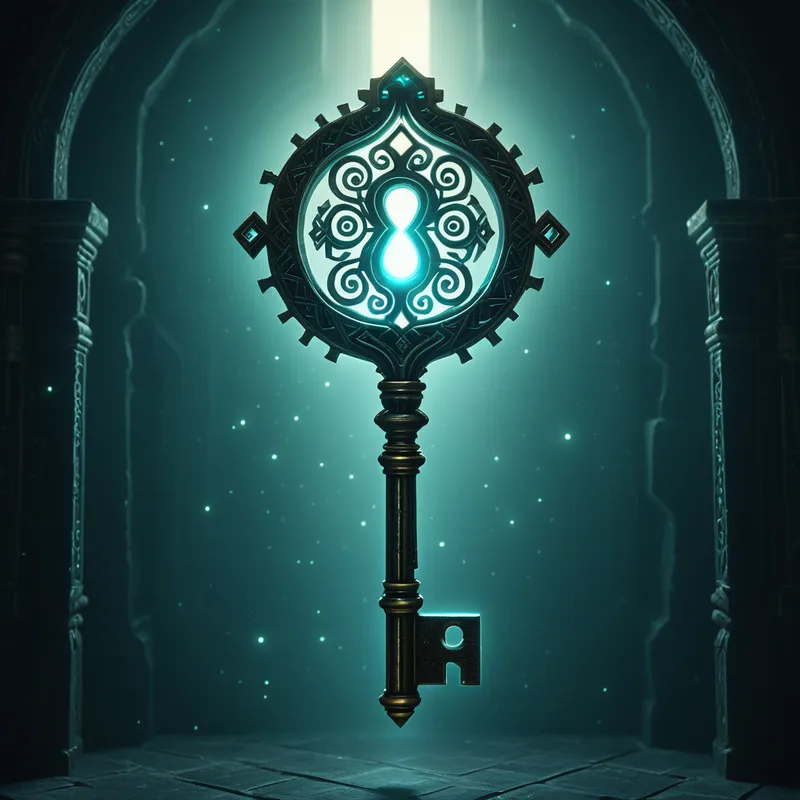
But when the sun flees and the world is painted in the silver-grey of twilight, another power stirs. At the place where three roads meet, where choices multiply and certainty dies, a presence gathers. It is Hecate. She arrives without sound, accompanied only by the baying of hounds from the unseen world. In one hand she may hold a torch, cutting through the gloom of uncertainty. In another, a key, to unlock what is hidden or to seal a fate. She is the guardian of the crossroads, the witness to every secret rite performed in the liminal hours. She sees what passes from life to death, from waking to dream. To her, the lost and the haunted pray, for she knows the paths that run beneath the visible world. Her faces look down each road, seeing all possible outcomes, all destinations born from a single, trembling moment of choice.
And then there are the spaces themselves—the doorways. They are watched by Janus, though his lineage is older, woven into the fabric of Rome from Greek threads. He is the two-faced one, but his duality is not of deceit. One face, weathered and wise, looks into the past, into the room you leave. The other, bright and expectant, gazes into the future, the room you enter. He is the pivot. In his silence, he holds the entire architecture of transition: the arch, the lintel, the hinge. War passes through him, and so does peace. He is the first god invoked in any prayer, for all beginnings must pass through a gate.
These are not the gods of the steadfast center. They are the deities of the permeable margin. Their domain is the breath held between inhalation and exhalation, the heartbeat between systole and diastole, the instant the traveler becomes a stranger, and the stranger becomes a guest. They rule the moment of potential, where everything is possible and nothing is yet fixed.

Cultural Origins & Context
The veneration of liminal deities arose from a fundamental Greek understanding of the cosmos: that order (kosmos) was perpetually negotiated with chaos, and that boundaries were sacred because they were perilous. In a world perceived as populated by spirits and divine forces, the points of transition were where the veil was thinnest. These were zones of both danger and opportunity.
Hermes, perhaps originally a stone marker (herma) on roads and borders, evolved into the agile psychopomp. His cult was ubiquitous. Every doorway might have a small offering to him; every marketplace thrived under his patronage of trade and luck. Hecate’s worship was more intimate and chthonic, often practiced at household shrines or remote crossroads. Her triple form likely represented her sovereignty over heaven, earth, and the underworld, making her a comprehensive liminal force. Stories of these gods were not confined to grand epics but lived in daily ritual—the libation poured at the threshold, the coin placed on the tongue of the dead for Charon, the whispered prayer at a junction.
Their myths served a crucial societal function: they provided a divine map for navigating life’s inevitable transitions. Birth, adolescence, marriage, death, travel, commerce—each was a threshold event presided over by these ambiguous, powerful figures. They offered a way to ritualize anxiety, to assign a face and a protocol to the inherently frightening act of leaving one state of being for another.
Symbolic Architecture
Psychologically, the liminal deity is the archetypal personification of the ego’s experience at the edge of the known. They represent the necessary function that manages the interface between consciousness and the unconscious, between the persona and the shadow, between the safety of the familiar and the terror and promise of the new.
The threshold is not an obstacle but the very substance of transformation. To cross it is to be dissolved and remade.
Hermes symbolizes the active principle of liminality: the quick intelligence, the adaptive trick, the communicative link. He is the psychic energy that can navigate complex inner landscapes, retrieve insights (like his theft of Apollo’s cattle), and mediate between conflicting inner forces. His caduceus is not a weapon but a tool of diplomacy, representing the integration of opposites.
Hecate embodies the receptive principle of liminality: the deep, moonlit wisdom of the crossroads. She represents the moment of suspension and choice, where multiple potentials coexist. Her three faces see the past, present, and future of a decision. She is the archetype of the deep intuition that operates in the dark, guiding us through psychic night and connecting us to the ancestral or instinctual layers of the self (the "ghosts").
Together, they model a complete psychic process for transition: Hermes provides the movement and the message; Hecate provides the pause, the reflection, and the access to hidden resources.
The Dreamer's Resonance
When the pattern of the liminal deity stirs in modern dreams, it signals the dreamer is in a state of profound transition, often felt somatically as restlessness, anxiety, or a sense of being "stuck." The psyche is assembling its guides for a crossing.
Dreaming of endless corridors, waiting in airports or train stations, standing before multiple doors, or encountering mysterious guides or messengers—these are the hallmarks. A dream figure offering a key, a map, or a cryptic message is a direct manifestation of the Hermetic function. A dream set at a crossroads, a shoreline, or a twilight landscape, especially with a feeling of being watched or accompanied by animals, speaks to the Hecatean dimension.
The psychological process is one of disassembly. The old identity or life structure is becoming untenable, but the new one has not yet coalesced. The dream imagery does not provide an answer but confirms the state of liminality itself. It is the psyche’s way of saying, "You are in the between. Do not rush to false solidity. This ambiguous space is where the work is done."

Alchemical Translation
The myth of the liminal deities provides the core model for psychic transmutation, or individuation. Alchemy’s nigredo—the blackening, the dissolution—is the essential, liminal phase. It is the death of the old, known form. Hermes, as Mercurius, is the volatile spirit that both dissolves and unites. Hecate is the dark moon phase, the necessary descent into the unconscious where the raw material of the self is found.
Individuation is not a journey to a destination, but a lifelong practice of becoming fluent in the language of thresholds.
For the modern individual, this translates to cultivating a relationship with one’s own liminality. The "Hermes work" involves developing mental agility, curiosity, and the ability to listen for messages from the unconscious (dreams, synchronicities, intuitions) and translate them into conscious understanding. It is the art of the inner negotiator.
The "Hecate work" involves the courage to stand at the inner crossroads—to hold the tension of opposites without prematurely choosing one. It is to make offerings to one’s own shadows at the junction, to invoke the deep, often terrifying wisdom that comes from acknowledging the full spectrum of one’s potential. It is learning to wait in the dark, trusting that the torch and the key will appear from within.
To integrate this myth is to stop fearing transitions and to begin to sanctify them. It is to recognize that the most profound growth does not happen in the secure fortress of the known, but in the vulnerable, open, and magically charged space of the threshold, guided by the inner deities of the in-between.
Associated Symbols
Explore related symbols from the CaleaDream lexicon: