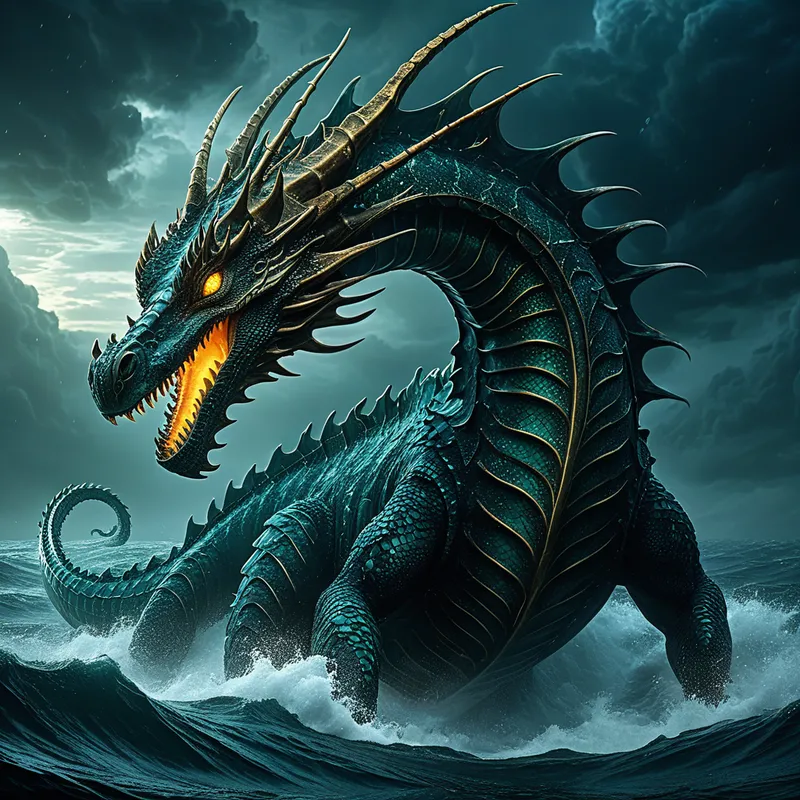
Leviathan Myth Meaning & Symbolism
A primordial chaos dragon of the deep, tamed only by the divine, symbolizing the raw, untamed power of the unconscious and the necessity of integration.
The Tale of Leviathan
In the beginning, before the firmament was named, there was the deep. And the deep was not empty. It teemed with a life too vast for name, a churning, primordial breath. From this womb of unformed potential, from the salt and the dark and the cold pressure of the abyss, it arose. Not born, but being. Leviathan.
Listen. Can you hear the crash of its tail? It is the sound of mountains falling into the sea. Can you feel the heat of its breath? It is the forge that boils the ocean, sending pillars of steam to challenge the clouds. Its back is a range of shields, locked together like the plates of the world, impervious to spear or sword. Its eyes are dawns burning in the deep, and from its nostrils comes a smoke as from a great furnace. When it rises, the waves are made proud. The mightiest warriors see it and despair, for their courage melts away.
It played in the great, formless deep, this king over all the children of pride. It churned the waters into a seething pot, and the very foundations of the world felt its stirring. The chaos was its domain, the untamed, unbounded deep its throne. No net could hold it, no harpoon pierce its hide. It was the incarnate question mark against the order of heaven, a coil of pure, animate potentiality that defied boundary and name.
Then came the Voice that had said, "Let there be light." And the Voice spoke to the chaos of the deep. It did not speak to destroy, but to engage. From the whirlwind, the Voice challenged the beast of the deep, not with a legion of angels, but with a series of profound, unanswerable questions. "Can you draw out Leviathan with a fishhook? Can you put a cord in its nose? Will it make a covenant with you to be taken as your servant forever?"
And in the confrontation, a terrible, awesome game was played. The Voice spoke of binding the dragon, of placing a hook in its jaw, of making its mighty companions tremble. The narrative does not describe a battle of claws and thunder, but a battle of sovereignty. It is the moment the limitless deep meets the defining Word. The resolution is not slaughter, but a drawing of boundaries. Leviathan is not erased; it is contained. It becomes a kept thing, a wonder beside which all earthly power is humbled, a testament to the One who can walk the circumference of the deep and call the dawn to its place. The beast remains, but its chaos is now framed within a greater, divine order. It is left, a permanent, awe-inspiring monument to the tamed fury of creation itself.
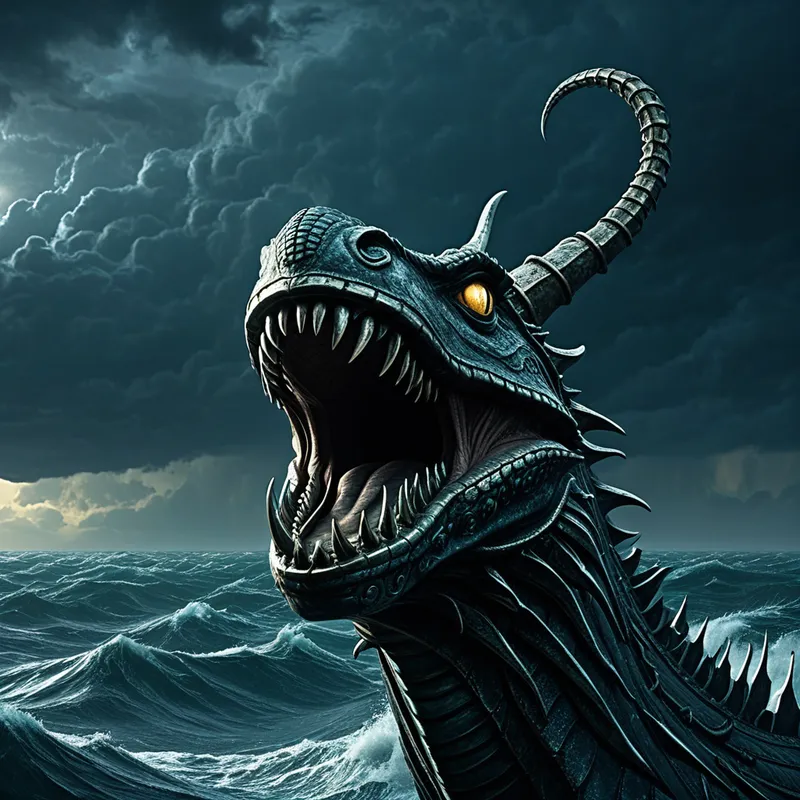
Cultural Origins & Context
The myth of Leviathan is a sedimentary layer in Biblical literature, an older, cosmological story absorbed into the monotheistic framework. Its roots likely tap into ancient Near Eastern chaoskampf (chaos battle) myths, like the Yam or the Tiamat, where a storm god battles and subdues a primordial sea monster to establish cosmic order.
In the Hebrew tradition, this myth was retold and refined. It appears not as a central creation narrative in Genesis, but as a powerful echo in the poetic and wisdom books—Job, Psalms, and Isaiah. It was the province of poets, prophets, and sages, not just priests. In Job, it is the climax of Yahweh's awe-inspiring reply, a rhetorical masterpiece meant to humble human presumption by showcasing a power beyond human comprehension or control. In Psalms, it is the monster crushed at the founding of the world. In Isaiah, it is the twisting, piercing serpent whose future defeat symbolizes ultimate redemption.
Its societal function was multifaceted. It was a theodicy, explaining the existence of terrifying, uncontrollable forces (chaos, evil, suffering) within a world governed by a sovereign God. It was a tool for instilling holy fear and wonder, putting human struggles into a vast, cosmic perspective. Most importantly, it served as a boundary myth: it defined order not by the absence of chaos, but by the divine capacity to encompass and give limits to it.
Symbolic Architecture
Leviathan is the archetypal symbol of the untamed, unconscious psyche in its raw, elemental form. It is not "evil" in a simplistic sense, but the primal, amoral force of being before it is shaped by consciousness, culture, or the differentiating light of the ego.
Leviathan is the psychic totality that exists before the 'I' is formed—the churning sea of instinct, affect, memory, and potential that underpins our conscious life.
It represents the Shadow in its most collective and formidable aspect: the autonomous complexes, the repressed traumas, the volcanic passions, and the creative daimons that operate independently of our will. Its home is the "deep," the Tehom, synonymous with the unconscious itself. Its "pride" is the psyche's natural state of undifferentiated wholeness, which resists being dissected, named, or controlled by the rational mind.
The divine confrontation, then, symbolizes the necessary engagement of consciousness (the ego, or in this transcendent model, the Self) with this unconscious material. The hook in the jaw is not destruction, but the act of relating to and defining a relationship with one's own depths. It is the moment an overwhelming complex is finally made conscious, not to eliminate it, but to integrate its power.
The Dreamer's Resonance
When Leviathan surfaces in modern dreams, it heralds an encounter with a psychic force of monumental proportions. This is not a dream of a simple fear or a personal anxiety; it is a dream of the oceanic.
The dreamer may find themselves on a shore before a suddenly stormy, impossibly vast sea. They may see a dark, immense shape moving just beneath the waves, threatening to breach. They may be on a ship that feels infinitesimally small. The somatic experience is key: a feeling of awe that borders on terror, a profound sense of smallness, the gut-churning sensation of the ground of one's identity becoming unstable.
This dream pattern signals that contents of the collective or personal unconscious of overwhelming size are seeking recognition. It often occurs during life transitions where old structures of the personality are dissolving—a crisis of meaning, a profound loss, or the onset of a creative endeavor that demands tapping into unknown reserves. The psyche is announcing, "There is something here much larger than your daily concerns. You must reckon with it." The process is one of ego-humbling, of preparing the conscious mind to not fight the beast, but to witness its majesty and learn its nature.
Alchemical Translation
The alchemical journey mirrored in the Leviathan myth is the Nigredo, the descent into the black, chaotic waters of the prima materia. For the modern individual, the path to wholeness (individuation) requires not avoiding our personal "chaos monsters," but engaging them in a divine confrontation.
The first step is to acknowledge the "deep" within—to stop projecting our unruly, powerful, and frightening aspects onto the outside world (as enemies, failures, or overwhelming circumstances) and recognize them as endogenous psychic realities. Our Leviathan might be a buried rage, a bottomless grief, a chaotic creative impulse, or a foundational fear of annihilation.
The hook is the question we dare to ask of our own chaos: "What are you? What do you want?" This conscious questioning is the beginning of sovereignty.
The confrontation is internal. We must, like the Voice from the whirlwind, hold our ground and observe the beast without being destroyed by it. This is the act of containment: creating a conscious vessel (through reflection, art, therapy, or active imagination) strong enough to hold the chaotic material without being shattered. We do not slay our deepest nature; we dialogue with it.
The resolution is integration. The bound Leviathan becomes a "wonder," a source of awe and power within the now-larger personality. The raw energy of the unconscious, once a threatening chaos, is harnessed. It becomes the vitality behind our creativity, the depth of our compassion, the resilience in our spirit. We achieve a sovereignty of the Self not by ruling over a sterile kingdom, but by being the consciousness that can encompass the entire roaring, magnificent, and terrifying ecosystem of the soul. The chaos remains, but it is now part of a greater, more meaningful order—the unique and individual cosmos of a life fully lived.
Associated Symbols
Explore related symbols from the CaleaDream lexicon: