Leshy Myth Meaning & Symbolism
The myth of Leshy, the shape-shifting Slavic lord of the forest, embodies the untamed boundary between civilization and the wild, conscious and unconscious.
The Tale of Leshy
Listen, child of the plowed field, and hear the whisper that rides on the wind from the deep woods. This is not a story for the hearth, but for the threshold, for the place where your last furrow ends and the first shadow of the puszcza begins.
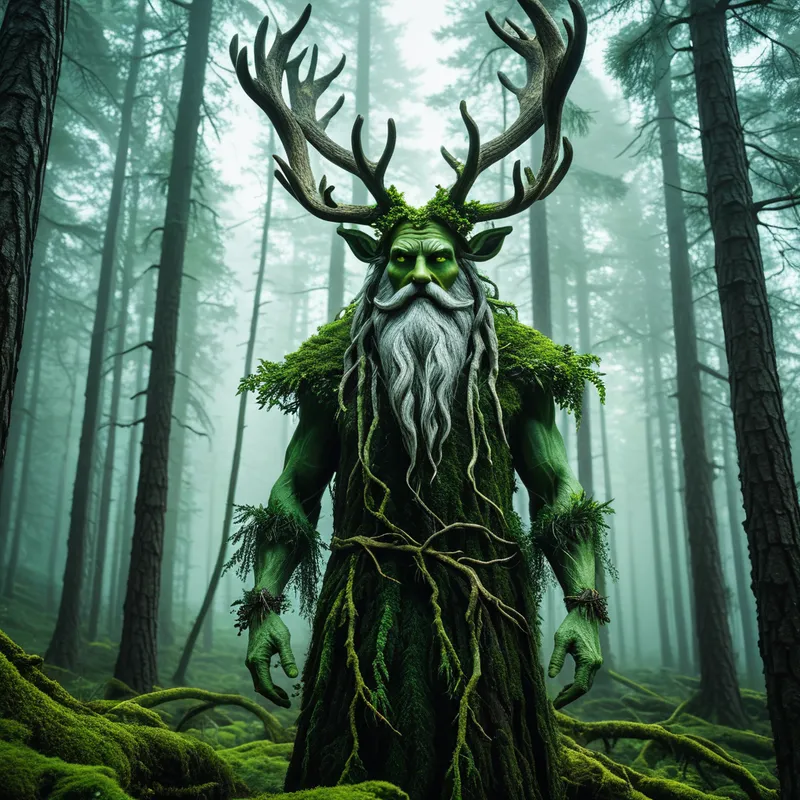
In the time before fences, when the world was a tapestry of village and vast, breathing wild, the forest was a kingdom. And every kingdom has its king. His name was not spoken lightly by the fire, but breathed with a mix of dread and reverence: Leshy. He was the forest, and the forest was him. His hair was the moss that draped the oldest oaks, his beard a tangle of living roots. His eyes, when you could bear to meet them, held the green, depthless gloom of a forest pool at midnight. He stood tall as the tallest pine, yet could shrink to the size of a blade of grass, hiding in plain sight.
He was a master of echoes and illusions. A traveler, bold or foolish, would enter his domain seeking mushrooms or game. The path, clear a moment before, would vanish. Familiar bird calls would twist into mocking laughter. The sun, glimpsed through the canopy, would seem to dance and shift, casting shadows that moved against the wind. The air would grow thick with the scent of damp earth and decaying leaves, a perfume of ancient life and death. The traveler would run, heart hammering against ribs, only to find the same gnarled birch tree for the third time, its bark seeming to form a sly, wooden smile.
But Leshy was not merely a tormentor. He was a guardian, fiercely possessive. He would lead a cruel hunter in circles until he dropped his bow, exhausted and humbled. Yet, to a woodcutter who showed respect—who left an offering of bread or salt at a stump, who never took more than he needed—Leshy might just part the branches to reveal a trove of berries, or gently steer him home with the sound of his own children’s laughter carried on the wind. His voice was the creak of bending boughs, the rustle of a thousand leaves, the sudden, silent fall of snow in a clearing. To be in his realm was to be unmoored from the human world of straight lines and right angles, and plunged into a living, sentient labyrinth where the only law was his wild whim.
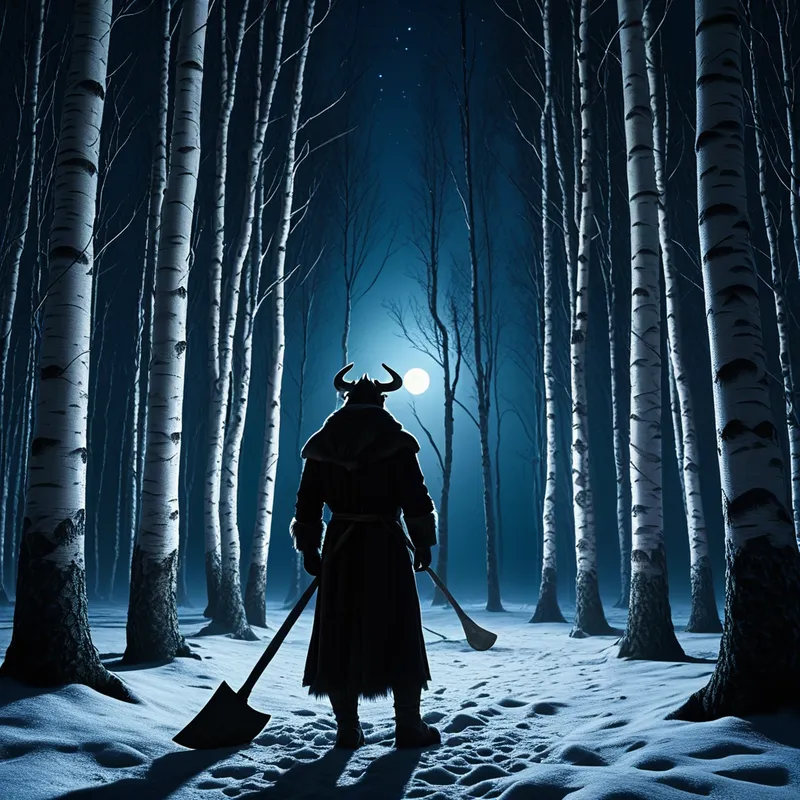
His greatest trick was his form. He could be a gray wolf with eyes too knowing, a brown bear that walked like a man, a gust of wind that seemed to whisper your name. But most often, he appeared as a tall, lean man, dressed in peasant clothes, but with his left shoe on his right foot, his coat buttoned the wrong way, and the shadow he cast pointing in the opposite direction of the sun. He was the world turned inside-out, the logic of the village undone. To encounter him was to have the veil between the ordered world and the chaotic, creative wildness of nature torn asunder. You did not conquer the Leshy. You survived the encounter, and were forever changed, carrying the scent of the deep woods in your soul.
Cultural Origins & Context
The myth of Leshy is not a single, codified tale but a living, breathing presence woven into the daily fabric of pre-Christian Slavic, particularly East Slavic, life. He was a genius loci of the most potent kind—the spirit of the forest as a whole. His stories were not recited in formal epics but shared in cautious whispers by hunters returning at dusk, in warnings mothers gave to children straying too far, in the explanations for lost livestock or strangely bountiful harvests of nuts.
This myth served a crucial societal and ecological function. In a subsistence culture deeply dependent on the forest for food, fuel, shelter, and medicine, the Leshy was the personification of the forest's danger and its generosity. He enforced a code of respect and sustainability. The offerings left for him, the rituals of asking permission to enter (like turning one's clothes inside-out to mimic his disorder), and the taboos against certain behaviors (whistling in the woods, which was said to summon him) were practical conservation ethics in mythological clothing. He was the psychological boundary-keeper, internalizing the very real perils of the wilderness and the need for humility before a power vastly greater than the human village.
Symbolic Architecture
Psychologically, Leshy represents the raw, untamed, and autonomous aspect of the unconscious psyche—what Carl Jung termed the Shadow, but specifically the Shadow in its natural, instinctual, and non-personal form. He is not the shadow of our personal failings, but the shadow of our civilized, domesticated selves.
The Leshy is the psychic embodiment of the boundary itself. He does not reside fully in the wild or the tame, but in the terrifying, fertile liminal space where one becomes the other.
His shape-shifting symbolizes the protean, elusive nature of the unconscious. It defies fixed definition, appearing to us in dreams and moods as various animals, enigmatic strangers, or unsettling distortions of familiar environments (like a path that won't stay straight). His trick of making travelers lose their way is the classic experience of ego-disorientation when confronted with a powerful unconscious content—we lose our conscious bearings, our planned direction.
His reversed clothing and wrong-facing shadow are profound symbols of the enantiodromia—the emergence of the unconscious opposite. He is the principle of contradiction to the ordered, logical, "right-sided" conscious mind. To meet him is to have one's conscious attitude confronted by its inverse.

The Dreamer's Resonance
When the archetype of Leshy stirs in the modern dreamer, it often manifests not as a green giant, but as the experience of his realm. You dream of being hopelessly lost in a vast, unfamiliar forest within a city, or your childhood home has become an overgrown, labyrinthine ruin. The dream-ego is disoriented, the rules of reality are fluid, and a palpable sense of being watched by the environment itself prevails.
This somatic and psychological process is one of confrontation with autonomous psychic energy that feels "wild" and "other." It often arises when one's life has become overly domesticated, predictable, or rigidly controlled—all forest cleared, no shadow tolerated. The Leshy-dream is a summons from the psyche's neglected wilderness. The anxiety it produces is the ego's fear of dissolution, of being swallowed by the untamed complexity it has tried to ignore. The dream is an initiation into a necessary chaos, a call to acknowledge that not all of the psyche can, or should, be cultivated and ordered.

Alchemical Translation
The alchemical journey, or the path of individuation, is not one of permanently moving into the forest, but of learning its laws and making a conscious relationship with its lord. The myth models this psychic transmutation.
The first stage is nigredo, the blackening: the traveler is lost, the ego is humbled and plunged into confusion (the dark woods). This is a necessary death of the old, rigid conscious attitude. The second stage involves the encounter itself—the confrontation with the Leshy. This is the coniunctio, the sacred marriage, but here it is a marriage with the wild Self. It requires not combat, but respect, observation, and the offering of one's conscious attention (the bread and salt).
The triumph is not in slaying the wild god, but in surviving the encounter with humility, thereby earning the right to carry a piece of his wild wisdom back into the world of order.
The resolution, where the respectful traveler is guided home, symbolizes the albedo, the whitening or illumination. The conscious ego, now informed by and in relationship with the wild unconscious, returns renewed. It can navigate the world with a deeper, more instinctual wisdom. The individual is no longer only a citizen of the village but also a respectful visitor to the forest within. They have transmuted the raw, frightening energy of the autonomous psyche into a source of creativity, resilience, and authentic vitality. They have learned that to be whole, one must sometimes dare to get lost, to have one's coat buttoned wrong by the ancient, green hands of the soul's own wilderness.
Associated Symbols
Explore related symbols from the CaleaDream lexicon: