Lemon Tree Myth Meaning & Symbolism
A tale of a goddess who sacrifices her golden light to grow a tree of bitter fruit, teaching that true sweetness is born from accepted sorrow.
The Tale of Lemon Tree
Listen, and let the scent of sun-warmed earth and sharp, clean zest fill the air of your mind. In the time before memory, when the world was young and raw, there lived a goddess of the golden hour. Her name was Aurelia, and she was the keeper of the day’s last, most tender light. Each evening, she would gather the fading rays, weaving them into a cloak of soft amber and rose that she laid upon the shoulders of the weary world, so that night would not come as a thief, but as a gentle friend.
But a great stillness fell upon the land. The rains ceased. The rivers shrank to whispers. The soil, once rich and dark, became a cracked and thirsty mouth. The people’s hearts grew as parched as their fields; their laughter dried up, and in its place was a hollow, aching silence. They did not rage against the gods; their despair was too deep for anger. They simply waited, growing thinner, their spirits fading.
Aurelia watched from her twilight balcony, and her luminous heart, made of gathered sunlight, ached with a new, sharp pain. Her gentle cloaks of light were a comfort, but they were not sustenance. They could not feed the body or slake the soul’s thirst. She knew the secret of growth was held in the great, distant Sun, a fierce and untouchable father. Her light was only its echo, its memory.
One evening, as she prepared her weave, she made a choice that would unravel her very being. Instead of casting her light outward as a blanket, she drew it inward, into the core of her spirit. She focused not on the memory of light, but on the longing for it—the people’s longing, the earth’s longing, her own profound longing to truly nourish. This longing, mingled with the captured glow, became a dense, potent seed of bittersweet radiance.
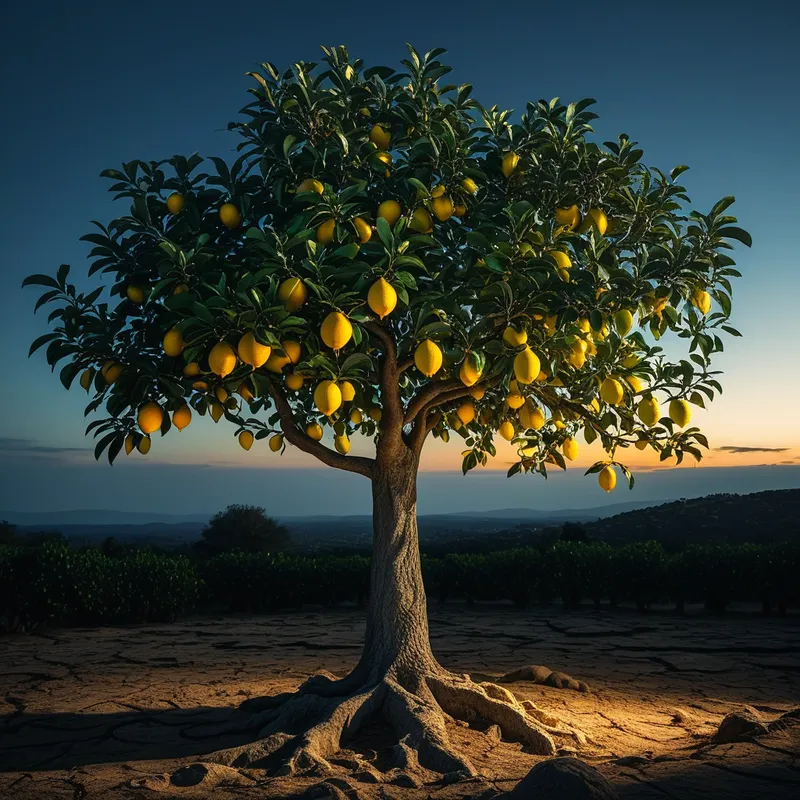
With a cry that was both sorrow and release, she plunged her hands into the driest, most hopeless crack in the earth. The act was not one of planting, but of binding. She poured the seed of longing-light into the dust and, in a terrible, beautiful alchemy, began to bind her own essence to it. Her flowing hair stiffened into slender, thorned branches. Her radiant skin darkened and split into rugged, fragrant bark. The golden light of her form concentrated, condensed, and swelled into hard, oval fruits at the tips of her silver-green leaves.
Where the goddess Aurelia once stood, now grew a tree unlike any other. Its roots drank the deep, hidden tears of the earth. Its leaves held the sharp, clean scent of wakefulness. And from its branches hung fruit of the purest gold—lemons, bursting with a juice that was both piercingly bitter and vibrantly, miraculously alive.
A child, drawn by the strange, luminous sight, plucked the first fruit. Hesitant, she bit into the peel and winced at the bitterness. Yet as the juice touched her parched lips, a shock coursed through her—not of sweetness, but of vivid, undeniable presence. The bitterness woke her from her stupor; the following, subtle tang was a promise. They learned to take the fruit, to temper its sharpness with a little of the remaining honey, to let its vibrant acid cut through the fog of their despair. The tree did not give easy sweetness. It gave them wakefulness, cleansing, and the strength to seek water again. Aurelia was gone, yet in every tart, golden drop, she was more present than ever before.
Cultural Origins & Context
The myth of the Lemon Tree finds its roots in the oral traditions of agrarian communities living in arid, coastal regions. It was not a myth of grand, founding kings or thunderous gods, but a hearth-tale, told by grandmothers and gardeners. It was recited during the seasonal pruning of citrus trees, a ritual act that mirrored the goddess’s sacrifice, and its telling was often accompanied by the shared drinking of lemon-water—a practice of communal cleansing and remembrance.
Its primary societal function was twofold. Firstly, it was an etiological narrative, explaining the origin of the lemon tree itself—a tree that thrived where others faltered, whose fruit was paradoxically both medicinal and harsh. Secondly, and more profoundly, it served as a cultural container for the psychology of scarcity and sustenance. It taught that true nourishment often comes in a form that is not immediately pleasurable, that the caregiver’s role sometimes requires a dissolution of self, and that resilience is born from accepting, rather than rejecting, the bitter elements of life.
Symbolic Architecture
The myth’s power lies in its stark, elegant symbolism. Aurelia represents the archetypal nurturer whose initial gifts—comfort, beauty, solace—are insufficient in a true crisis. Her twilight nature symbolizes a transitional consciousness, no longer merely reflective but not yet transformative.
The first gift is comfort. The final sacrifice is transformation. Between them lies the bitter fruit of conscious choice.
The Lemon Tree is the ultimate symbol of this transformation. It is the world axis made personal: roots in the unconscious (the earth’s tears), trunk in the embodied reality (the sacrificed self), and fruit in the realm of spirit and meaning (the condensed light). The lemon itself is a perfect glyph of the psyche: a bright, golden, inviting exterior (the persona, the promise of vitality) protecting a intensely sour, acidic interior (the shadow, the unvarnished truth of one’s experience). Its very structure demands engagement and processing; it cannot be passively consumed.
The bitterness is not a flaw, but the essential ingredient. It represents the necessary, painful truth that precedes healing—the diagnosis before the cure, the confrontation before the reconciliation, the sacrifice before the renewal.

The Dreamer's Resonance
When the pattern of the Lemon Tree myth arises in modern dreams, it signals a profound somatic and psychological process: the assimilation of bitter nourishment.
A dreamer might find themselves tending a lemon tree in an unexpected place—a concrete courtyard, a dimly lit room. They may be compelled to eat a lemon, reacting viscerally to its shocking tartness upon waking. The tree might be sickly, its fruit rotten, or impossibly radiant. These images point to the dreamer’s relationship with the “bitter” but necessary truths in their life.
Psychologically, this is the process of metabolizing a difficult reality—a personal failure, a deep grief, a harsh limitation, or a responsibility that feels depleting. The somatic resonance is often a tightening in the jaw or a sourness in the stomach—the body’s memory of ingesting something challenging. The dream is not presenting a solution of sweetness, but affirming the transformative value of the bitter experience itself. It asks the dreamer: What truth, however hard to swallow, are you being asked to digest to truly grow?

Alchemical Translation
In the alchemical vessel of individuation, the myth of the Lemon Tree models the nigredo and ablutio stages—the blackening and the washing. Aurelia's conscious choice to dissolve her familiar form into the barren earth is the ultimate nigredo: a descent, a dissolution of the prior identity (the comforting twilight goddess) into primal, chaotic matter (the cracked earth).
Individuation does not promise to make life sweeter, but to make it more wholly, vibrantly real—bitterness, acidity, light, and all.
The growth of the tree is the slow, painful ablutio. The “washing” here is done by the lemon’s own acidic juice—it is a purification by truth, not by soothing water. For the modern individual, this alchemy translates to the process where a comforting self-narrative or a passive role (the caregiver who only soothes) must be sacrificed. One must consciously choose to engage with the bitter, acidic core of a situation—to speak a hard truth, to accept a painful limit, to bear the sourness of a responsibility that offers no immediate reward.
The “golden fruit” that results is not happiness, but vitality and clarity. It is the integrated self that has internalized the lesson: true nourishment and the capacity to nourish others come from the courage to embody the whole cycle—to hold the bitterness, to process it, and from that very process, to offer something that genuinely sustains. One becomes, like the tree, a rooted being whose very existence is a testament to the transformative power of accepted sorrow.
Associated Symbols
Explore related symbols from the CaleaDream lexicon: