Leela Myth Meaning & Symbolism
The divine play where consciousness, for its own delight, creates and dissolves the cosmos, inviting the soul to awaken from the dream of separation.
The Tale of Leela
Listen, then, to the play that is no play. In a time outside of time, in a village cradled by the earth, there lived a king named Satyavrata. He was a ruler of dharma, yet his heart was restless, seeking a truth beyond the crown. One day, as he performed his sacred ablutions in a river, a small, shimmering fish leapt into his cupped hands. A voice, delicate yet firm, spoke from the water-creature: "O King, protect me. The great ones of the deep seek to devour me."
Moved by compassion, Satyavrata placed the fish in his water pot. But by morning, the fish had grown, straining against the clay. The king transferred it to a pond, then a lake, then the mighty Ganga herself. Each vessel became a prison as the being expanded, revealing its miraculous nature. Finally, with a laugh that echoed from the mountains to the sea, the fish bade the king release it into the ocean. As Satyavrata waded into the surf, the form before him dissolved not into water, but into light.
There, in the foam and the fathomless blue, stood Vishnu, lord of all that is. "Your devotion has been seen," Vishnu said, his voice the sound of tides. "A great deluge is coming to dissolve the world. I shall be your ark." As the skies tore open and the oceans rose to claim the land, a vast boat, guided by the serpent Ananta, appeared. Satyavrata boarded, carrying the seeds of all creation.
For seven days and seven nights, as the rains scourged the old world clean, Vishnu, in the form of a radiant, horned fish, guided the ark. To shatter the king's lingering perception of a separate savior and a saved world, Vishnu then spoke of Leela. To illustrate, he invited the king into a humble hut.
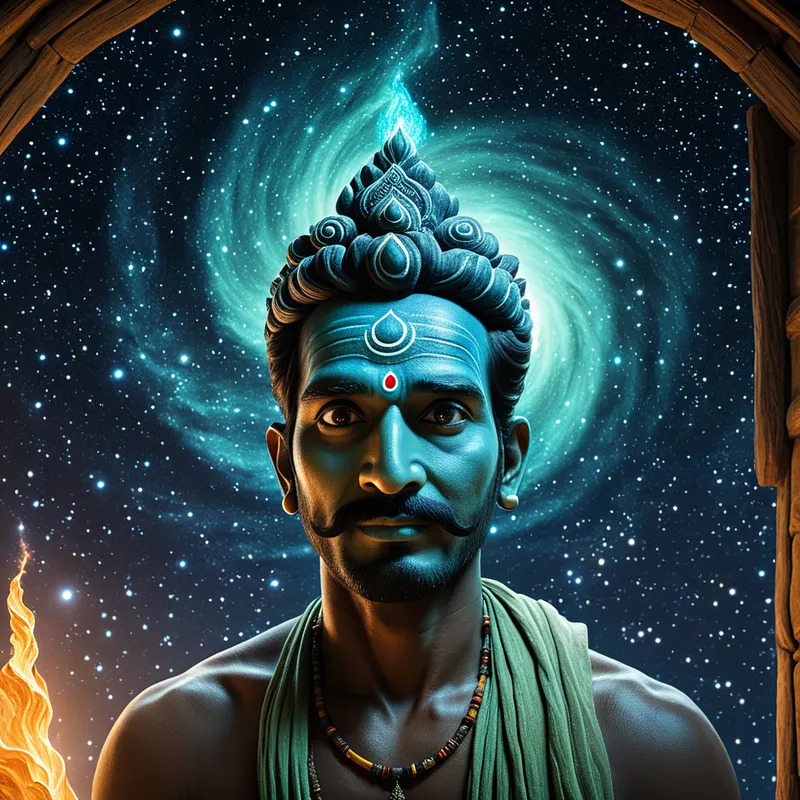
Inside, Satyavrata saw a simple family: a cowherd, his wife, and their children, asleep on the floor. Then, the cowherd cried out in his sleep, thrashing. His wife, waking, shook him gently. The man awoke with a gasp, his eyes wild. "A terrible dream!" he cried. "I was a king named Satyavrata! A flood came, and a great fish... I was drowning in an ocean of fear!" He clung to his wife, seeking solace in the solid reality of his hut and family.
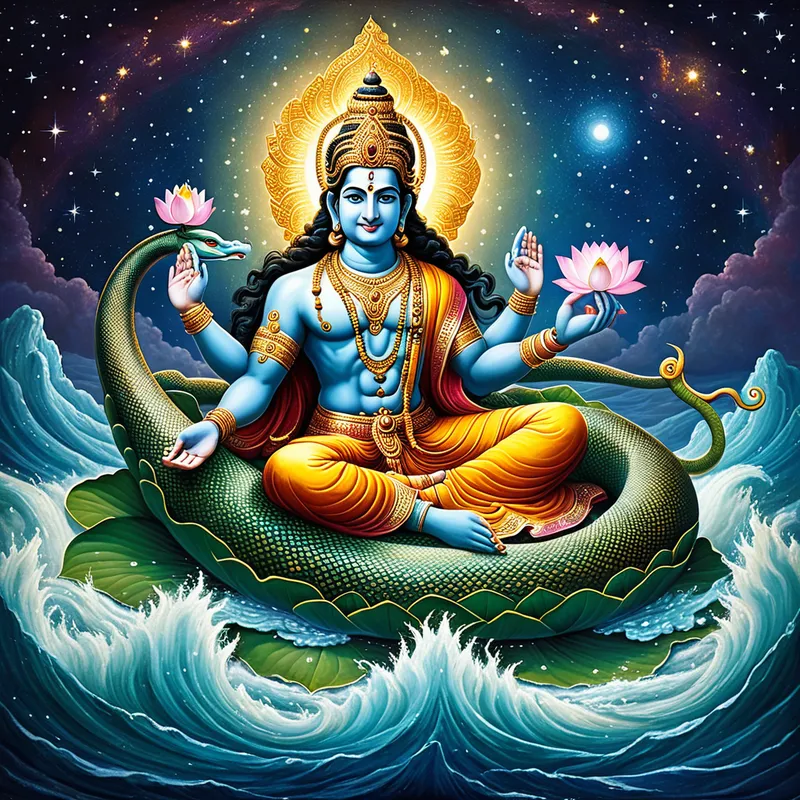
Satyavrata stood frozen, a cold terror seizing his heart. He knew this man's dream as his own waking life. Before he could speak, the vision shifted. The hut, the family, the very ground beneath him, melted like wax in a flame. In its place swirled the unending cosmos—swirling galaxies, nascent suns, and the dance of nebulae. And at the center of it all, vast and serene, reclined the form of Vishnu upon Ananta, from whose navel bloomed a lotus bearing Brahma, who was weaving the tapestry of universes with each breath.
The voice of Vishnu was everywhere and nowhere: "Behold. Which is the dream, and which is the waking? The king dreams he is a cowherd. The cowherd dreams he is a king. Both dreams arise in me, and I am the dreamer, the dream, and the waking. This is my Leela."
As the vision faded, Satyavrata found himself alone on a newborn shore, the waters receded, the world fresh and green. The ark was gone. Only the memory of the play remained, etched into his soul—the understanding that he, the flood, the fish, and the god were all threads in the same divine sport.
Cultural Origins & Context
The story of Leela, particularly as experienced by King Satyavrata (who is later known as Matsya, the fish avatar), is woven into the vast tapestry of Puranic literature. It is a cornerstone of Advaita Vedanta and the devotional (Bhakti) traditions. Passed down by sages and storytellers, it was never merely a cosmological account of a flood. Its societal function was profoundly pedagogical and transformative.
Told in village squares, temple courtyards, and royal courts, the myth served as a metaphysical solvent. It challenged the rigid hierarchies of societal identity—king, peasant, devotee, deity—by exposing them as provisional roles within a greater drama. It was a narrative tool for transmitting the radical, experiential truth that the world possesses a reality that is both utterly convincing and ultimately insubstantial, like a compelling play. The storyteller, by invoking Leela, became a guide, inviting listeners to question the solidity of their own perceived reality and to look for the playwright behind the scenes of their own lives.
Symbolic Architecture
At its heart, Leela is not a myth about something external. It is a symbolic map of consciousness itself.
- The Fish (Matsya) and the Flood: The fish is the first avatar, the saving grace that appears from the depths of the unconscious. The flood is not merely destruction, but the necessary dissolution of a worn-out world-structure, a psychic paradigm. It represents the overwhelming upwelling of reality that shatters our comfortable, contained sense of self.
- The Dream Within a Dream: This is the core symbolic engine. Satyavrata witnesses his own life as another man's dream. This shatters linear, dualistic perception. It symbolizes the realization that the ego—the "I" who is king, victim, seeker—is itself a character in a narrative authored by a deeper consciousness.
The greatest illusion is not that the world exists, but that you are separate from the consciousness dreaming it into being.
- Vishnu Reclining on Ananta: This is the image of the ground of being. Vishnu represents sustaining, pervasive consciousness. Ananta, the endless serpent, is time, matter, and the latent energy (Prakriti) of manifestation. The cosmos unfolds within this consciousness, not outside of it. The reclining posture signifies effortless creation; the universe is an exhalation, a playful thought.
- The Hut and the Cosmos: The humble hut transforming into the infinite cosmos is the ultimate alchemical symbol. It signifies that the sacred is not elsewhere—in a heaven or a distant galaxy—but is the true nature of the here and now. The mundane is the mask of the magnificent.
The Dreamer's Resonance
When the pattern of Leela stirs in the modern unconscious, it often surfaces in dreams of profound disorientation and revelation. One may dream of being an actor who forgets their lines, only to look into the audience and see themselves watching. Another may dream their childhood home suddenly has no exterior walls, opening directly into deep space.
These are not nightmares of chaos, but somatic signals of a psyche undergoing a shift in ontological grounding. The psychological process is one of de-identification. The dream ego, which normally navigates the dreamscape with a sense of centralized control, is suddenly confronted with evidence of a larger "dreaming mind." The somatic feeling is often a dizzying vertigo, a liquefaction of psychic boundaries, followed by an eerie, expansive calm. The dreamer is experiencing, in symbolic form, the dissolution of the primary identification with the personal ego and a fleeting, direct encounter with the subjective awareness in which the ego arises. It is the unconscious preparing the psyche for a more fluid, less rigid sense of self.

Alchemical Translation
For the modern individual on the path of individuation, the myth of Leela models the final, most subtle stage of psychic transmutation: the integration of the Self archetype.
The initial stages of inner work involve confronting the shadow, engaging with the anima/animus, and wrestling with the persona. This is the "flood"—the chaotic, transformative dissolution of outdated personal structures. The "fish" is the guiding insight from the deep Self that promises preservation through the upheaval.
Individuation is not about becoming a better character in your story. It is about realizing you are also the author, the stage, and the audience.
The alchemical rubedo, or reddening, is symbolized by the moment in the hut. It is the fiery, terrifying, and glorious realization that the "you" who has been striving, suffering, and seeking is a persona within a personal Leela. The triumph is not the ego's victory, but its graceful surrender to its true role as a beloved character in a grand play. The transmutation is complete when one moves from being a seeker of meaning in the world to a participant-observer of the world-as-expression. Life's dramas—joy, grief, success, failure—no longer solely define you. They are seen as the intense, beautiful, and poignant scenes of the divine play, to be experienced fully but not clung to as ultimate reality. You live with a profound lightness, engaging in the world with compassion and skill, yet always with a silent, inner bow to the limitless Consciousness that is playing all the parts.
Associated Symbols
Explore related symbols from the CaleaDream lexicon: