Leda and the Swan Myth Meaning & Symbolism
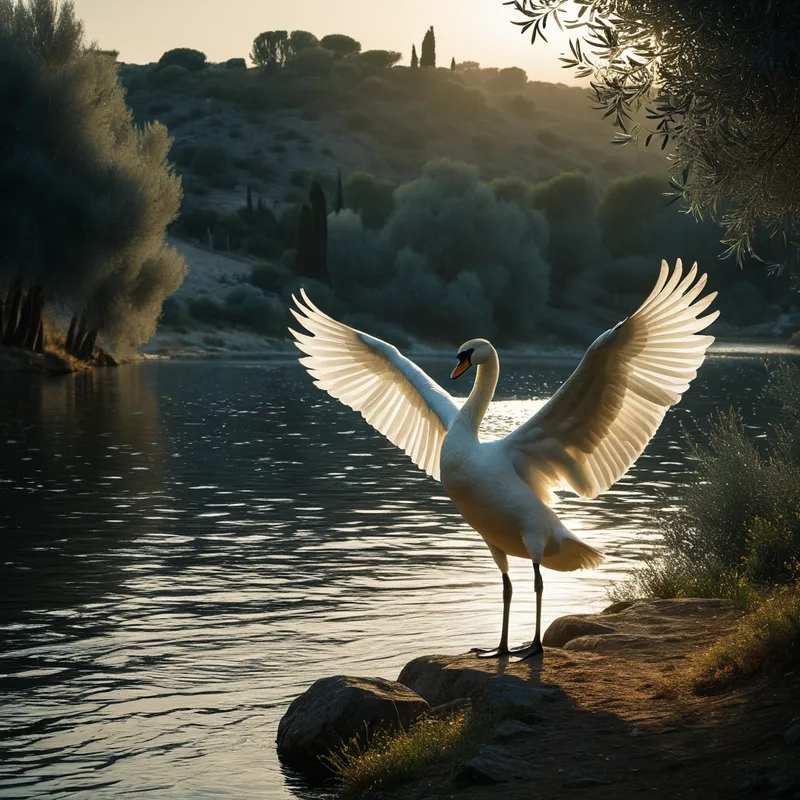
Zeus, as a swan, visits Queen Leda, resulting in the conception of Helen of Troy and the Dioscuri, a union of mortal and divine that shaped destiny.
The Tale of Leda and the Swan
Let the tale be told not as a dry record, but as it was whispered by the river reeds and sung by the night wind. It begins in the soft, violet hour when day bleeds into night, on the banks of the Eurotas. There walked Leda, Queen of Sparta, her heart a quiet pool amidst the clamor of court. The air was heavy with the scent of oleander and damp earth, and the first stars were pricks of silver in the deepening blue.
She sought solitude, a moment to feel the cool mud between her toes, to be a woman and not a queen. The water murmured secrets she could almost understand. Then, a disturbance—a great beating of wings that was not of this world. It was a sound like the tearing of silk, like the rush of a sudden storm descending to earth.
From the darkening sky it came: a swan. But no ordinary bird. This creature was a sculpture of moonlight and power, its neck a proud curve, its wings vast enough to blot out the last of the sun. It moved with a terrible, beautiful purpose, driven not by animal instinct, but by a will as old as the mountains. It was Zeus, the Cloud-Gatherer, his divine fire cloaked in down and feather. He had seen Leda’s mortal grace, a calm beauty that called to his eternal restlessness, and he desired her.
Leda froze, caught between flight and fascination. The great bird did not attack, but approached with an unnerving gentleness, its black eyes holding galaxies of intent. It nestled against her, a shocking warmth radiating from its form. In that touch was the weight of the sky and the inevitability of thunder. Was it a violation or a visitation? A predation or a profound, terrifying grace? The myth holds the question in its heart, refusing to answer. She yielded, or was overcome; the story sings both truths at once.
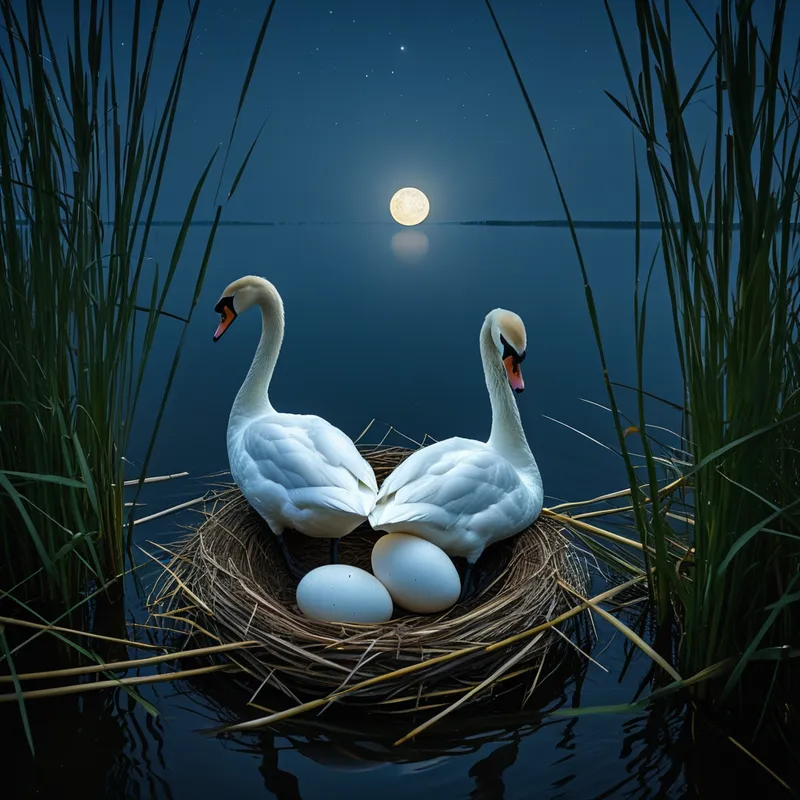
In the stillness that followed, the swan—its purpose fulfilled—unfurled those impossible wings and vanished into the star-flecked night, leaving Leda alone by the whispering river, her world forever altered. From this union, she would later lay eggs—a testament to the surreal nature of the encounter. From these shells emerged children of two fathers: the mortal King Tyndareus and the immortal Zeus. There was Helen, whose face would launch a thousand ships and burn the towers of Ilium. And there were the Dioscuri, the twin stars, one mortal, one divine, bound together in life and placed in the heavens in death. The cosmic had touched the earthly, and the fate of nations was set in motion by the river’s edge.
Cultural Origins & Context
The myth of Leda is not a single, canonical text, but a haunting refrain woven through the tapestry of Greek storytelling. Its earliest surviving threads are found in fragmentary verses from the Homeric cycle and the cryptic allusions of lyric poets like Sappho. It was a story told in the symposium and the theater, a narrative that explored the porous, dangerous, and fertile border between the human and the divine.
In the Greek worldview, the gods were not distant abstractions but imminent forces, capable of erupting into human life with catastrophic and creative consequences. The Leda myth served as an aetiology, a "cause-story," for the origins of the Trojan War. It answered the profound question: how could a single woman’s beauty cause such cataclysmic strife? The answer lay in her divine paternity. Helen was not merely a beautiful mortal; she was a daughter of Zeus, a semi-divine object of desire, her very existence a spark thrown into the tinder of human ambition.
The myth also functioned as a meditation on fate and agency. Leda is often portrayed as a passive vessel for divine will, a theme that reflected Greek anxieties about the limited power of mortals in the face of Moira. Yet, in some artistic and poetic interpretations, a complexity lingers—a hint of awe, of a transformative encounter that, while overwhelming, bridges worlds. The story was a tool for grappling with the experience of forces beyond human control, whether the caprice of the gods, the surge of destiny, or the overwhelming power of eros itself.
Symbolic Architecture
Beneath the narrative of divine seduction lies a profound symbolic architecture. The swan is no mere disguise; it is a perfect vessel for the paradox at the myth’s core. The swan symbolizes transformation, beauty, and an otherworldly grace, but also potent sexuality and a fierce, territorial power. It glides on the surface of the water—the unconscious—yet can strike with sudden force. Zeus as swan represents the divine logos (order, word) taking on the form of primal eros (life force, desire), a union of opposites that initiates creation.
The divine does not always arrive with a clap of thunder; sometimes it comes on silent wings, a beautiful, terrifying pressure that cracks the shell of the known self.
Leda represents the human soul or psyche in its receptive state. She is the vessel of consciousness approached by the overwhelming contents of the unconscious (the god/animal). The riverbank is the liminal space, the threshold where these two realms meet. The egg is the ultimate symbol of this encounter: a sealed universe of potential, containing both the glorious and the catastrophic (Helen, the bringer of war, and the Dioscuri, the savior brothers). It signifies the nascent, unintegrated psychic content born from a confrontation with the numinous.
The children themselves are the differentiated outcomes. Helen is the anima in its most potent and destructive form, the soul-image that drives men to madness and greatness. The Dioscuri, one mortal, one immortal, represent the dual nature of the self—the earthly personality and the eternal, divine spark—and the yearning for integration, symbolized by their shared constellation.
The Dreamer's Resonance
When this myth pattern stirs in the modern dreamer, it rarely appears as a literal retelling. Instead, one might dream of a beautiful but intimidating animal entering one’s personal space, of a sudden, awe-inspiring natural event, or of an intimate encounter with a figure that is both familiar and utterly alien. There is a somatic signature here: a feeling of being simultaneously captivated and overwhelmed, of profound warmth mixed with a tremor of fear.
Psychologically, this signals an encounter with an autonomous content of the unconscious—what Carl Jung would call an archetype constellating with immense energy. It is the psyche announcing a necessary, often disruptive, visitation. The dreamer may be on the cusp of a major life transition, a creative awakening, or a confrontation with a deep, instinctual force (sexual, spiritual, or ambitious) that cannot be ignored. The "Leda moment" in a dream is the ego being approached by something much larger than itself, a process that feels both like a violation of one’s former boundaries and an invitation to a greater, if more dangerous, state of being.
Alchemical Translation
The alchemical journey mirrored in this myth is not for the faint of heart. It is the nigredo, the blackening, where the pristine, ordered ego-world is dissolved by contact with the primal, divine mystery. Leda’s quiet life by the river is the prima materia. The swan’s visitation is the infusion of the anima mundi, the world soul, which shatters her previous identity.
Individuation begins not with a quest we choose, but with an encounter that chooses us. The swan finds Leda; the unconscious elects the conscious for transformation.
The struggle is the assimilation of this experience. The ego must not simply be obliterated nor reject the encounter as mere trauma. The alchemical work is to brood over the "egg"—the new, raw psychic potential—with the heat of conscious reflection. To integrate the visitation is to give birth to one’s own "divine children": the creative works, the deep insights, the courageous actions (the Dioscuri) that can emerge from such a union. It also means accepting the "Helen" within—the devastating beauty, the capacity for chaos and desire that can overturn one’s life. The goal is not to avoid the catastrophic but to contain it within a larger, more resilient psyche, to become a vessel capable of holding both the human and the divine, the destructive and the creative, in a tense, sacred union. From the collision of swan and queen, a new constellation of the self is born in the inner heavens.
Associated Symbols
Explore related symbols from the CaleaDream lexicon: