Lazarus Myth Meaning & Symbolism
A man dead for four days is called back to life, embodying the ultimate human confrontation with mortality and the psyche's capacity for radical renewal.
The Tale of Lazarus
In the village of Bethany, where the dust tastes of olive leaves and sorrow, there lived a man named Lazarus. He was a friend to the wandering teacher, a brother to two sisters whose love for him was as deep as the well from which they drew water. But a shadow fell upon their house—a sickness that coiled in the lungs and stilled the breath. The sisters, Mary and Martha, sent word to their friend, the one who spoke of a kingdom not of this earth: “Lord, the one you love is sick.”
But the teacher did not come. He spoke of a sickness that would not end in death, but in glory for the Son of God. And so they waited, their hope a fragile vessel emptying day by day. The fever burned, the breath rattled, and then ceased. Lazarus lay still. The wails of the women pierced the quiet of Bethany. They washed his body with spices and tears, wrapped him in linen from head to foot, and carried him to the tomb—a cave sealed with a heavy, cold stone. For four days, the stone held its vigil. The scent of myrrh and decay mingled in the dark. The sisters’ grief was a country with no borders.
Then, a murmur on the road. He was coming. Martha ran to meet him, her accusation tempered by a flicker of desperate faith: “Lord, if you had been here, my brother would not have died.” Mary came after, falling at his feet, her tears watering the dust. When he saw her weeping, and the Jews with her weeping, a profound disturbance stirred within him. He was deeply moved in spirit and troubled. “Where have you laid him?” he asked.
“Come and see, Lord.”
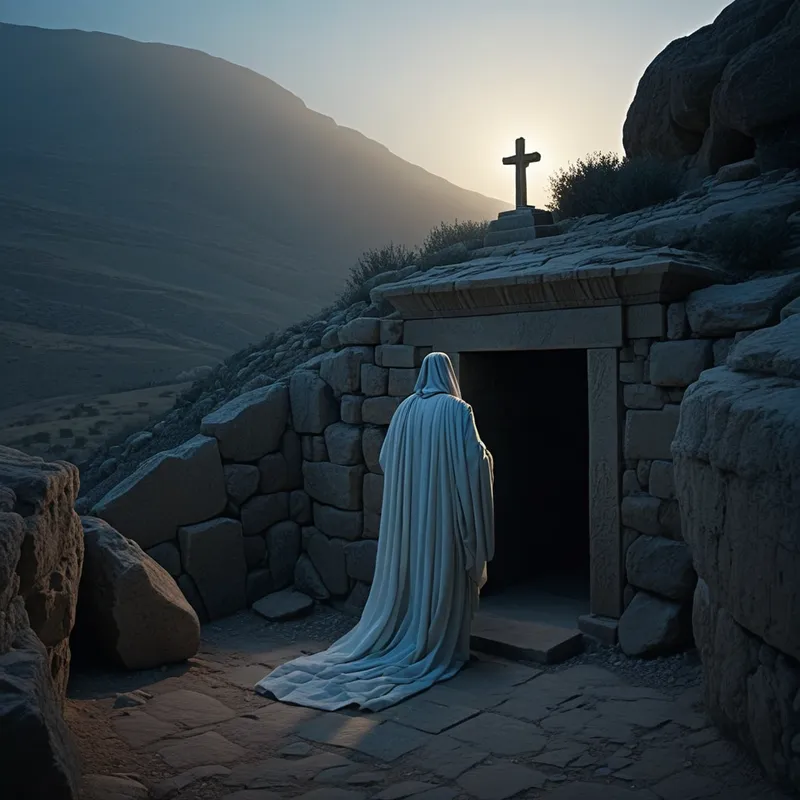
They led him to the place of the dead. The stone, grey and implacable, blocked the mouth of the cave. “Take away the stone,” he commanded. Martha, practical even in despair, whispered of the stench, for it had been four days. He looked at her, and his voice was the sound of foundations being laid: “Did I not tell you that if you believe, you will see the glory of God?”
The stone groaned as it was rolled aside. The dark mouth of the tomb yawned open, releasing a breath of spices and mortality. He lifted his eyes and spoke not to the crowd, but to the silence that listens behind all things: “Father, I thank you that you have heard me. I knew that you always hear me, but I said this for the benefit of the people standing here, that they may believe that you sent me.”
Then, a voice that was not sound but the shaping of reality itself, a cry that split the veil between worlds: “Lazarus, come out!”
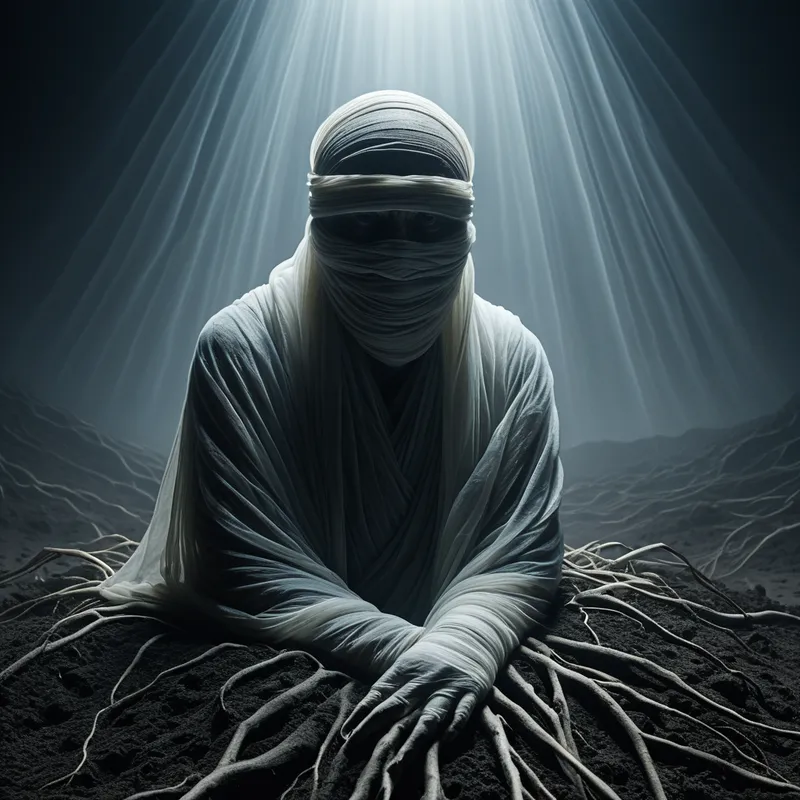
A hush swallowed the world. The birds stopped their songs. The wind held its breath. And in the profound silence of the tomb, there was a stirring. A rustle of linen. The shuffle of feet bound by cloth. And into the harsh daylight stumbled a figure, wrapped head to foot in grave clothes, a man walking backwards out of death’s own house. “Take off the grave clothes,” the teacher said, “and let him go.”
And Lazarus stood, blinking in the sun, returned.
Cultural Origins & Context
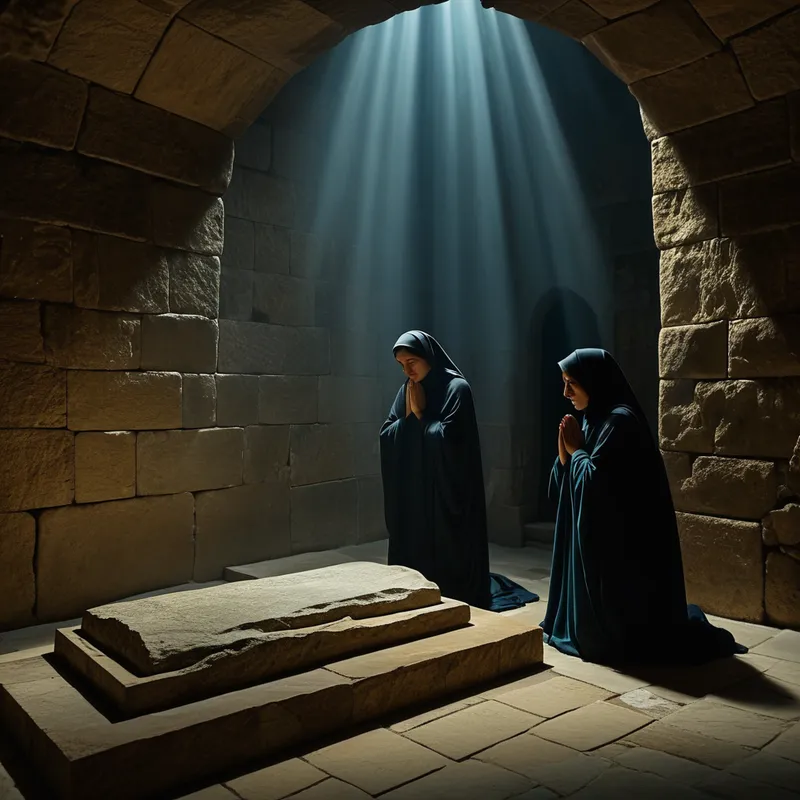
The story of Lazarus is found exclusively in the Gospel of John, a text composed towards the end of the first century CE. Unlike the synoptic gospels (Matthew, Mark, and Luke), John’s narrative is deeply theological and symbolic, structured around seven “signs” that point to the identity of Jesus. The raising of Lazarus is the seventh and greatest of these signs, a climactic miracle that serves as the direct catalyst for the authorities’ decision to execute Jesus. It is not merely a story of compassion but a provocative, public declaration of power over the final enemy—death itself.
In the early Christian communities facing persecution and martyrdom, this story functioned as a profound anchor for faith. It was a narrative weapon against despair, asserting that the God of their teacher was Lord even of the grave. The detail of the four-day interval is critical; a common Jewish belief held that the soul lingered near the body for three days before departing. By the fourth day, decay was undeniable, and hope was extinguished. The miracle, therefore, is framed as an absolute victory, a reclaiming of what was utterly and irrevocably lost. It was told in clandestine gatherings, whispered as a comfort to the grieving, and proclaimed as proof of the resurrection hope that lay at the heart of the nascent Christian movement.
Symbolic Architecture
On the surface, Lazarus is the object of the miracle, the one acted upon. But symbolically, he is every human soul. His journey is the universal human drama of entombment and release.
His sickness represents not just physical ailment, but any state of spiritual or psychological death—depression, addiction, the crushing weight of trauma, or the slow death of a life lived without meaning. The tomb is the sealed chamber of the ego, the hardened persona, the defensive structure we build that eventually becomes our prison. The grave clothes are the binding identities, the old stories, the traumas and limitations we have internalized and wrapped ourselves in, until we mistake them for our own skin.
The call from beyond the tomb is not an invitation to a better version of your current life; it is a command to leave the life you have altogether.
The four days signify the point of no return in a psychological process. It is the moment when the old way of being is not just sick, but conclusively dead. All self-deception is gone; the “stench” of the reality is apparent. This is the dark night of the soul, where hope itself seems to decay. It is only from this place of absolute conclusion that an authentic resurrection—a rebirth of the self, not a resuscitation of the old pattern—can occur. Jesus’s tears are often noted; they signify the divine participation in human suffering, the necessary honoring of the grief that must accompany any true death before a new life can be born.

The Dreamer's Resonance
When the Lazarus pattern stirs in the modern psyche, it often manifests in dreams of profound enclosure and subsequent emergence. You may dream of being trapped in a basement, a coffin, a cocoon of webs, or a room with no door. The somatic feeling is one of suffocation and paralysis, a deep, visceral anxiety of confinement. This is the psyche signaling that some essential part of you has reached a dead end, has been entombed by circumstance, choice, or unconscious habit.
Conversely, or as a resolution, you may dream of breaking out of such a space—crawling from a wreck, tearing through a membrane, or having stone roll away from a cave mouth. These dreams are often accompanied by a mix of terror and exhilaration upon waking. The psychological process at work is the Self (the total, integrating center of the psyche) confronting the complex or the defensive structure that has “killed” your vitality. The dream is the call of the Self: “Come out!” It is an imperative from your own depths to shed the persona that has become a shroud and to walk, however stumblingly, back into the light of conscious life.
Alchemical Translation
The alchemical process mirrored in the Lazarus myth is nigredo, followed by albedo. The nigredo is the blackening, the decay in the tomb. Psychologically, this is the indispensable stage of confronting the shadow, of allowing the cherished self-image to die, of sitting in the despair and futility until it is fully cooked. One must, as it were, “stay dead” for the necessary four days. There are no shortcuts. Any attempt to bypass this putrefaction results only in a spiritual bypass, a painted corpse.
The voice that calls one forth is the voice of the integrated Self, the Self archetype, which has been at work in the darkness. The emergence is the albedo, the whitening. But note: Lazarus emerges still bound. The miracle of revival is divine, but the unwinding is human. “Unbind him, and let him go.” This is the work of individuation—the slow, patient, often communal process of shedding the old bindings. Friends, family, therapy, ritual, art—these are the hands that help remove the grave clothes of the former life.
Resurrection is not a return to the old house in Bethany; it is the beginning of a life lived on entirely new terms, with the smell of the tomb still on your skin and the memory of the dark forever in your eyes.
To integrate the Lazarus myth is to accept that profound renewal requires a prior, total ending. It is to recognize that the most lifeless, hopeless, and foul-seeming place within you—the very tomb of your spirit—is the precise location where the call to your most authentic life will finally echo, and where you will, against all reason, learn to walk again.
Associated Symbols
Explore related symbols from the CaleaDream lexicon: