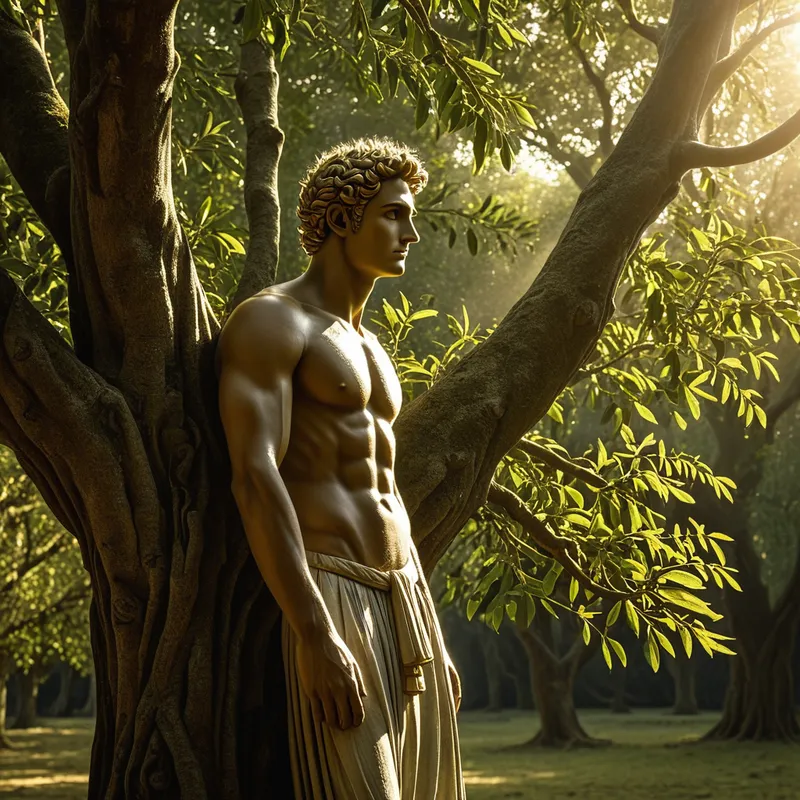
Laurel Wreath of Apollo Myth Meaning & Symbolism
A god's love becomes a nymph's terror, transforming her into the laurel tree. From this tragedy, Apollo crafts a crown of eternal, bittersweet victory.
The Tale of Laurel Wreath of Apollo
Hear now the tale spun from golden light and desperate flight, a story of love that scorched and a love that sought only to vanish into the earth.
The sun was high, a chariot driven by the radiant Apollo. His mood was bright, his heart still singing with the pride of a recent victory over the serpent Python. But pride, as the Fates weave, often draws the thread of folly. He spied Eros, the youthful archer, stringing his bow. Apollo, in his gleaming arrogance, laughed. “What have you, little boy, to do with warlike weapons? Leave them to those who can wield true power, like mine.”
A dangerous smile touched Eros’s lips. “Your arrows may strike true, Phoebus Apollo, but mine strike the heart.” From his quiver, he drew two arrows of opposing power. One was sharp and tipped with gold, destined to ignite consuming passion. The other was blunt and tipped with lead, forged to inspire utter aversion. He drew his bow. The golden dart flew swift and sure, piercing Apollo’s divine heart. A fire, sudden and all-consuming, bloomed within his chest. At that same moment, the leaden dart found its mark in the heart of a nymph who dwelt in the river’s cool embrace—Daphne.
Daphne was a child of the wild, a devotee of Artemis. She loved the forest’s deep shadows, the chase, the freedom of untouched groves. The touch of the leaden arrow sealed her fate: she would flee from love, from marriage, from the very touch of men and gods.
Then Apollo saw her. She was moving through a sun-dappled clearing, her hair a dark cascade, her limbs swift as a deer’s. The god’s new-fired heart seized. He called out, but his voice, usually so sweet with music, now carried the heat of his obsession. Daphne heard only danger. She fled, a streak of fear through the greenwood.
The chase was terribly unequal. Apollo, fueled by divine power and desperate love, gained with every stride. Daphne felt his breath on her neck, saw his shadow overtaking her own. The banks of her father’s river, the Peneus, were near. In a voice choked with terror and exhaustion, she cried out to the one who gave her life: “Father, help me! If your waters hold power, destroy this beauty that has pleased too well!”
No sooner were the words uttered than a heavy numbness seized her limbs. Her racing feet rooted to the earth, digging deep. Her soft skin hardened into rough bark. Her flowing hair transformed into a canopy of shimmering, dark-green leaves. Her arms stretched upward, becoming graceful branches. The nymph Daphne was gone. In her place stood a new, beautiful laurel tree, its leaves trembling in the breeze.
Apollo skidded to a halt, his hands reaching out to embrace only unyielding wood. The fire in his heart did not extinguish; it transmuted. He felt the tree’s living spirit within the bark. Wrapping his arms around the slender trunk, he whispered, “If you cannot be my bride, you will at least be my tree. Your leaves will crown the heads of heroes, poets, and victors. You will be evergreen, a symbol of eternal fame, and you will forever be mine.”
With a god’s tenderness, he broke a branch and wove the first crown. The leaves, touched by the sun, seemed to gleam with a captured, sorrowful light. And so the laurel wreath was born, not from celebration, but from a love that could only be held in memory and symbol.

Cultural Origins & Context
This poignant myth finds its most famous telling in the Roman poet Ovid’s Metamorphoses, a vast tapestry of stories about transformation. However, its roots are deeply Greek, belonging to the rich oral tradition of aetiological myths—stories explaining the origin of things. The laurel wreath, or kotinos, was a tangible, sacred object in Greek life. It crowned the victors of the Pythian Games at Delphi, Apollo’s primary sanctuary. It adorned the brows of triumphant generals in Roman triumphs and, most significantly, became the emblem of the poet, the one inspired by Apollo, god of music and verse.
The myth was not merely an explanation for a plant’s significance. It was a narrative tool that explored profound cultural tensions: the conflict between untamed nature (Daphne, Artemis) and civilized order (Apollo, poetry, victory); the dangerous power of uncontrolled desire (eros); and the tragic cost of immortality when it is not chosen but forced. Bards and poets would recite this tale, linking the physical wreath placed on a champion’s head to this deep, divine, and tragic history, infusing the symbol with layers of meaning far beyond simple victory.
Symbolic Architecture
At its core, the myth is a profound allegory of consciousness confronting its own unconscious shadow. Apollo represents the radiant, ordering principle of the psyche—the light of reason, culture, and conscious striving. Daphne embodies the anima, the soul-image, in its most pristine, autonomous, and untamed form. She is the instinctual life, the connection to nature that flees from the possessive grasp of a consciousness that seeks to name, claim, and control it.
The pursuit is the ego’s attempt to assimilate the soul, but the soul’s deepest wisdom is sometimes to become unreachable, to root itself in a deeper reality.
The transformation into the laurel tree is not a defeat, but a profound act of self-preservation. Daphne chooses a form of being that protects her essence. She becomes a symbol—enduring, sacred, and communicative, but forever beyond literal possession. The laurel wreath, then, is the ultimate symbol of this bittersweet resolution. It is the conscious mind (Apollo) learning to honor, rather than consume, the unconscious (Daphne). Victory, poetry, and prophecy—all Apollo’s domains—are now forever dependent on this respectful relationship with what has been lost and transformed.

The Dreamer's Resonance
When this myth stirs in the modern dreamer, it often signals a critical moment of psychic reorientation. To dream of a desperate chase may reflect a conscious attitude (the Apollo complex of achievement, perfection, or idealized love) relentlessly pursuing an aspect of the self that feels wild, free, and threatened by that very pursuit—perhaps one’s creativity, autonomy, or simple peace.
Dreams of turning into a tree, feeling roots grow from one’s body, or being embraced by bark speak to a somatic process of grounding. It is the psyche’s instinct to “become the laurel” when faced with overwhelming pressure: to retreat into a deeper, more rooted, and less personal state of being. This is not regression, but a necessary metamorphosis. The dreamer may be in a situation where their true nature feels so besieged by external demands or internal obsessions that the only healthy response is a fundamental change in form—setting a firm boundary, changing a life pattern, or internalizing a value so deeply it becomes part of one’s structure.

Alchemical Translation
The alchemical journey modeled here is the transmutation of possession into veneration, of literal desire into symbolic meaning. Apollo begins with the prima materia of raw, inflaming desire (the golden arrow) aimed at an object (Daphne). Through the painful process of the chase and the shock of transformation, that object is lost. This is the nigredo, the blackening, the moment of despair and putrefaction where the old form of the desire dies.
But the work does not end in loss. Apollo does not abandon the tree. He learns its language. He touches its bark, hears the wind in its leaves. This is the albedo, the whitening, the stage of illumination. He sees the essence within the new form. Finally, in fashioning the wreath, he performs the rubedo, the reddening, the creation of the sacred stone. The raw, painful emotion is distilled into a lasting, meaningful symbol.
The laurel wreath is the philosopher’s stone of this myth: the concrete symbol born from the ashes of literal fulfillment, representing the crowning achievement of a consciousness that has learned to love what it cannot own.
For the individual, this is the path of individuation. We all have our “Daphne”—a dream, a feeling, a state of innocence that our ambitious, solar consciousness wants to capture and make its own. The myth teaches that true victory lies not in the capture, but in honoring the transformation that occurs when we approach with respect. Our creative works, our hard-won wisdom, our personal triumphs are the laurel wreaths we weave—evergreen reminders that our greatest achievements are born from a sacred, and often sorrowful, dialogue with the parts of ourselves that forever elude our grasp.
Associated Symbols
Explore related symbols from the CaleaDream lexicon: