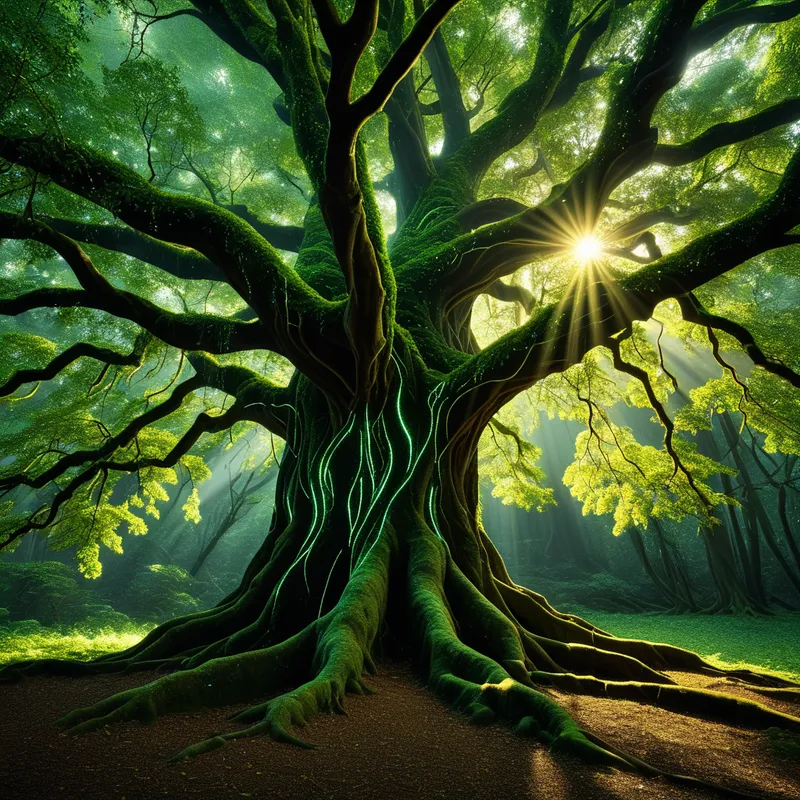
Laurel Tree Myth Meaning & Symbolism
The nymph Daphne, fleeing the god Apollo's desire, is transformed into the first laurel tree, an eternal symbol of victory, poetry, and unassailable spirit.
The Tale of the Laurel Tree
Hear now the rustling of leaves that are not merely leaves, but a prayer made permanent. It begins not with a tree, but with a god’s pride and a wound that festered into desire.
The sun-god Apollo, still flush with victory from slaying the great serpent Python, spied the young Eros at his archery. He laughed, a sound like golden bells, and mocked the boy’s tiny bow. “What have you, little lord of trifling passions, to do with weapons such as mine?” Eros said nothing, but his smile was a sliver of night. From his quiver, he drew two arrows: one of piercing gold, tipped with desire, and one of blunt lead, tipped with aversion. The gold he shot deep into Apollo’s shining heart. The lead he shot into the heart of the nymph Daphne, daughter of the river god Peneus.
And so the fever took hold. Apollo burned. He saw Daphne in the forest glades, her hair a dark cascade, her feet light on the moss, and his divine mind became a single, aching want. He called to her, his voice the promise of music and immortality. But Daphne felt only a cold dread, a sacred revulsion for the union he offered. She fled. She, the lover of wooded solitude, became the quarry in her own home.
The chase was a dissonant symphony—Apollo’s golden pleas ringing against the silent drum of Daphne’s terror. She felt his breath, like a hot wind, on her neck. She saw his shadow, long and grasping, fall over her. The riverbanks echoed with her desperate footfalls. As his hand reached to clasp her shoulder, she cried out to her father, her voice breaking against the sky: “Destroy this beauty that has pleased too well! Open, Earth, or change this form that is my ruin!”
The prayer was heard. A deep heaviness seized her limbs. Her swift feet rooted to the soil, digging deep as tendrils. Her soft flesh roughened and grew gray, encasing her in bark. Her arms stretched and branched, her hair transformed into a crown of trembling, evergreen leaves. Where the nymph stood, now stood a laurel tree, proud and fragrant.
Apollo, arriving, embraced not a maiden but a trunk. He felt the heart still beating within the wood. His desire did not vanish; it transmuted. “If you cannot be my bride,” he whispered, his voice now thick with a different kind of reverence, “you will be my tree. Your leaves, ever green, will crown the heads of victors, of poets, of those who achieve the highest glory. You will be sacred to me forever.” And the laurel, in a soft rustle, seemed to bend its new-made boughs in a kind of acceptance. The pursuit was over. The transformation was complete.

Cultural Origins & Context
This myth, primarily preserved for us in Ovid’s Metamorphoses, is a quintessential Greek exploration of boundaries—between divine and mortal, desire and autonomy, the fleeting and the eternal. It was not merely a fanciful tale but a foundational aetiology for a core cultural symbol: the laurel wreath (kotinos).
The story was told by bards and poets, performed in rituals, and embedded in the landscape itself, near the sacred groves of Delphi. Its societal function was multifaceted. It explained why Apollo’s priests, the Pythia, chewed laurel leaves to induce prophetic trances, and why victors at the Pythian Games were crowned with laurel. It served as a narrative vessel to process the potent, often dangerous, forces of eros (desire) and phobos (flight), and to sanctify the idea that some forms of honor are born not from possession, but from a profound, respectful distance.
Symbolic Architecture
At its core, the myth is a profound map of psychic forces. Apollo represents the radiant, conscious, pursuing principle—the drive for knowledge, possession, and luminous order. Daphne embodies the elusive, instinctual, autonomous soul—the part of nature (and of our own nature) that resists being categorized, captured, or fully known.
The ultimate victory is not in the capture, but in the sacred pact formed at the moment of surrender to a higher transformation.
The river god Peneus, who facilitates the change, symbolizes the deep, fluid unconscious from which new forms emerge when the conscious mind presses too hard. The laurel tree itself is the ultimate symbol of this alchemy. It is neither the pursuer nor the pursued, but the third, transcendent thing born from their collision: a symbol of victory that comes from release, of fame that is rooted in integrity, of evergreen endurance born from radical change. It represents the spirit that, rather than be consumed, becomes consecrated.
The Dreamer's Resonance
When this myth stirs in the modern dreamer, it often manifests as dreams of being chased through labyrinthine landscapes—urban or wild—by a force that is both alluring and terrifying. The pursuer may not be a god, but a looming deadline, an overwhelming person, or a facet of one’s own ambition or desire.
Somatically, the dreamer may awaken with a racing heart, tightness in the legs, or a feeling of being “rooted” in anxiety. Psychologically, this is the soul’s signal of a profound boundary violation in the making. The “Daphne process” is the psyche’s emergency protocol for preserving core autonomy. The dream asks: What part of me is being pursued to the point of dissolution? What must I renounce or transform to save my essential self? The transformation in the dream, if it occurs, is not a defeat, but a profound somatic truth: the body-mind seeking a new, more resilient form of being.

Alchemical Translation
For the individual on the path of individuation, the Laurel Tree myth models the critical stage of mortificatio and sublimatio—the dying of an old form and its uplifting into a higher purpose.
The initial, inflamed pursuit (Apollo’s eros) is akin to a psychic complex—a one-sided, consuming obsession, perhaps with an ideal, a person, or a goal that threatens to obliterate other parts of the self. The flight (Daphne’s phobos) is the healthy, instinctual rebellion of the soul against this psychic imperialism. The crisis at the riverbank is the pivotal moment of ego-surrender.
The god does not get what he wants, but is given what he needs: a sacred symbol to worship, not a soul to consume.
The alchemical work is in the prayer and the transformation that follows. The individual must, like Daphne, call upon their deepest resources (the “father,” the inner guiding principle) to enact a radical change of form. The old identity—the “nymph” who can only run—must “die” and be reborn as the “laurel”: a being of enduring presence, rooted in its own truth, offering its leaves not for possession, but for consecration. The Apollo complex is not destroyed; its energy is redirected from possession to reverence. The outcome is not a marriage, but a sacred dedication. The individual becomes aligned with something eternal and self-possessed, crowned not by another’s hand, but by their own transmuted nature. They become their own sacred grove.
Associated Symbols
Explore related symbols from the CaleaDream lexicon: