Lapis Niger Myth Meaning & Symbolism
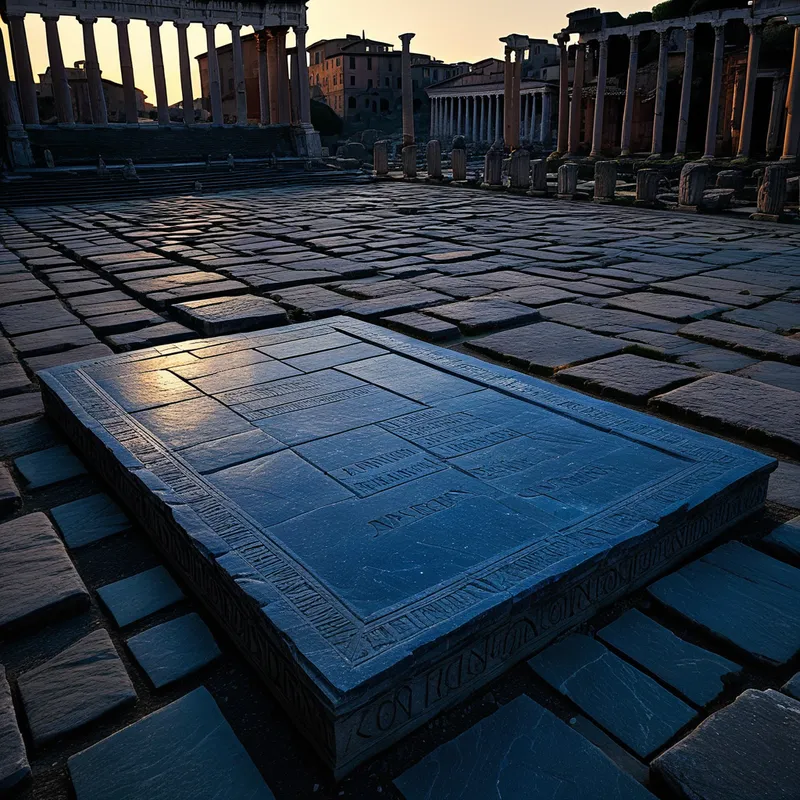
The sacred Black Stone in the Roman Forum, a tomb and shrine to the city's first king, marking the shadow where divine order meets primal chaos.
The Tale of Lapis Niger
Beneath the sun-hammered stones of the Forum, where the voices of senators once clashed like swords and the sandals of merchants wore grooves into history, there lies a silence. It is not an empty silence, but a full one, thick as blood and old as the hills. Here, in the very womb of the world’s power, the pavement opens to reveal a secret: the Lapis Niger.
Listen. Before the marble rose, before the laws were etched in bronze, this was a place of earth and omen. They say it marks the spot where the first king fell. Not in battle against some foreign host, but in a sacred transaction at the very dawn of things.
Romulus, the founder, twin son of Mars, walked here with the elders, tracing the sacred boundary of his new city. The sky was a bowl of brass, the air still. He sought the favor of the gods, to make the soil Roman, to bind the spirit of the place to his people. But the gods demand a price for such a binding. A voice spoke, not from a mortal throat, but from the earth itself, from the stones and the roots. It was the numen of the land, ancient and demanding.
“A king for a city,” it whispered on the wind. “A life for a life. The foundation must be watered with the blood of its founder.”
A shadow fell across Romulus. Some say it was a sudden storm cloud; others claim the sun itself darkened in witness. There was no enemy to fight, only a terrible, necessary truth. The city could not be born without a death. Its walls would be meaningless unless they enclosed a grave. In a moment of profound and terrifying acceptance, Romulus understood. The ruler must become the sacrifice. His body, his very being, must pass into the earth to become its enduring strength.
He did not flee. He ordered the black stone—a slab of midnight rock, cold and impenetrable—to be brought. Upon it, he lay down. The elders, his companions, became priests in that instant. With rites older than memory, they consecrated the act. As the life passed from the king into the stone, the stone sank into the earth, sealing the covenant. The Lapis Niger was not a marker of an end, but of a transformation. The king was gone. The Sacred King was born, eternal in the dark heart of Rome.
From that day, the stone was feared and revered. To tread upon it was a dire sacrilege. Birds would not fly over it. It became the bidental—a place struck by lightning, twice-sanctified by Jupiter himself. It was the mundus—the door to the underworld, closed for all but three days of the year when the spirits of the dead whispered through the crack. It was the navel, the scar, the everlasting wound that gave Rome its life.
Cultural Origins & Context
The Lapis Niger is not a myth from a single poet’s tongue, but an archaeological and ritual reality. Discovered in the Roman Forum, it is one of the oldest extant monuments, dating back to the 6th century BCE—the Regal period. Its name comes from the black marble slabs that covered it in later centuries, but its core is archaic.
This was not a story told for entertainment, but a sacred truth embedded in topography. It existed at the Comitium, the very spot where political and legal life pulsed. Next to the speaker’s platform, this black, forbidden zone served as a perpetual reminder. The Romans were a people profoundly conscious of religio—the binding obligation to the gods and the ancestors. The Lapis Niger was the physical anchor of that bond.
It was maintained by the state priesthoods. The inscribed pillar found at the site, one of the oldest known Latin texts (the so-called Lapis Niger Stele), warns in fractured, ancient language that any who violate the sacred precinct will be consecrated to the gods of the underworld—a fate worse than death. The myth of the fallen king (whether identified as Romulus, an earlier Latin hero like Faustulus, or a shadowy figure like Hostus Hostilius) provided the aition—the sacred cause—for this terrifying taboo. It explained why this spot, at the center of worldly power, was fundamentally dedicated to death.
Symbolic Architecture
The Lapis Niger is a master symbol of the paradox at the heart of civilization. It represents the necessary shadow that upholds the light of order.
The foundation of the city is a tomb. The birth of order requires a sacred death.
Psychologically, it embodies the archetype of the ruler in its most profound and sacrificial aspect. The ruler is not merely the one who commands, but the one who carries the collective shadow and pays the price for the community’s existence. The stone is the axis mundi, the world pillar, but one that descends into the underworld rather than reaching to the heavens. It connects the conscious, political realm of the Forum with the unconscious, chthonic realm of the ancestors and the Furies.
The black stone itself is a symbol of the nigredo—the first, dark stage of the alchemical process. It is the unformed primal matter, the chaos that must be contained and transformed. By burying the king-figure within it, the myth narrates the containment of individual ego (the king) into a collective, enduring structure (the city). The king’s personal identity is sacrificed to become the eternal, impersonal spirit of the place—the genius loci. This is the shadow work of a culture: acknowledging that its power, law, and identity are rooted in a primal, sacrificial act that must never be forgotten.
The Dreamer's Resonance
When the pattern of the Lapis Niger emerges in modern dreams, it speaks to a process of foundational psychic restructuring. The dreamer is not building a city, but a Self.
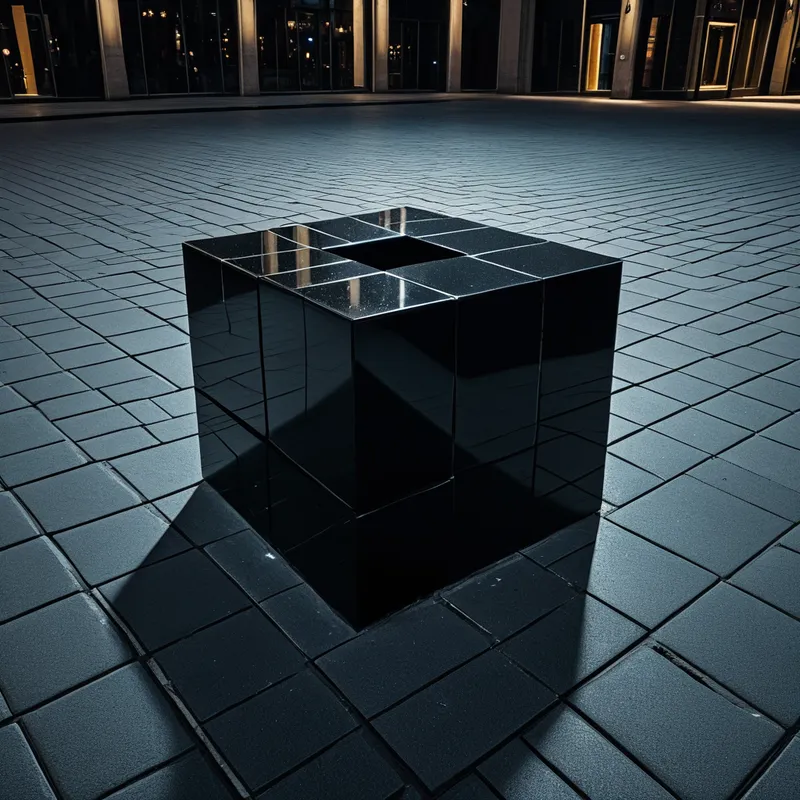
To dream of a black stone or slab at the center of one’s personal “forum”—perhaps in one’s childhood home, workplace, or a familiar plaza—signals that a deep, foundational part of the psyche is being confronted. This is often experienced somatically as a weight in the chest, a feeling of sacred dread, or a chilling stillness. The stone represents a core complex, a buried trauma, or a forgotten oath that underpins the dreamer’s current identity.
The dream may involve being forbidden to touch the stone, or feeling compelled to make an offering to it. This is the psyche’s intuition that to proceed with conscious life (to “build the forum”), one must first acknowledge and honor this dark, central truth. It is the shadow of one’s own authority, the hidden cost of one’s achievements, or the repressed memory that silently structures one’s relationships. The process is one of confrontation and consecration—not necessarily to dissolve the stone, but to recognize its sacred, necessary place in the architecture of the soul.
Alchemical Translation
The myth of the Lapis Niger is a precise map for the alchemical stage of mortificatio and the foundational step of Jungian individuation.
The ego, like the king, must consent to its symbolic death to serve a greater, more enduring order—the Self.
The modern individual’s “Rome” is the coherent, functioning personality. We build our forums of career, family, and social identity. But this construction often rests upon a buried, unintegrated truth—a talent sacrificed, a passion denied, a trauma unspoken. This is our personal Lapis Niger. The alchemical work is to journey to the center of our own forum and confront this black stone.
First, we must perform the Recognition (nigredo): Seeing the dark, foundational thing we have built upon. This is often accompanied by depression, confusion, and a sense of meaninglessness—the “dark night of the soul.”
Second, we enact the Sacrifice (mortificatio): This is the voluntary relinquishment of the old, heroic ego-identity (the “king” who founded our current life) that refuses to acknowledge this shadow. It is not self-destruction, but a surrender to a deeper truth.
Finally, we achieve the Integration (coniunctio): The sacrificed ego does not vanish. Like Romulus, it is transmuted. It becomes the Sacred King—no longer a personal ruler, but the internal, archetypal principle of order and authority that is in right relationship with both the conscious world and the unconscious depths. The black stone remains, but it is no longer a feared taboo; it becomes the sacred temenos, the protected center that gives depth, gravity, and authentic power to the entire personality. The individual learns that true sovereignty comes not from ignoring the shadow, but from enthroning it at the very heart of one’s being.
Associated Symbols
Explore related symbols from the CaleaDream lexicon: