Lan Hua Myth Meaning & Symbolism
A tale of an orchid spirit, Lan Hua, who endures obscurity to reveal her true essence, embodying the virtue of quiet resilience and inner nobility.
The Tale of Lan Hua
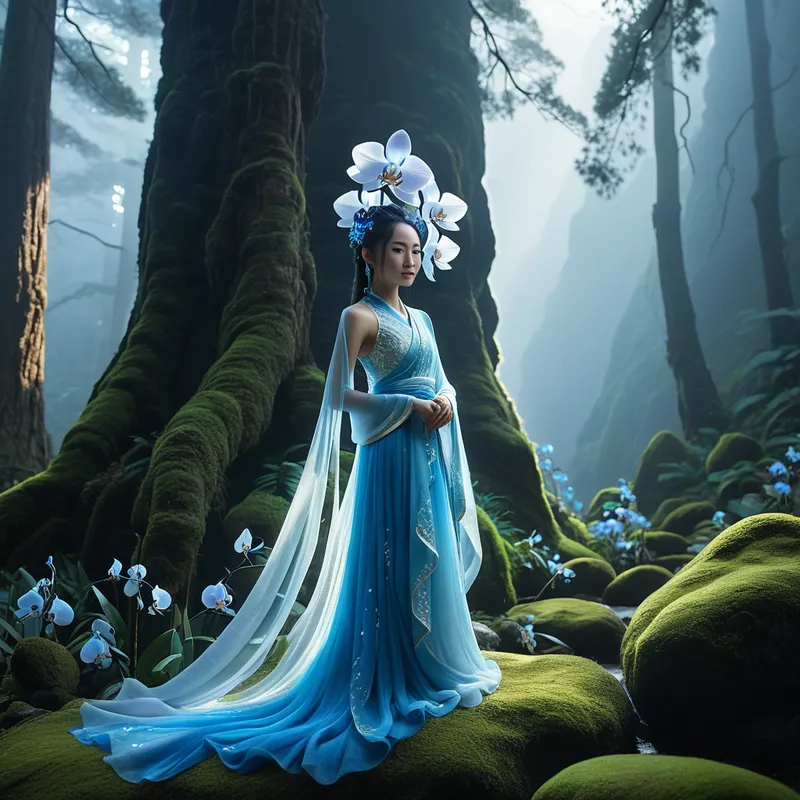
Listen, and let the mists of time part. In the deep, silent valleys where [the world](/myths/the-world “Myth from Tarot culture.”/)’s breath grows still and the mountains hold their ancient counsel, there lived a spirit not of thunder or flame, but of the quiet earth. Her name was Lan Hua.
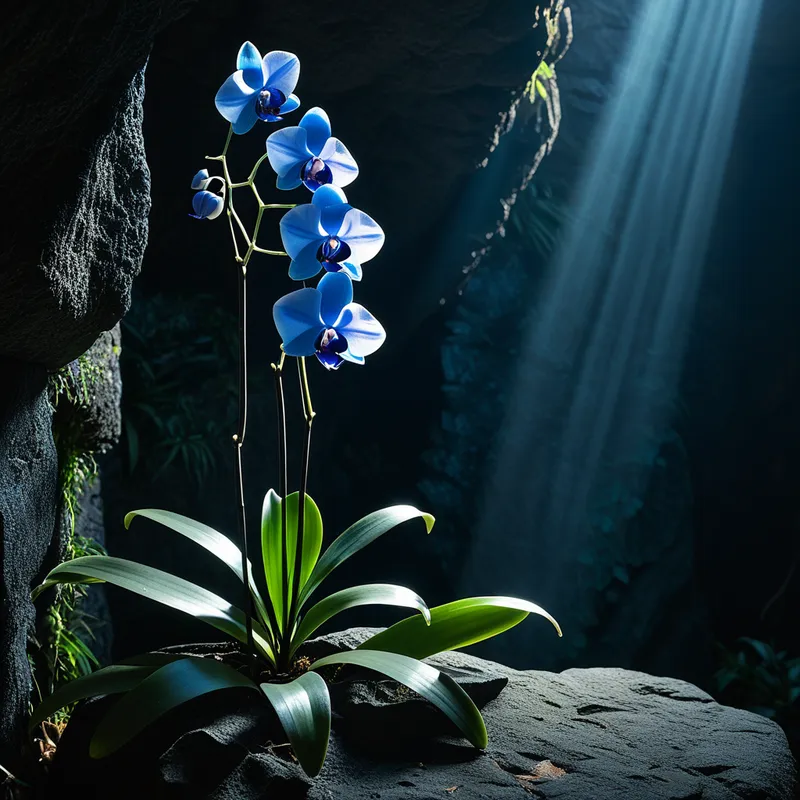
While the peonies clamored for the sun’s favor in the imperial gardens and the plum blossoms braved the winter frost with bold defiance, Lan Hua dwelt in the hidden places. Her realm was the damp, shaded crevice of a cliff, the cool hollow at the root of an ancient pine. She was the orchid, a creature of exquisite form and a fragrance so subtle, so refined, that only the stillest heart and the purest intention could perceive it. To the rushing world, she was invisible, a wisp of color mistaken for shadow.
For years uncounted, she endured the obscurity. The boisterous wind never sang her praises; the flashy butterflies sought brighter blooms. She was passed over by the poets who sought dramatic subjects, ignored by the painters who desired vivid contrast. Yet, Lan Hua did not wither. In the deep silence, she tended her own essence. She drew sustenance not from adulation, but from the secret dew and the whispered wisdom of the stone. Her beauty was not for display, but was the very expression of her being—a quiet, unwavering truth.
Then, one day, a traveler came. He was not a king or a warrior, but a scholar whose eyes were tired from reading too many arrogant texts, whose soul was weary from the noise of human contention. Lost and seeking solace, he stumbled into her secluded valley. He sat to rest, closing his eyes, letting the chatter of his mind settle like dust. It was in that profound stillness that he first sensed it—a fragrance, cool and complex, like moonlight given scent. It filled his chest, clearing the fog of ambition and disappointment.
He opened his eyes and searched. And there, in a place where light barely touched, he saw her. Not a mere flower, but a presence. The elegant arch of her stem, the delicate patterning on her petals—it spoke of a nobility that needed no court, a perfection that asked for no audience. In that moment of pure, unasked-for recognition, a silent communion passed between them. The scholar’s heart, once heavy, felt light. Lan Hua, in being truly seen for what she was, seemed to glow with a gentle, inner luminescence. The traveler departed, carrying not the flower, but its fragrance etched upon his spirit, a permanent reminder of the beauty that thrives in authenticity, unseen yet essential.
Cultural Origins & Context
The myth of Lan Hua is less a single, codified epic and more a pervasive cultural motif woven into the fabric of Chinese literati tradition for millennia. It finds its roots in the early symbolism of the Four Gentlemen and the Three Friends of Winter, where the orchid (lan) holds a place of supreme honor. Unlike myths of creation or great battles, this is a “quiet myth,” propagated not by folk storytellers in village squares, but by scholars, poets, and painters in their studios and mountain retreats.
Its primary tellers were the Confucian literati and Daoist recluses. For them, Lan Hua was the ultimate allegory for the junzi—the noble person. In a society often governed by rigid hierarchy and political intrigue, the orchid became a symbol of maintaining one’s moral integrity and refined character (de) away from the corrupting glare of power and popularity. Its fragrance, detectable only up close, paralleled the notion that true virtue is not loud or self-promoting, but reveals itself intimately to those of similar quality. The myth served as a societal balm, validating the choice of retreat, study, and personal cultivation over public acclaim, and offering a model of resilience that was passive yet potent.
Symbolic Architecture
Psychologically, Lan Hua represents the archetypal Self in its nascent, hidden state. She is not the heroic ego battling external monsters, but the essence of the [soul](/symbols/soul “Symbol: The soul represents the essence of a person, encompassing their spirit, identity, and connection to the universe.”/) that exists prior to and independent of social recognition.
The deepest value does not shout for attention; it whispers in the spaces where the noise of the world falls away.
Her secluded [valley](/symbols/valley “Symbol: A valley often symbolizes a period of transition or a place of respite between two extremes.”/) is the unconscious itself—the fertile, shadowy interiority of the [psyche](/myths/psyche “Myth from Greek culture.”/) where the most authentic aspects of our being develop away from the [persona](/symbols/persona “Symbol: The social mask or outward identity one presents to the world, often concealing the true self.”/)‘s stage. The [obscurity](/symbols/obscurity “Symbol: A state of being unclear, hidden, or difficult to perceive, often representing the unknown, unconscious, or unresolved aspects of life.”/) she endures symbolizes the [period](/symbols/period “Symbol: Periods in dreams can symbolize cyclical patterns, renewal, and the associated emotions of loss or change throughout life.”/) of [incubation](/symbols/incubation “Symbol: A period of internal development, rest, or hidden growth before emergence, often associated with healing, creativity, or transformation.”/), where talents, true feelings, or core [identity](/symbols/identity “Symbol: Identity represents the sense of self, encompassing personal beliefs, cultural background, and social roles.”/) are neglected, suppressed, or simply not yet understood by the conscious mind or the outer world. The [cliff](/symbols/cliff “Symbol: Dreaming of a cliff often symbolizes a significant decision point or a transition, representing both the fear of failure and the potential for growth.”/) and the shade are not prisons, but protective vessels.
The pivotal [symbol](/symbols/symbol “Symbol: A symbol can represent an idea, concept, or belief, serving as a powerful tool for communication and understanding.”/) is her fragrance. This is the intangible quality of the authentic self—its unique [character](/symbols/character “Symbol: Characters in dreams often signify different aspects of the dreamer’s personality or influences in their life.”/), moral compass, or creative [spirit](/symbols/spirit “Symbol: Spirit symbolizes the essence of life, vitality, and the spiritual journey of the individual.”/). It cannot be grasped or owned; it can only be emanated and, under the right conditions, perceived. The [traveler](/symbols/traveler “Symbol: A person on a journey, representing movement, transition, and the search for new experiences or self-discovery.”/)-scholar represents the emerging conscious [attitude](/symbols/attitude “Symbol: Attitude symbolizes one’s mental state, perception, and posture towards life, influencing emotions and actions significantly.”/) capable of receptivity. His [stillness](/symbols/stillness “Symbol: A profound absence of motion or sound, often representing inner peace, creative potential, or existential pause in artistic contexts.”/)—the cessation of ego-driven seeking—is the prerequisite for [perception](/symbols/perception “Symbol: The process of becoming aware of something through the senses. In dreams, it often represents how one interprets reality or internal states.”/). His recognition is the [moment](/symbols/moment “Symbol: The symbol of a ‘moment’ embodies the significance of transient experiences that encapsulate emotional depth or pivotal transformations in life.”/) of [integration](/symbols/integration “Symbol: The process of unifying disparate parts of the self or experience into a cohesive whole, often representing psychological wholeness or resolution of internal conflict.”/), where a previously unconscious content (the authentic self) is acknowledged by [consciousness](/symbols/consciousness “Symbol: Consciousness represents the state of awareness and perception, encompassing thoughts, feelings, and experiences.”/), not through conquest, but through humble appreciation.
The Dreamer’s Resonance
When the pattern of Lan Hua stirs in modern dreams, it often signals a process of reconnecting with a neglected or undervalued aspect of [the self](/myths/the-self “Myth from Jungian culture.”/). The dreamer may not see an orchid, but the motifs are analogous.
One might dream of discovering a beautiful, fully furnished room in one’s own house that they had forgotten existed. Or of finding a unique, precious gemstone buried in the backyard dirt. There is a somatic feeling of quiet discovery, a release of gentle warmth in the chest, rather than the adrenaline of chase or fight. These dreams often come during periods of burnout, after leaving a hyper-competitive environment, or when feeling that one’s public life is a hollow performance. The psyche is directing attention inward, away from the “sunlit gardens” of social validation, and into the “shaded valleys” of personal essence.
The psychological process is one of withdrawal for renewal. It is [the ego](/myths/the-ego “Myth from Jungian culture.”/) learning to de-prioritize external metrics of worth and to develop an inner sensorium capable of perceiving its own intrinsic value. The conflict in such dreams is rarely dramatic; it is the subtle, chronic pain of being unseen, even by oneself. The resolution is the dream-image of something beautiful, intact, and thriving precisely where it had been overlooked.
Alchemical Translation
The alchemical journey modeled by Lan Hua is not one of fiery calcinatio but of moist [solutio](/myths/solutio “Myth from Alchemical culture.”/) and gentle coagulatio. It is the process of psychic transmutation through patient interiority.
[The first stage](/myths/the-first-stage “Myth from Alchemical culture.”/) is the acceptance of obscurity. The modern individual must consciously choose, or gracefully accept, a period of being “out of the spotlight.” This could be leaving a high-profile career, taking a social media hiatus, or simply ceasing to perform a personality that no longer fits. It is a voluntary descent into the valley, a commitment to nourish the roots in the dark, rich soil of the unconscious.
Individuation often begins not with a quest, but with a retreat—a sacred pause where the soul’s own fragrance can begin to accumulate.
The second stage is cultivation in silence. This is the active work done in that retreat: journaling, art without an audience, meditation, deep reading, or simply being in nature without agenda. It is the equivalent of Lan Hua drawing sustenance from [the dew](/myths/the-dew “Myth from Alchemical culture.”/) and the stone—seeking nourishment from primal, non-human sources of wisdom and stability. The ego’s constant “doing” is replaced by the Self’s subtle “being.”
The final, transformative stage is emanation, not proclamation. The goal is not to emerge from the valley and loudly declare one’s authenticity. It is to live from the integrated self so that its qualities—like the fragrance—naturally permeate one’s actions, choices, and presence. The right people (the “travelers” with still hearts) will perceive it and be nourished by it. The [triumph](/myths/triumph “Myth from Roman culture.”/) is not fame, but integrity; not visibility, but a profound and unshakeable congruence between one’s inner essence and outer life. The individual becomes, like the orchid, a self-contained ecosystem of meaning, whose very existence is a quiet testament to the beauty of the authentic.
Associated Symbols
Explore related symbols from the CaleaDream lexicon: