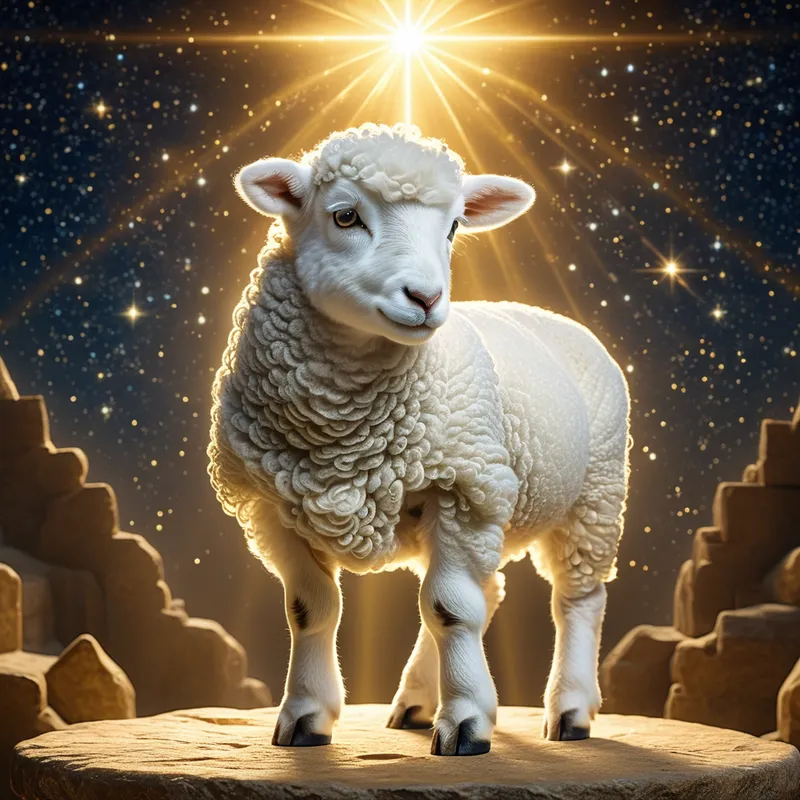
Lamb of God Myth Meaning & Symbolism
A myth of the divine scapegoat, whose willing sacrifice shatters the cycle of sin and death, offering a path of radical transformation.
The Tale of the Lamb of God
Listen. There is a silence that comes before the dawn, a hush in the heart of the world when the scales of eternity tremble. In a land taut with expectation, under a sky heavy with prophecy, walked a man who was also a Logos. His eyes held the depth of creation and the weight of its sorrow.
For generations, the people had known the law: life for a life, blood for blood. In the temple’s inner court, the scent of incense and iron hung perpetually in the air. Priests in linen would lay hands upon a bleating goat, transferring onto its twitching hide the collective guilt, the hidden shames, the broken promises of a nation. The creature, now burdened with a weight it did not choose, was driven out into the wilderness—a living vessel of exile, carrying sin away from the camp. This was the old covenant, a rhythm of temporary relief.
But he came speaking of a new rhythm, a deeper melody. He spoke of a shepherd who would lay down his life for the sheep, not from obligation, but from a love so vast it could swallow the abyss. The conflict was not with empires or thieves, but with a far older, colder adversary: the very principle of death and separation that had woven itself into the fabric of existence. The rising action was not a charge into battle, but a willing descent. He knelt in a garden, his sweat like drops of blood falling on the cold earth, and in that moment, the fate of worlds hung on a whispered “Nevertheless.”
He was taken. Not as a conquering king, but as the silent Lamb. Before the crowing of the cock, before the breaking of dawn, he stood bound. They clothed him in mock purple and pressed a crown of thorns into his brow, each point a tiny inversion of the royal diadem. He was led up the hill of the skull, the place of the ultimate exile. No hands were laid upon him to transfer guilt; he absorbed it into his own being, a cosmic sponge for the world’s shadow. The nails were driven, not into a post of cedar, but into the living intersection of time and eternity. As he breathed his last, the temple veil—the great curtain separating humanity from the holy of holies—tore from top to bottom with a sound like the universe gasping. The earth shook. The old wilderness of exile was now traversed, and in the silent tomb, a mystery deeper than death began to stir.
On the third day, at the first hint of light, the stone was rolled away. Not to let a ghost out, but to show the world that the tomb was empty. The Lamb that was slain was standing, bearing the wounds of love, now transformed into emblems of a life that death could not hold.
Cultural Origins & Context
The myth of the Lamb of God did not emerge in a vacuum. It is the profound culmination of a narrative thread woven through centuries of Judaic tradition. Its primary vessel was the New Testament, particularly the Gospel of John and the apocalyptic Book of Revelation, but its roots drink deeply from the well of the Tanakh.
The archetype was prefigured in the Passover lamb, whose blood marked the doors of the Israelites, signifying protection and deliverance. It echoed in the suffering servant poems of Isaiah, who described one “led like a lamb to the slaughter.” This myth was transmitted orally by the earliest followers of Jesus, then codified in Greek texts that spread across the Roman Empire. It functioned as the central explanatory story for a persecuted minority, transforming the shameful Roman execution of crucifixion into a symbol of divine victory. It provided a cosmic framework for understanding suffering, guilt, and the possibility of a fundamentally renewed relationship with the divine and the self.
Symbolic Architecture
Psychologically, the Lamb of God is perhaps the most potent symbol of the willing scapegoat. It represents the part of the psyche—or the transcendent principle touching the psyche—that consciously agrees to bear the unbearable: the shadow, the guilt, the fragmented and rejected aspects of the self and the collective.
The Lamb does not fight the wolf; it transforms the meaning of the predation. Sacrifice, in this myth, is not a transaction to appease an angry god, but the ultimate act of meaning-making, where death itself becomes the womb for new life.
The “slain” aspect signifies the total acceptance of the human condition, with all its vulnerability, pain, and mortality. The “standing” aspect (as in Revelation’s lamb “looking as if it had been slain”) symbolizes the emergence of a consciousness that has integrated this suffering, not as a defeat, but as the source of its authority and transformative power. The lamb, an ancient symbol of innocence and vulnerability, is fused with the divine Logos, creating a paradox: strength perfected in weakness, authority born of surrender.
The Dreamer's Resonance
When this myth stirs in the modern dreamer, it often signals a profound psychological process of atonement—literally, at-one-ment. To dream of a lamb, especially one that is wounded, silent, or in a position of sacrifice, may point to the dreamer carrying an unconscious burden of guilt, shame, or a sense of responsibility that feels crushing and inescapable. It may not be personal guilt, but a more ancestral or collective shadow.
The somatic experience can be a feeling of weight, constriction in the chest, or a deep, inexplicable sorrow. The dream is presenting the image of the burden itself. Alternatively, dreaming of a radiant or peaceful lamb, particularly after a period of turmoil, can symbolize the emergence of a new, innocent, and resilient core of the self that has survived a deep crisis. It is the psyche’s way of narrating a passage through a necessary “death”—of an old identity, a toxic pattern, a crippling belief—and the tentative, vulnerable birth of what comes after.
Alchemical Translation
For the individual on the path of individuation, the myth of the Lamb models the alchemical stage of mortificatio and sublimatio. The ego, which naturally seeks to preserve itself, avoid suffering, and project its shadow onto others, must undergo a symbolic death. This is the “slaying.”
The alchemical gold is not found by avoiding the leaden weight of our shadow, but by consenting to be the crucible in which it is transmuted.
This is not self-annihilation, but the surrender of the ego’s totalitarian control. We are invited to “lay down our life”—our defensive, self-justifying, fear-driven life—to find a deeper, more authentic one. The “taking away of the sin of the world” translates psychologically as the dis-identification from our inner persecutor and the internalized voices of condemnation. By consciously bearing witness to our own pain and brokenness without fleeing or denying it (the Lamb’s silent acceptance), we perform the sacred inner rite. The resurrection is the inevitable dawn that follows: the realization that our core being is not defined by our wounds, sins, or history, but is capable of holding them, transforming their meaning, and emerging with a compassion for oneself and the world that is born directly from the wound. The Lamb of God becomes, in the soul’s inner landscape, the symbol of the Self that orchestrates this whole, terrifying, and glorious process.
Associated Symbols
Explore related symbols from the CaleaDream lexicon: