Lamashtu the Demon Myth Meaning & Symbolism
A terrifying demoness, cast from heaven, preys upon mothers and newborns, embodying the unthinkable shadow of creation and the raw terror of vulnerability.
The Tale of Lamashtu the Demon
Hear now a tale not of glorious Anu in his high heaven, nor of Ea in the deep Apsu, but of a terror that walked in the spaces between. A terror born of heaven but banished to the dust.
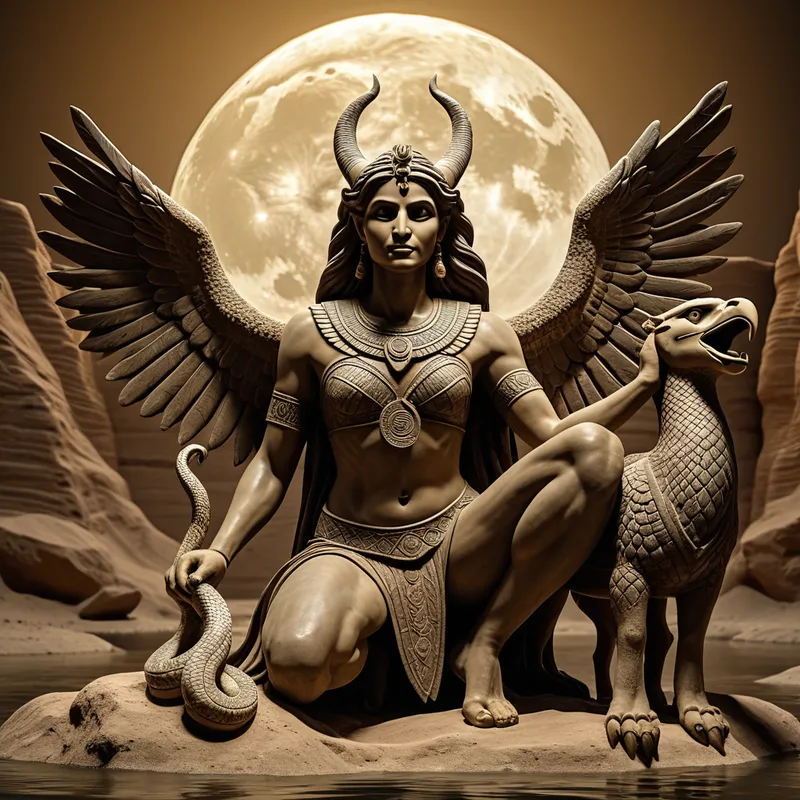
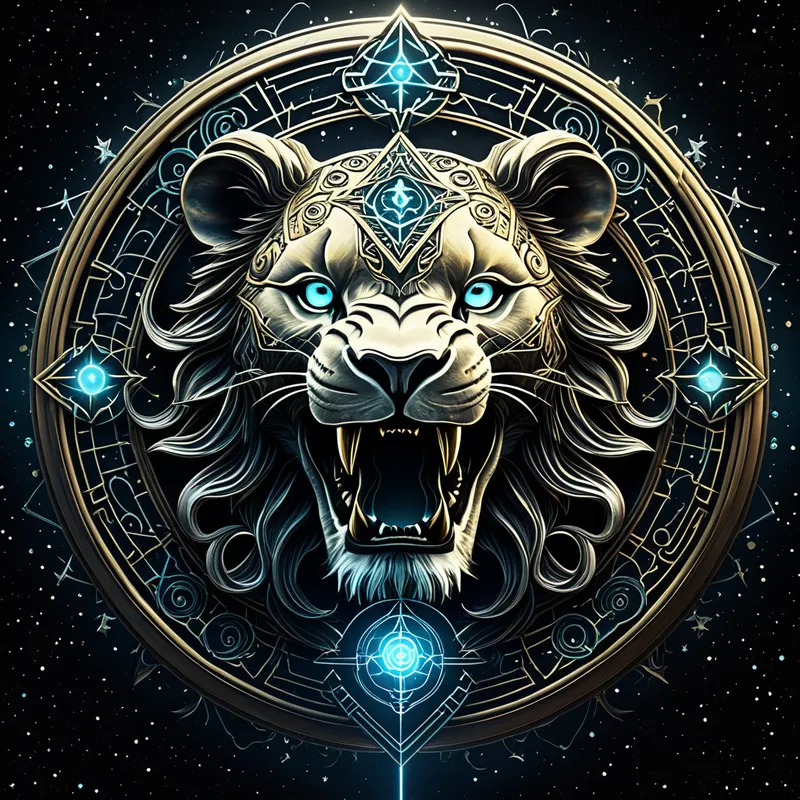
In the time when the gods fixed the destinies, a daughter was born to the sky itself. But her heart was not tuned to the harmony of the spheres. She was Lamashtu, and her desire was a devouring hunger. She looked upon the ordered world and saw not creation to nurture, but life to consume. Her form was a blasphemous mosaic: the head of a roaring lioness, the teeth of a braying donkey, bared in a perpetual grimace. Her body was hairy like a beast, her hands were stained, and her feet ended not in toes, but in the sharp talons of the Anzu bird. In one hand she clutched a writhing serpent, in the other, a double-edged dagger.
The great gods could not abide her in the divine assembly. Her presence was a poison, a shriek against the silence of cosmic law. With a voice like grinding stones, Anu pronounced her exile: "You shall dwell no more in the pure places. Go down! Go down to the dust, to the forgotten places, to the crossroads and the riverbanks where the reeds whisper of forgotten things."
Cast down, Lamashtu’s fury fermented into a singular, malignant purpose. She would prey upon that which the gods cherished most: the fragile spark of new life. She stalked the night, a shadow with weight and breath. She slithered into the homes where mothers lay in the sacred, vulnerable sleep after birth. She would steal the breath from newborns, drink the milk meant for them, and with her clawed fingers, she would snatch the infant from its mother’s side. She brought fever to the mother, blight to the father, and a creeping sickness to the household. Her laughter was the sound of a child’s cry, cut short.
The land wept. The lament of mothers rose like smoke to the heavens. The gods heard, but the law of exile held. They could not directly strike her down. Instead, wisdom found another path. Ea, in the deep waters of knowing, summoned a spirit of a different dread: Pazuzu, the demon of the scorching southwest wind. His face was a grotesque mask, his body scaled, with wings of a predator and the paws of a lion. "Go," commanded Ea. "You are terror itself. Use your dread as a shield. Drive back the devourer. Let fear fight fear."
And so, Pazuzu, the king of evil spirits, became the unlikely guardian. His visage, carved into amulets of clay or stone, was hung above the bed of the laboring woman. His name was invoked not to bless, but to warn. "See here, Lamashtu," the amulet seemed to say. "This territory is claimed by a greater terror. Your hunger is not welcome." It was a sacred trick, a binding of chaos with a mirrored chaos, a wall of ferocity to protect the tender and the new. The demoness was repelled, not destroyed, forced back to the riverbanks and the wild places, her menace held at bay by the image of a rival horror. The balance was terrible, fragile, and absolute.
Cultural Origins & Context
The myth of Lamashtu emerges from the very bedrock of Mesopotamian domestic anxiety. Unlike the grand state epics of Gilgamesh or the cosmic battles of Enuma Elish, her story was etched on amulets and recited in incantations within the home. This was personal mythology, the folklore of survival. The tales were likely passed down by midwives, healers (ashipu), and mothers—the first line of defense against very real, inexplicable infant mortality.
Her function was dual: explanation and empowerment. She gave a name and a form to the terrifying randomness of childbirth fever, miscarriage, and sudden infant death. By personifying the threat, it could be addressed, negotiated with, and potentially warded off. The elaborate descriptions of her appearance in incantation texts were not merely horror; they were a form of magical combat. To know the demon’s exact form was to have power over it. The prescribed rituals—offering her figurines threaded on a donkey’s hair and sent downriver—were acts of symbolic bribery and expulsion, a psychological technology to restore a sense of agency in the face of life’s most profound vulnerability.
Symbolic Architecture
Lamashtu is not merely a monster; she is the embodied Shadow of the creative principle itself. She represents the terrifying inverse of the Mother archetype: the Mother who consumes, the womb that becomes a tomb.
She is the unspoken fear that lives in the same psychic space as the deepest love: the possibility that creation and destruction are intimately, horrifyingly twinned.
Her hybrid, chaotic form symbolizes the breakdown of natural order. The lion (wild predation), the donkey (stubborn impurity), and the eagle (ruthless aerial dominion) are fused into a being of pure anti-nurturance. She steals milk, the symbol of sustenance, perverting its life-giving function. Her exile from heaven marks her as a rejected aspect of the divine itself—a stark acknowledgment that the cosmos contains forces inimical to life, even within its own source. The myth confronts the terrifying truth that vulnerability is not just a condition, but a target.
The Dreamer's Resonance
When Lamashtu stalks the modern dreamscape, she rarely appears in her ancient guise. Her presence is felt somatically: a suffocating weight on the chest upon waking, a chilling sense of being watched in a supposedly safe place (like one’s bedroom), or nightmares of a beloved child or a nascent project being stolen or corrupted.
Psychologically, she manifests when the dreamer is in a state of profound, creative vulnerability. This could be after the birth of a child, the launch of a business, the sharing of intimate art, or the nurturing of a new, fragile part of the self. Lamashtu-dreams signal an acute encounter with the inner critic or sabotaging complex that seeks to "devour the newborn" before it can draw breath. The process is one of confronting a primal, annihilating fear that arises precisely because something precious and vulnerable has come into being. The dream is the psyche’s way of screaming, "It is in danger!"
Alchemical Translation
The individuation process modeled here is not one of heroic slaying, but of sacred containment and intelligent repurposing of terror. One does not "defeat" the Lamashtu complex—the deep-seated fear that what we create will be destroyed, or that we are inherently destructive. To try to annihilate it only gives it more energy.
The alchemy lies in the Pazuzu maneuver: recognizing that the force which guards the vulnerable new life is often a redirected form of the very fear that threatens it.
The modern "Pazuzu amulet" is the conscious act of setting boundaries, of creating rituals of protection for one’s nascent endeavors. It is the fierce, perhaps even grim, determination to say, "This new life, this fragile idea, this tender feeling, is under my protection." The guardian energy may not feel purely "good"; it might feel like stubborn will, aggressive defense of one’s time, or a sharp intellectual scrutiny that fences off the creative space. The myth teaches that the protection of the innocent (the new self) sometimes requires mobilizing a sanctioned, focused ferocity. We transmute raw, free-floating anxiety (Lamashtu) into a specific, stationed guardian function. We acknowledge the shadow of destruction not to succumb to it, but to consciously appoint its counter-force, achieving a difficult, dynamic balance that allows growth to proceed.
Associated Symbols
Explore related symbols from the CaleaDream lexicon:
- Demon — The personification of a primal, externalized threat to life and order, representing the psyche's need to give form to formless dread.
- Mother — Lamashtu is the terrifying inversion of this archetype, embodying the shadow side of nurture: consumption and smothering.
- Child — The ultimate symbol of vulnerability and nascent life, the primary target of Lamashtu's hunger, representing anything new and fragile within the self.
- Blood — Symbolizes both the life-force of birth and the violence of predation, the sacred threshold that Lamashtu transgresses.
- River — The flowing boundary between the settled world and the wild, where Lamashtu dwells and where ritual offerings to appease her were sent.
- Amulet — Represents the human impulse to create symbolic, magical protection against intangible threats, a physical focus for psychic defense.
- Shadow — Lamashtu is a classic manifestation of the Jungian Shadow, the rejected, terrifying aspect of reality and the self that must be confronted.
- Fear — The core atmosphere of the myth, a raw, protective emotion that, when harnessed, can become the guardian of vulnerability.
- Protection — The central struggle and purpose of the myth, achieved not through elimination of danger, but through strategic, symbolic containment.
- Milk — The symbol of nurturing sustenance that Lamashtu perverts and steals, representing the corruption of life-giving resources by fear or envy.
- Door — The threshold of the home and the self, the vulnerable point of entry that must be guarded against invasive, predatory forces.