Lakshmi's Lotus Myth Meaning & Symbolism
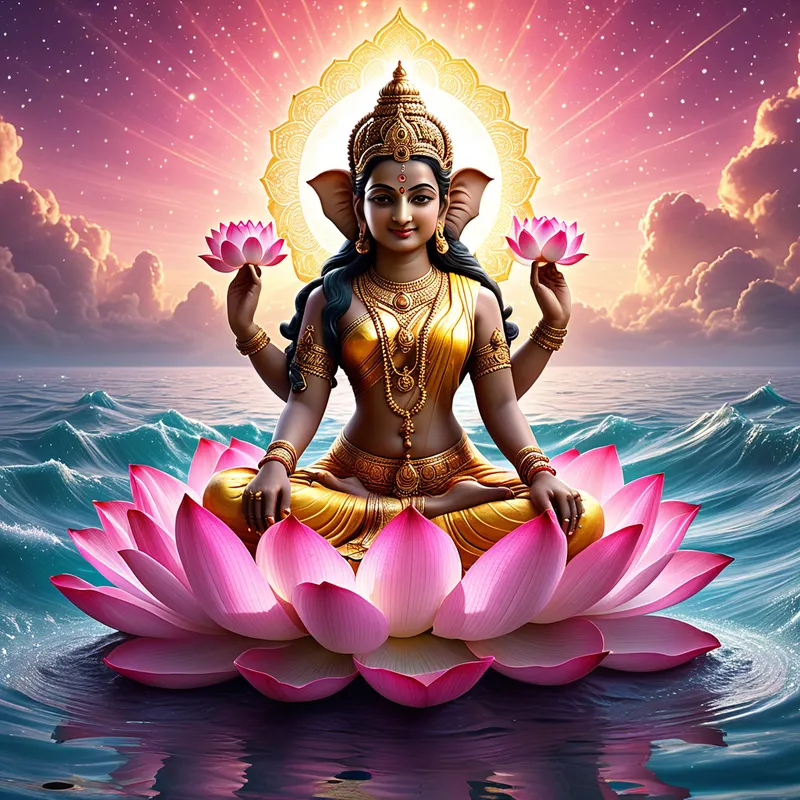
The story of the goddess Lakshmi emerging from the churning ocean of existence, seated upon a pristine lotus, symbolizing the birth of beauty from chaos.
The Tale of Lakshmi’s Lotus
Listen. Before time was counted, when the universe was a single, boundless ocean of milk, a silence heavier than any mountain lay upon the waters. There was no sun, no moon, no earth beneath one’s feet—only the potential of all things, sleeping in the deep. From this stillness, a desire was born, a cosmic hunger. The Devas and the Asuras, perpetually locked in their celestial dance of opposition, found a rare moment of accord. They sought the Amrita, the elixir that would grant them eternal life. And so, they decided to churn the ocean itself.
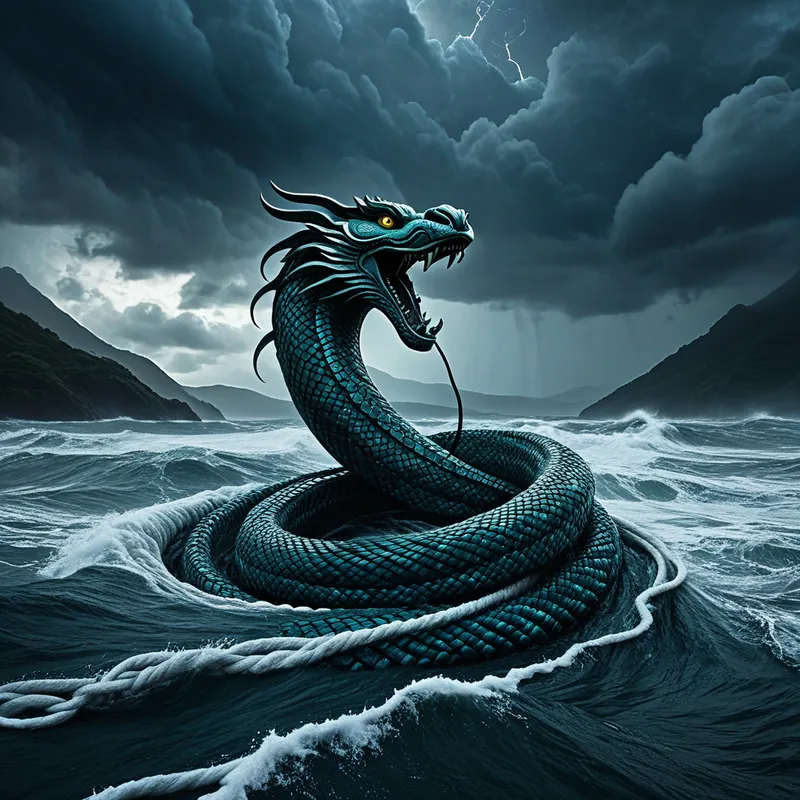
They uprooted the great mountain Mandara to be their churning rod. The mighty king of serpents, Vasuki, offered himself as the rope. The [Vishnu](/myths/vishnu “Myth from Hindu culture.”/), in his form as the great [tortoise](/myths/tortoise “Myth from Greek culture.”/) [Kurma](/myths/kurma “Myth from Hindu culture.”/), dove to the bottom of the milky sea to bear the mountain on his immovable shell. The gods took hold of Vasuki’s tail, the demons his head, and they began to pull. Back and forth. The mountain spun. The ocean roared and frothed.
But the labor was immense. The mountain began to sink into the soft ocean bed. Fire and venom spewed from Vasuki’s mouth, threatening to scorch the worlds. [Shiva](/myths/shiva “Myth from Hindu culture.”/), in an act of supreme compassion, drank the poison, holding it in his throat, which turned blue. The churning continued, a titanic, groaning effort that shook the foundations of possibility.
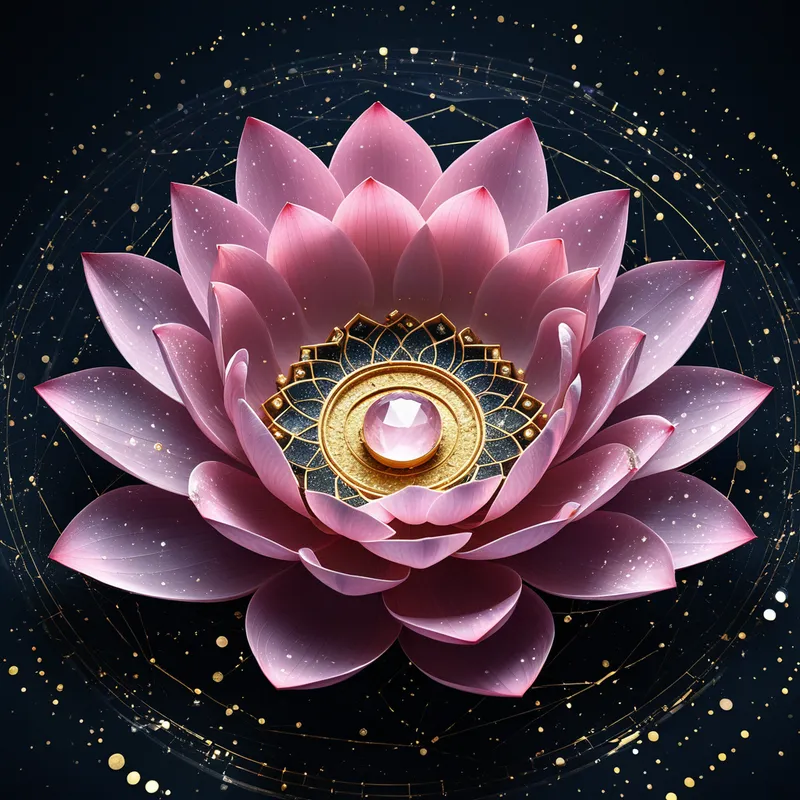
And then, from the seething, exhausted waters, treasures began to arise. The celestial cow, the wish-fulfilling tree, [the moon](/myths/the-moon “Myth from Tarot culture.”/). But these were mere preludes. The waters, agitated to their very soul, began to yield a different kind of wealth. A fragrance, sweet and calming, pierced the acrid air. A soft, radiant light emanated from the foam. And there, rising on a stem of pure emerald, was a [lotus](/myths/lotus “Myth from Hindu culture.”/). Not a mere flower, but a throne, a [mandala](/myths/mandala “Myth from Buddhist culture.”/), a universe in bloom. Its petals, layers upon layers of tender pink and gold, unfolded with a sound like the first sigh of creation.
Seated upon it, in a posture of perfect ease and boundless grace, was she. [Lakshmi](/myths/lakshmi “Myth from Hindu culture.”/). Her eyes held the compassion of a thousand mothers and the wisdom of the first dawn. In her hands, she held lotus buds, symbols of potential yet to unfold. She did not struggle from the chaos; she emerged from it, perfected, as its most natural and beautiful conclusion. The ocean of struggle had given birth to the goddess of grace. She looked upon the churners, both god and demon, and then her gaze settled on Vishnu, who watched from the waters. Choosing the principle of preservation over power, of harmony over conflict, she moved toward him, and he welcomed her. Where [Lakshmi](/myths/lakshmi “Myth from Hindu culture.”/) rests, there is abiding prosperity—not of mere gold, but of spirit.
Cultural Origins & Context
This myth, known as the [Samudra Manthan](/myths/samudra-manthan “Myth from Hindu culture.”/), is narrated in several ancient texts, most prominently the Mahabharata and the Vishnu Purana. It is a foundational narrative, a creation story that explains the origin of divine beings, celestial objects, and the very substances of the cosmos. It was not merely a tale told for entertainment but a cosmological map and a societal allegory.
Passed down through an oral tradition of sages and storytellers, it functioned on multiple levels. It explained the perennial tension between order (Devas) and chaos (Asuras), suggesting that both are necessary forces in the universe’s evolution. It established Lakshmi’s nature as Saubhagya—the embodiment of good fortune that arises from righteous effort and cosmic balance, not from hoarding or force. Societally, it reinforced the ideal of Dharma; true prosperity (Lakshmi) aligns with and supports preservation and order (Vishnu), not with the disruptive, selfish power sought by the Asuras. Her emergence is the moment the universe gained not just things, but value, beauty, and auspiciousness.
Symbolic Architecture
The myth is a profound symbolic [blueprint](/symbols/blueprint “Symbol: A blueprint represents the foundational plan or design for something, often symbolizing potential, structure, and the mapping of one’s inner self or future.”/) for the [birth](/symbols/birth “Symbol: Birth symbolizes new beginnings, transformation, and the potential for growth and development.”/) of [consciousness](/symbols/consciousness “Symbol: Consciousness represents the state of awareness and perception, encompassing thoughts, feelings, and experiences.”/) from the unconscious. The primordial [ocean](/symbols/ocean “Symbol: The ocean symbolizes the vastness of the unconscious mind, representing deeper emotions, intuition, and the mysteries of life.”/) of milk is the unmanifest, potential-filled [psyche](/myths/psyche “Myth from Greek culture.”/)—the [collective unconscious](/symbols/collective-unconscious “Symbol: The Collective Unconscious refers to the part of the unconscious mind shared among beings of the same species, embodying universal experiences and archetypes.”/). The churning is the necessary, often painful, process of engaging with [life](/symbols/life “Symbol: The symbol of ‘Life’ represents a journey of growth, interconnectedness, and existential meaning, encompassing both the joys and challenges that define human experience.”/)‘s opposites: our light and [shadow](/symbols/shadow “Symbol: The ‘shadow’ embodies the unconscious, repressed aspects of the self and often represents fears or hidden emotions.”/) (Devas and Asuras), our aspirations and our fears.
The lotus does not grow in a pristine, manicured garden. It roots itself in the mud, the muck, the decaying matter of the swamp. Its stem must push through the dark, resistant water to reach the light. Its beauty is a direct alchemical result of its engagement with the murky depths.
Lakshmi herself symbolizes the value that emerges from this engagement. She is not the [effort](/symbols/effort “Symbol: Effort signifies the physical, mental, and emotional energy invested toward achieving goals and personal growth.”/), but the grace that crowns it. She represents the psychic [wealth](/symbols/wealth “Symbol: Wealth in dreams often represents abundance, security, or inner resources, but can also symbolize burdens, anxieties, or moral/spiritual values.”/) that appears when we consciously work with our inner conflicts: self-worth, inner [peace](/symbols/peace “Symbol: Peace represents a state of tranquility and harmony, both internally and externally, often reflecting a desire for resolution and serenity in one’s life.”/), creative inspiration, and the [capacity](/symbols/capacity “Symbol: A measure of one’s potential, limits, or ability to contain, process, or achieve something, often reflecting self-assessment or external demands.”/) for love. Her [choice](/symbols/choice “Symbol: The concept of choice often embodies decision-making, freedom, and the multitude of paths available in life.”/) of Vishnu is critical. Vishnu represents the sustaining, integrative principle of the psyche. Lakshmi (value) is stable and generative only when allied with this conscious, preserving function. If she were to align with the Asuric (purely shadowy, power-seeking) principle, [wealth](/symbols/wealth “Symbol: Wealth in dreams often represents abundance, security, or inner resources, but can also symbolize burdens, anxieties, or moral/spiritual values.”/) becomes corrosive and destructive. [The lotus](/myths/the-lotus “Myth from Hindu culture.”/) seat signifies her transcendent [nature](/symbols/nature “Symbol: Nature symbolizes growth, connectivity, and the primal forces of existence.”/); she is in [the world](/myths/the-world “Myth from Tarot culture.”/) of form (the flower) but is untouched by its muddy origins. She is the realized Self, born of struggle yet embodying perfect [peace](/symbols/peace “Symbol: Peace represents a state of tranquility and harmony, both internally and externally, often reflecting a desire for resolution and serenity in one’s life.”/).
The Dreamer’s Resonance
When this mythic pattern stirs in the modern dreamer, it often manifests during periods of intense inner or outer turmoil—a “churning” of one’s life. One might dream of being in a vast, chaotic body of [water](/myths/water “Myth from Chinese culture.”/), of pulling on ropes in a great effort, or of being poisoned by a situation. The somatic feeling is one of exhaustion, of being caught in an endless, reciprocal tension.
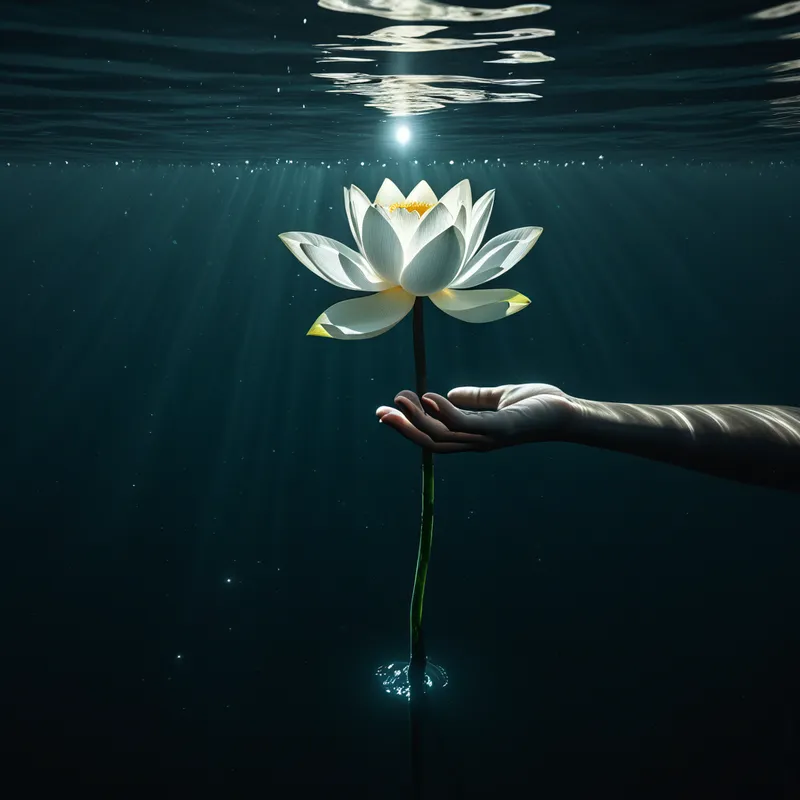
The appearance of the lotus in a dream, especially one emerging from murky water, is a profound signal from the deep psyche. It indicates that the painful process of conflict and effort is nearing a point of fruition. The dream-ego may feel lost in the churn, but the unconscious is presenting the symbol of the potential resolution: a new, intrinsic value is being born. This is not about achieving an external goal, but about the emergence of a new quality of being—perhaps self-respect after a period of self-doubt, creative clarity after creative block, or a sense of inner fortune after a streak of perceived bad luck. The dream is an assurance that the mud of our experience is the very nutrient for our blossoming.
Alchemical Translation
For the individual on the path of individuation, the myth of Lakshmi’s Lotus models the entire arc of psychic transmutation. [The first stage](/myths/the-first-stage “Myth from Alchemical culture.”/) is the recognition of the inner ocean—the vast, undefined potential and chaos of the unconscious. [The ego](/myths/the-ego “Myth from Jungian culture.”/) must then initiate the “churning” by engaging with its opposites, often projected onto external conflicts, relationships, or life challenges.
The alchemical gold is not found by avoiding the base matter, but by submitting it to the rigorous, transformative process. The churning is the opus, the great work.
This engagement is arduous. It brings up our personal “poison”—the toxic patterns, shame, and anger (Shiva’s role, integrating the poison). It feels destabilizing (the sinking mountain). Yet, this very process agitates the psyche, forcing hidden contents to the surface. The treasures that emerge first are often partial: insights, talents, or shadow aspects (the preliminary treasures of the myth). But the ultimate goal is the birth of [the Self](/myths/the-self “Myth from Jungian culture.”/), symbolized by Lakshmi on the lotus.
The alchemical translation is this: we do not create this Self. We create the conditions—the churning, the engagement with shadow and light—through conscious effort and endurance. The Self, the core of intrinsic value and wholeness, emerges as a grace. It is the lotus that grows from the mud of our lived experience. To complete the individuation process, this newly realized value (Lakshmi) must be integrated into the sustaining structure of the conscious personality (Vishnu). It must choose preservation over inflation, order over chaos. Then, the individual is no longer merely churning in life’s ocean but has become a vessel for the grace that blossoms from its very depths.
Associated Symbols
Explore related symbols from the CaleaDream lexicon: