
Laelaps Myth Meaning & Symbolism
A magical hound destined to always catch its prey is set upon a fox fated to never be caught, creating a divine paradox of impossible pursuit.
The Tale of Laelaps
Hear now a tale not of a hero’s sword, but of a chase that shook the heavens. It begins in the forge-fire heart of Hephaestus, where magic is hammered into form. From his anvil, he crafted a wonder: a hound of living bronze and divine breath. This was Laelaps, “The Hurricane.” His gift, woven into his very sinews, was a decree from the Fates themselves: whatever he pursued, he would inevitably catch. No stag could outrun him, no hare could hide. He was the embodiment of perfect, inescapable conclusion.
This peerless hound passed through godly hands, a treasure of ultimate utility, until he came to rest with the hero Cadmus, that sower of dragon’s teeth. Yet, the world holds balances. As Thebes grew proud under Cadmus’s line, a blight was sent upon it. From the shadowed rocks of Teumessus came a fox, but no ordinary beast. This creature was a phantom of speed, a darting silver streak cursed with its own divine paradox: it was destined to never, ever be caught. The Teumessian fox ravaged the land, a taunting spirit of evasion, snatching the city’s children from their very doorsteps as if they were morning dew.
The king of Thebes in those days was Amphitryon. Desperate, he called upon the hero Heracles, who was in his service. Heracles, whose strength could strangle serpents and hold up the sky, saw a puzzle that muscle could not solve. He smiled, recognizing the shape of a divine joke. He unleashed Laelaps, the hound of certain capture, upon the fox of certain escape.
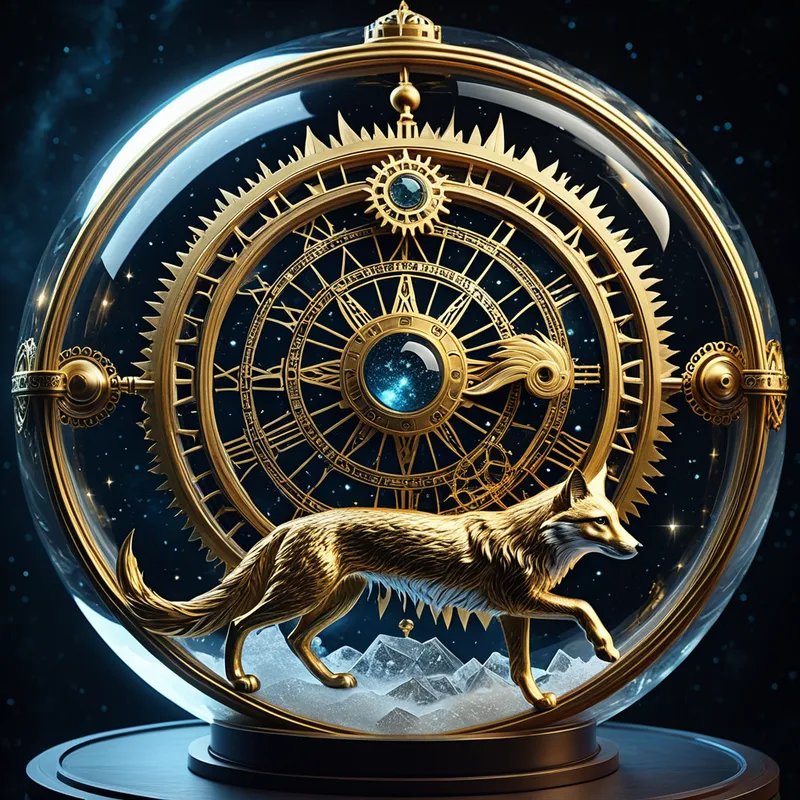
What followed was a spectacle that stilled the wind. Across the thyme-scented hills and through the dry riverbeds of Boeotia, the two destinies clashed. Laelaps, a bolt of gilded lightning, his breath a hot wind, closed the distance with relentless, mechanical grace. The fox, a whisper of mist and cunning, would seem cornered, only to dissolve and reappear a stone’s throw away, its eyes gleaming with an eternal “almost.” The chase stretched from dawn till dusk, from one horizon to the other, a perfect equation with no solution. The very earth grew tired beneath their feet. The people watched, not with fear now, but with a dawning, awful awe. They were witnessing a crack in the logic of the world.
The conflict, a spiral tightening on nothing, could not be borne by the mortal plane. The air grew heavy, charged with the scent of ozone. From the peak of Olympus, Zeus himself looked down. He saw not a hunt, but an affront—two absolute laws, creation and evasion, threatening to unravel the fabric of cause and effect. With a brow furrowed in thunder, he intervened. His hand reached down, not in wrath, but in final arbitration. In that instant, as Laelaps’s jaws were a hair’s breadth from the fox’s tail, both hunter and hunted were frozen, their essence transformed. The hurricane and the zephyr were stilled, translated into cold, silent stone, or according to some whispers, lifted into the starry vault to become constellations—eternal fixtures in the night, forever chasing, forever apart, a celestial monument to an impossible task.

Cultural Origins & Context
This myth reaches us primarily through the fragmented, scholarly compilations of later antiquity, such as the Library of Pseudo-Apollodorus and the astronomical poetry of Aratus. It lacks the grand epic treatment of a Homer, existing instead as a potent aiton—a story explaining the origin of something, in this case, likely a pair of constellations (Canis Major, the Great Dog, and perhaps Vulpecula, the Fox) or a notable rock formation in Boeotia.
Its societal function was multifaceted. On one level, it was a cautionary tale about the limits of human and even heroic agency against the higher, often paradoxical, designs of the gods. It served as a narrative anchor for the Boeotian landscape, giving divine history to its hills. More profoundly, it operated as a philosophical folktale. Told in symposia or by traveling storytellers, it presented a brain-teaser of fate, a divine logic puzzle that invited listeners to ponder the nature of inevitability, contradiction, and the point where opposing perfections cancel each other out, demanding a transcendent resolution.
Symbolic Architecture
At its core, the myth of Laelaps is an archetypal depiction of the psychic paradox. Laelaps represents the unstoppable force of conscious intention, the ego’s drive for resolution, closure, and conquest. He is the will that says, “I will catch, I will solve, I will succeed.” The Teumessian fox embodies the elusive essence of the unconscious, the shadow, or the complex that defies direct confrontation. It is the problem that reshapes itself when approached, the trauma that slips away from memory, the creative insight that vanishes at the moment of grasping.
The ultimate chase is not between hunter and prey, but between the mind’s demand for a final answer and the soul’s inherent, fluid mystery.
Their conflict is the central drama of much psychological work: the ego’s attempt to “capture” and integrate a part of the psyche through force of will, meeting the resilient, shape-shifting autonomy of that psychic content. The chase is endless because the method is flawed; one absolute is pitted against another, on the same plane of existence. The myth brilliantly illustrates that when two opposing “certainties” collide, they create a deadlock that can only be broken from a higher order of consciousness—represented by Zeus.
The Dreamer's Resonance
When this mythic pattern stirs in the modern dreamer, it often manifests as dreams of futile pursuit. You are running after a train that perpetually leaves the station, trying to read a text that blurs before your eyes, or arguing with a person whose face you cannot see. The somatic feeling is one of immense effort leading to exquisite frustration, a racing heart with nowhere to go.
Psychologically, this signals a point of profound impasse in the individuation process. The dreamer is likely caught in a “solution loop,” attempting to resolve an inner conflict—perhaps around perfectionism, a past relationship, or a creative block—using the same conscious strategies that created the stalemate. The Laelaps complex is active: the heroic ego is determined to catch the problem, to force integration or resolution. The dream is a message from the deeper Self that the current approach is an infinite loop. It is an invitation to stop running, to acknowledge the paradox, and to look for the “hand of Zeus”—the unexpected, transcendent insight that comes not from more effort, but from a shift in perspective.

Alchemical Translation
The alchemical journey modeled here is the coniunctio oppositorum—the conjunction of opposites—but one that fails on the material level and must be achieved through sublimation. The initial stages are clear: the sol (gold, active principle) of Laelaps seeks to combine with the luna (silver, passive, elusive principle) of the Fox. Yet, forced conjunction leads only to a frantic, unresolved circulatio, the endless circular chase.
The alchemical gold is not found in the capture of the elusive, but in the stillness that acknowledges the necessity of both chase and escape.
Zeus’s intervention is the critical mortificatio and sublimatio. The mortal, literal chase must “die” (be petrified) so that its essence can be raised to a higher plane (the stars). For the modern individual, this translates to the psychic transmutation that occurs when we surrender the ego’s demand to solve a core paradox (e.g., freedom vs. security, independence vs. connection, power vs. vulnerability). The struggle is not resolved through victory of one side over the other, but by finding the tertium non datur—the third thing, the transcendent viewpoint.
This might mean holding the tension creatively, allowing the opposing forces to exist in dialogue, or finding a symbolic container (like art, ritual, or a new narrative) that can hold both truths without forcing a false resolution. The individuated Self emerges not when the fox is caught, but when the individual can see the beauty and necessity of the entire, frozen, celestial dance—recognizing that the chase itself, once transformed from a literal battle to a symbolic constellation, becomes a permanent, guiding fixture in the inner sky. The energy of the impossible pursuit is not lost; it is eternalized, becoming a fixed point of reference in the soul’s cosmology.
Associated Symbols
Explore related symbols from the CaleaDream lexicon: