
Lady of the Lake Myth Meaning & Symbolism
A mysterious goddess of the deep waters offers a king-making sword and demands its return, weaving fate, sovereignty, and the unconscious into one myth.
The Tale of the Lady of the Lake
Hear now a tale not of earth, but of the threshold where earth ends. In the time of mists, when the world was young with magic, there was a king without a sword, and a sword without a king. The great Arthur, fostered and hidden, came to his moment of destiny on the shores of a lake that held its breath.
The water was a sheet of darkened silver, beneath a sky the color of a bruise. No bird called. The air was thick with the scent of wet stone and deep, cold roots. With him was the enchanter Merlin, whose eyes saw the threads of fate woven beneath the surface of things. They had come seeking a sign, for the land was broken and cried out for a true sovereign.
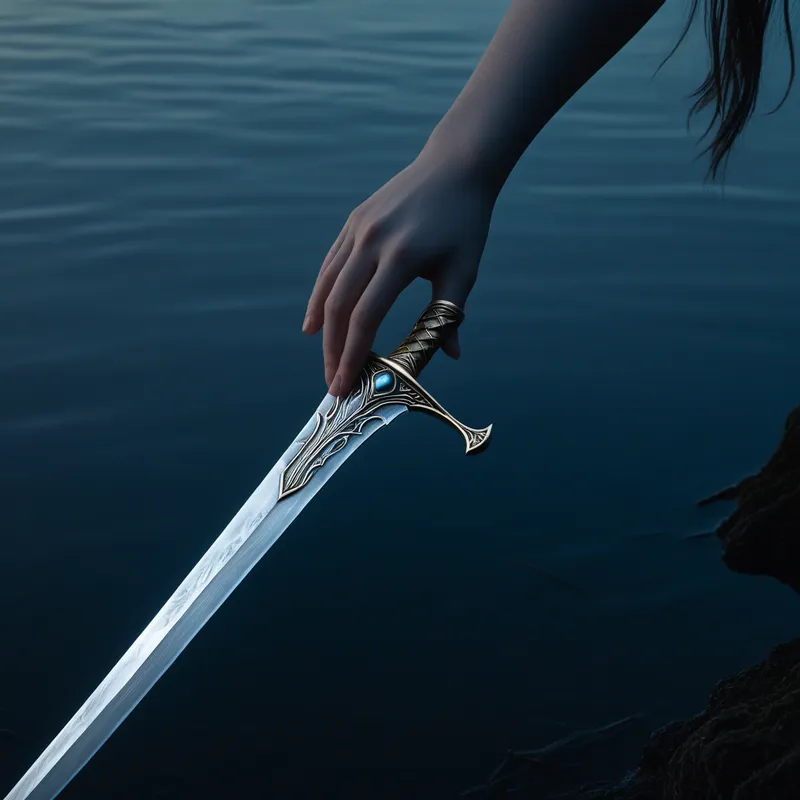
And then, the water stirred. Not with wind, but from within its own heart. A ripple became a wave, and from the center of the lake, a figure began to rise. She was the Lady. Her form was clad in samite, white and glimmering like the inside of a shell. Her hair was the deep green of the lake’s abyss, flowing with the memory of currents. In her hands, held high above the water, was a sword. It was not of any mortal forge. Its pommel was set with gems that held the light of drowned stars, and its blade was a shard of captured moonlight, fierce and terrible in its promise.
Her arm, pale and strong, extended. The sword was offered, not with a word, but with a silence that spoke of ancient covenants. Arthur, his heart pounding like a drum of war, rowed a small boat out to the marvel. He reached, his fingers closing around the hilt—the grip of destiny itself. The sword came free, and its name was whispered by the water itself: Excalibur. The Lady watched, her gaze an ocean of knowing, and then she descended, dissolving back into the deep without a ripple, leaving only the weapon and its weight in the young king’s hands.
Years flowed like rivers. Arthur built a kingdom of light, a Round Table of fellowship, with Excalibur’s justice at its core. But all covenants have two ends. Mortally wounded in his final, tragic battle, the king’s light was fading. He gave a last command to his most loyal knight, Bedivere: “Return the sword.”
Twice Bedivere went to the lonely lake, and twice he could not bear to cast such a treasure into the water. The third time, duty overcoming awe, he hurled Excalibur far out over the still surface. And again, the water parted. A hand, clad in silver samite, shot forth, caught the sword by the hilt, brandished it three times, and drew it down into the eternal dark. The covenant was complete. The sword had returned to the water from which it came, and the Lady, keeper of the sacred trust, had reclaimed her own.
Cultural Origins & Context
The figure we call the Lady of the Lake is a profound echo from the Celtic underworld, refracted through the later medieval romances of Arthurian legend. She is not a singular, fixed character in early texts, but a manifestation of a deep archetype: the sovereignty goddess of the watery otherworld. In pre-Christian Celtic belief, bodies of water—springs, wells, rivers, and lakes—were seen as portals to Tír na nÓg or Avalon. They were the domain of goddesses like Boann or Arianrhod, who conferred kingship and legitimacy.
The myth was preserved not by historians, but by bards and storytellers, from the Welsh Mabinogion to the works of Thomas Malory. Its societal function was multifaceted: it legitimized rulership as a divine gift (not mere inheritance), it emphasized the sacred contract between a king and the spirit of the land (represented by the feminine water deity), and it served as a narrative anchor for the concept of a cyclical, rather than linear, destiny. The weapon comes from the otherworld and must return to it, completing a sacred circle.
Symbolic Architecture
The Lady is the unconscious itself—the deep, feminine, formative psyche from which conscious identity and power (the sword) must emerge. She is the anima in its most majestic and impersonal form, the guide to the inner sources of authority. The lake is the liminal space, the threshold between the known world and the unknowable depths of the soul.
The sword from the stone is the claim of birthright; the sword from the lake is the gift of soul.
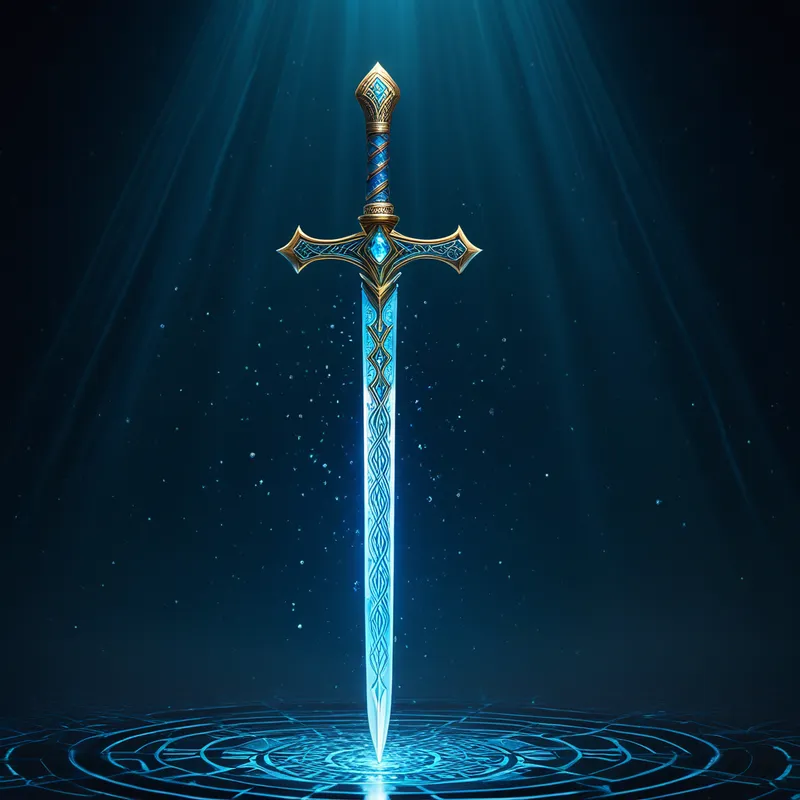
Excalibur is not merely a weapon; it is the symbol of differentiated consciousness, of the will and discernment required for true sovereignty. It is “Ex-calibur”—cutting out the kingly self from the chaos of undifferentiated potential. The act of receiving it is an initiation, a baptism not of water, but of purpose drawn from the deep. The return of the sword is perhaps the most psychologically potent act: the relinquishment of the conscious ego’s primary tool back to the unconscious from which it sprang, signifying the end of a cycle, acceptance of mortality, and the trust that what the soul gives, it also receives back in another form.
The Dreamer's Resonance
When this myth stirs in modern dreams, it speaks to a critical juncture in the dreamer’s relationship with their own inner authority and its source. To dream of a hand offering a weapon or tool from water suggests a moment of readiness to accept a difficult truth or a new responsibility that originates from the intuitive, emotional depths (the feminine/unconscious), not from logic or external validation.
Conversely, dreaming of being commanded to throw a precious possession into a body of water—be it a career, a relationship, or a long-held identity—signals a profound somatic process of release. The body may feel heavy with resistance, mirroring Bedivere’s hesitation. The psyche is working through the necessity of surrendering a hard-won conscious achievement (the sword of the ego) to a deeper, unknown process. The dream is an enactment of trust in the Self, beyond the understanding of the conscious mind. The appearance of the mysterious feminine figure in such dreams is a reassuring sign that the process, however painful, is guided and sacred.

Alchemical Translation
The myth of the Lady of the Lake is a perfect map for the alchemical process of individuation. It begins with the nigredo, the dark night of the soul—Arthur’s desperation by the lakeshore, the unformed king before the unclaimed sword. The rising of the Lady with the sword is the albedo, the washing in the mystic water, the emergence of the lapis or philosophical stone—here, the symbol of integrated consciousness and will (Excalibur).
To rule the outer world, one must first be given the sword by the queen of the inner world.
The king’s long reign represents the citrinitas, the application of this integrated consciousness to the world, bringing order and meaning. The final battle and the return of the sword embody the rubedo, the reddening, which is not merely an end but a sublime culmination. It is the ultimate transmutation: the conscious ego, having fully utilized its divine tool, willingly dissolves it back into the prima materia of the unconscious. The circle closes. The king dies, but the pattern is eternal. For the modern individual, this translates to the lifelong work of courageously drawing our unique “sword”—our vocation, our authentic voice—from the deep, nurturing waters of our own unconscious, using it to shape our world, and finally, having the wisdom to surrender it, trusting that our essence is not lost, but reintegrated into a greater, timeless whole.
Associated Symbols
Explore related symbols from the CaleaDream lexicon: