Lada Myth Meaning & Symbolism
The myth of Lada, goddess of love and harmony, tells of a cosmic balance broken and restored through sacrifice, mirroring the soul's journey to wholeness.
The Tale of Lada
Listen, child of the earth, to the tale that the old oaks whisper and the rivers sing at dawn. It begins not with a bang, but with a sigh—the long, cold sigh of a world held in the fist of Morana. The sky was a lid of grey iron, the earth a bed of sleeping stone. No green thing dared stir. No bird sang. The heart of the world had grown still, and in that stillness, a terrible imbalance festered. The people huddled in their huts, their songs forgotten, their hands too cold to weave or carve. Love grew thin as old linen; harmony was a memory.
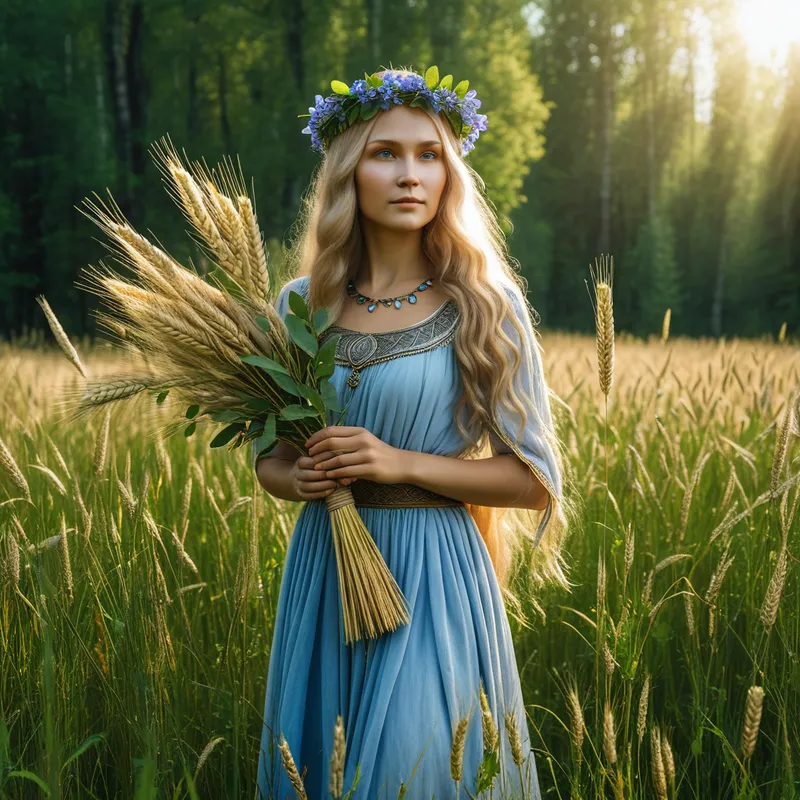
But deep in the Vyraj, the land of eternal spring that lies beyond the sunrise, a warmth was kept alive. Here dwelled Lada. She was not just beauty, but the very principle of connection—the joining of hand to hand, of seed to soil, of note to note in a song. Her hair was the colour of ripe wheat under the summer sun, her eyes held the soft light of the early dawn. Where she walked, flowers unfurled without her bidding, and discord softened into melody.
She felt the world’s ache as a pain in her own spirit. The great World Tree, which should have thrummed with life from root to crown, was silent on one side, its branches brittle with hoarfrost. The sacred balance between light and dark, growth and rest, giving and receiving, was shattered. Rest alone ruled, and it was becoming death.
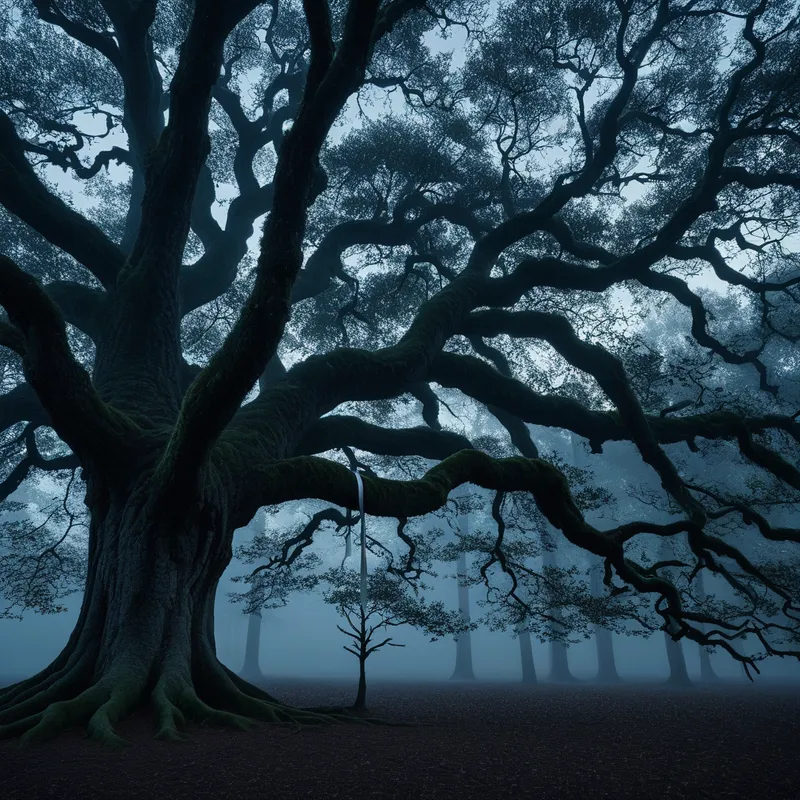
Lada knew the law of the cosmos: what is taken must be given. To rekindle the world’s heart, a spark from the very source of love must be surrendered. No command could do this. No battle. Only a willing offering. So, she descended from Vyraj, not in a chariot of fire, but as the first warm breath upon the ice. She went to the oldest, most sacred grove, where a single mighty oak stood as a testament to time.
There, with no witness but the watching stars and the sleeping earth, she performed the rite. She did not chant loud spells. Instead, she took from her own essence—a shimmering, intangible cord of light that was her direct connection to the unending spring of Vyraj. With a sorrow that was also a promise, she tied this cord, visible as a silver ribbon, to the lowest branch of the sleeping oak. As she did, her vibrant form grew faint, translucent. The immediate, personal spring within her dimmed. She had anchored a part of her own being into the frozen world.
For three days and three nights, the ribbon glimmered in the gloom. On the fourth morning, a sound cracked the silence—not thunder, but the sound of sap stirring. A single drop fell from the oak’s branch, landing on the frozen roots. Where it touched, the iron ground softened. A single, brave snowdrop pushed through. The ribbon was gone, absorbed, but its work had begun. The ice retreated, not with a flood, but with a weep of grateful water. Buds swelled on the trees. Birds, returning from their own Vyraj, filled the air with the songs the people had forgotten. Lada, now woven into the very fabric of the land, was no longer just in Vyraj. She was in the first kiss of lovers reunited after the long winter, in the harmony of the sowing song, in the fragile, triumphant green of every new leaf. The world did not just wake; it remembered how to love.
Cultural Origins & Context
The figure of Lada emerges from the deep, polytheistic soil of pre-Christian Slavic spirituality, a tradition intimately tied to the agrarian cycle and the rhythms of nature. Unlike the codified pantheons of Greece or Rome, Slavic mythology was primarily an oral, folk tradition, passed down through seasonal rituals, byliny, and embroidery patterns on ritual garments. Scholars debate whether Lada was a supreme goddess of love and marriage or a later, personified abstraction from ritual refrains ("Lado! Lado!" sung in wedding and spring folk songs). What remains undeniable is her central function.
Her myth was not read but enacted. It was lived every year during the spring festivals that marked the end of Morana's reign. Effigies of Morana were ritually drowned or burned, and the coming of Lada was invoked with dances, wreaths of fresh flowers, and songs celebrating fertility and union. She was the divine justification for marriage, seen not merely as a social contract but as a sacred microcosm of the cosmic harmony between masculine and feminine, sky and earth. The storytellers were the grandmothers teaching the patterns, the village singers leading the khorovod, and the communal feeling of relief and joy as winter broke. Her tale served as a societal anchor, explaining why the world renews and prescribing the human actions—through ritual, song, and ethical union—that help maintain that precious, fragile balance.
Symbolic Architecture
At its core, the myth of Lada is a profound map of psychic ecology. Lada represents the archetypal principle of Eros in its fullest sense—not merely romantic love, but the connective force that binds the cosmos, the drive toward relationship, synthesis, and beautiful order.
The sacrifice of harmony is not its loss, but its investment; the goddess must become diffuse to become omnipresent.
The frozen world symbolizes a psyche in stasis, dominated by the inertia of the unconscious or the cold grip of a single, unchallenged complex (winter, depression, isolation). The World Tree represents the Self, the total psyche, which is dysfunctional when one pole is utterly dominant. Lada's journey from Vyraj (the paradisiacal unconscious) to the mortal world is the necessary descent of consciousness into the frozen, conflicted areas of life. Her key act—tying her essence to the oak—is the critical symbolic moment. It is the voluntary limitation of the divine, the acceptance of embodiment and vulnerability for the sake of relationship and healing. She exchanges perfect, self-contained bliss for effective, distributed love. The silver ribbon is the symbol of this covenant, a tangible thread of consciousness and intention that bridges the ideal and the real, the spiritual and the material.
The Dreamer's Resonance
When this myth stirs in the modern dreamer, it often manifests as dreams of profound seasonal change within the psyche. One might dream of a beloved garden covered in thick, unyielding frost, yet feel a compulsion to plant a single seed in the iron-hard earth. Or dream of a house where one wing is bright, warm, and full of music, while the other is sealed, dark, and silent, with the dreamer searching for a key that is not a metal object, but a forgotten song.
Somatically, this process can feel like a deep, melancholic longing—a "spring fever" of the soul that aches for a connection or creativity that feels just out of reach. Psychologically, it is the process of confronting a life that has become stagnant, orderly but lifeless, or a relationship that has lost its Eros. The dreamer is in the phase where the conscious mind recognizes the "winter," but the instinctive, life-giving response has not yet been activated. The myth appears to guide the dreamer toward the Lada-like sacrifice: the willingness to risk a part of one's current stability, self-image, or emotional reserves (the "ribbon") to invest in a frozen area, trusting it will catalyze a wider thaw.

Alchemical Translation
The alchemical journey mirrored in Lada's myth is the process of individuation, specifically the integration of the anima/animus to restore psychic balance. The initial state is nigredo—the frozen world, the depression, the dominance of the critical or deathly principle (Morana).
The work is not to conquer the winter, but to willingly become the bridge upon which spring can cross.
Lada's decision represents the conscious ego's agreement to engage in the painful but necessary work. The descent is the mortificatio, a symbolic death where old structures of perfect, isolated self-sufficiency must die. Tying the ribbon to the oak is the central act of coniunctio—the sacred marriage. Here, it is the marriage of the divine principle (Lada's essence) with the earthly, rooted reality (the oak). This is not a union that creates a third thing externally, but one that transforms the base material (the frozen earth/psyche) from within.
The three-day wait is the albedo, the whitening, a period of incubation and purification where the change works invisibly. The final thaw and blossoming are the rubedo, the reddening, the emergence of the new, integrated consciousness. The goddess, now immanent in the world, symbolizes the achieved state where love and harmony are no longer sought as external gifts, but recognized as the fundamental, operative principles of a psyche that has accepted its own embodiment, vulnerability, and capacity for regenerative sacrifice. The individual becomes a vessel for the seasonal rhythm of death and rebirth, no longer fearing the winter, because they carry the promise of the ribbon within.
Associated Symbols
Explore related symbols from the CaleaDream lexicon:
- Love — The central, animating force Lada embodies, representing not just passion but the cosmic principle of connection, synthesis, and beautiful order that binds all things.
- Sacrifice — The voluntary offering of a part of one's essence or comfort for a greater wholeness, as seen in Lada's gift of her ribbon to thaw the world.
- Rebirth — The inevitable return of life and harmony following the sacrificial act, symbolized by the spring that erupts after Lada's offering.
- Tree — The World Tree or sacred oak, representing the axis of the cosmos and the individual Self, which must be healed and balanced.
- Flower — The direct manifestation of Lada's influence, symbolizing fragile beauty, blossoming potential, and the triumph of life over stagnation.
- Song — The vehicle of the myth and the expression of restored harmony; the music that returns to the world and to the human heart.
- Circle — The cyclical nature of the seasons and the myth itself, representing the eternal process of harmony, dissolution, sacrifice, and renewal.
- Ritual — The human actions (dances, songs, wreath-making) that enact and participate in the divine drama, maintaining the covenant with the generative forces.
- Goddess — The divine feminine principle as the source of nurturing, connective, and creatively fertile energy.
- Seed — The latent potential buried in the frozen earth of the psyche, awaiting the catalytic sacrifice to trigger its inevitable growth.
- Light — The warmth and consciousness that Lada brings, which is not a blinding glare but a gentle, pervasive dawn that awakens life.
- Balance — The ultimate goal of the myth, the restoration of the sacred equilibrium between growth and rest, giving and receiving, which is true health.