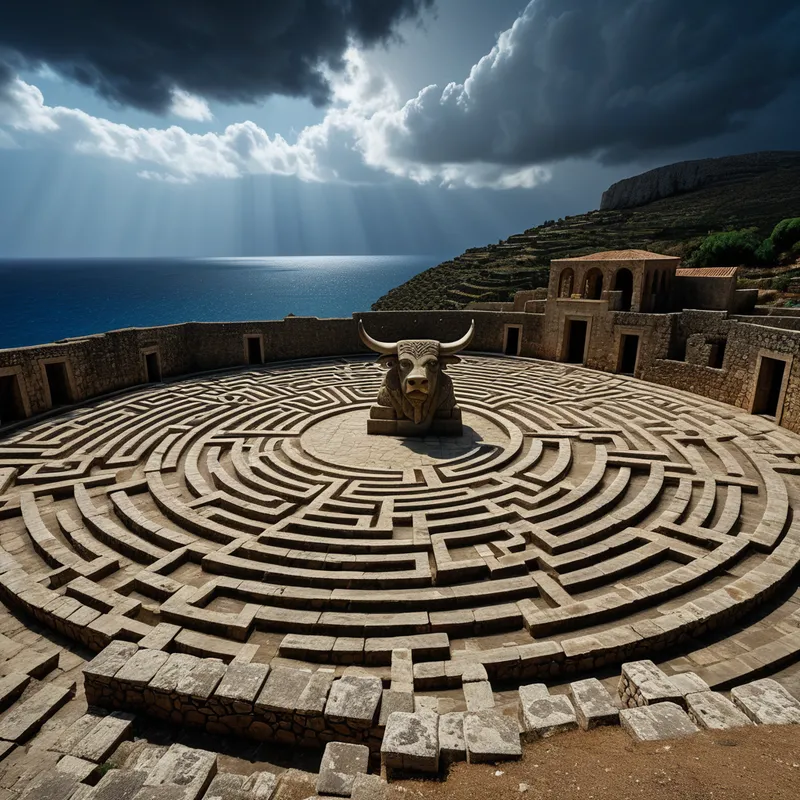
Labyrinth of Minos Myth Meaning & Symbolism
A king's broken vow births a monster, imprisoned in a maze. A hero descends with a thread, confronting the beast to reclaim his people's freedom.
The Tale of Labyrinth of Minos
Hear now of a king’s pride and a god’s wrath, of a monster born from broken faith, and of a darkness built not of earth, but of cunning. In the great palace of [Minos](/myths/minos “Myth from Greek culture.”/) on sun-drenched Crete, a bull of purest white emerged from [the sea](/myths/the-sea “Myth from Greek culture.”/)’s foam, a gift from [the Earth](/myths/the-earth “Myth from Hindu culture.”/)-Shaker himself, [Poseidon](/myths/poseidon “Myth from Greek culture.”/). The god’s command was clear: sacrifice the beast to honor the gods. But [Minos](/myths/minos “Myth from Greek culture.”/), his heart swollen with avarice, looked upon the magnificent creature and could not bear its loss. He hid the bull and slew another in its place.
The sea is not so easily deceived. Poseidon’s fury did not strike with a trident, but with a far crueler twist of fate. He poured a maddening passion into the heart of Pasiphaë, the queen, a lust that bent toward the white bull. From this unholy union, a child was born—but no mortal babe. He was a creature of two natures: the body of a powerful man, the head and tail of a bull. They named him Asterion, but [the world](/myths/the-world “Myth from Tarot culture.”/) would know him as [the Minotaur](/myths/the-minotaur “Myth from Greek culture.”/), the Bull of Minos.
The king’s shame was as deep as his fear. To conceal this living testament to his sin and the queen’s affliction, he summoned the divine artisan Daedalus. “Build me a prison,” commanded Minos, “from which nothing that enters may ever find its way out.” And so Daedalus, his genius turned to a dark purpose, conceived [the Labyrinth](/myths/the-labyrinth “Myth from Greek culture.”/). It was not merely a maze of stone, but a place of perfect confusion, a winding, twisting, ever-turning architecture of despair. Into its heartless core, the bellowing [Minotaur](/myths/minotaur “Myth from Greek culture.”/) was cast, fed on a grim tribute: seven youths and seven maidens, shipped across the wine-dark sea from conquered Athens, delivered to the darkness to sate the monster’s hunger.
This was the world’s order, a cycle of shame and death, until a prince with the sun in his lineage set sail. [Theseus](/myths/theseus “Myth from Greek culture.”/), son of Poseidon or of the mortal king Aegeus—the stories whisper both—volunteered to be among the tribute. His goal was not surrender, but termination. In Crete, before the descent, a princess saw him. Ariadne, her heart pierced by the sight of the doomed hero, offered him a way through the impossible: a simple ball of thread. “Fasten this to the entrance,” she whispered, her voice a thread itself in the palace shadows. “Unwind it as you go. It will be your memory in stone, your path back from forgetting.”
Torch in one hand, sword in the other, thread in his grip, Theseus stepped into the mouth of the [Labyrinth](/myths/labyrinth “Myth from Various culture.”/). The air grew cold and still, the only sounds the scuff of his sandals and the distant, echoing roar of the beast. He walked for what felt like ages, the path doubling back, leading in circles, the very walls seeming to breathe and shift. The thread spooled out, a fragile lifeline of reason in the realm of chaos. Deeper and deeper he went, until the roars were not echoes but presence, until the stench of old blood filled his nostrils. And there, in the central chamber, the Minotaur stood—a mountain of muscle and rage, a primal scream given form.
The battle was not long, but it was titanic, a clash of hero and heritage, of order and raw instinct. With a final, mighty thrust, Theseus slew the beast. Silence fell, heavier than the darkness. Then, hand trembling not from fear but from the enormity of the act, he took up the thread and began to rewind his fate, following the slender guide back through the winding stone intestines, back to the world of light, back to Ariadne’s waiting eyes, and toward a freedom yet to be won.
Cultural Origins & Context
This myth, crystallized in the epic poetry of the Archaic age and later refined by Athenian tragedians, is not a simple monster-slaying story. It is a foundational political and psychological narrative for the ancient Greek world, particularly for Athens. The myth served to explain and justify Athenian maritime dominance and its complex relationship with the earlier, powerful Minoan civilization of Crete (from which Minos’s name derives). The tribute of youths symbolized a historical subjugation, and Theseus’s victory represented Athens’s rise and liberation from Cretan hegemony.
The story was a living entity, passed down by bards, enacted in rituals, and painted on pottery. It functioned as a civic myth for Athens, with Theseus as its culture hero. The annual festival of the Theseia celebrated his deeds, and his symbolic journey was re-enacted. The Labyrinth itself may echo the bewildering layout of the actual Minoan palace complexes at Knossos, which later Greeks saw as the monstrous prison of their imagination. The myth thus sits at a crossroads: between history and fantasy, between the power of a lost civilization and the founding identity of a new one.
Symbolic Architecture
The [Labyrinth](/symbols/labyrinth “Symbol: The labyrinth represents a complex journey, symbolizing the intricate path toward self-discovery and understanding one’s life’s direction.”/) is the myth’s central [symbol](/symbols/symbol “Symbol: A symbol can represent an idea, concept, or belief, serving as a powerful tool for communication and understanding.”/), far more than the [Minotaur](/symbols/minotaur “Symbol: The Minotaur, a creature from Greek mythology, is often interpreted as a symbol of inner turmoil and the struggle between human and beast.”/) itself. It is not a [puzzle](/symbols/puzzle “Symbol: A symbol representing the challenge of solving complex problems, finding order in chaos, or assembling fragmented aspects of self or reality.”/) to be solved, but a state of being to be endured and traversed.
The Labyrinth is the architecture of the unconscious mind—a structured chaos where logic fails and the only way out is through.
The Minotaur is the [shadow](/symbols/shadow “Symbol: The ‘shadow’ embodies the unconscious, repressed aspects of the self and often represents fears or hidden emotions.”/) made flesh: the bestial, unacceptable [offspring](/symbols/offspring “Symbol: Represents legacy, responsibility, and the future self. Often symbolizes creative projects or personal growth.”/) of a [king](/symbols/king “Symbol: A symbol of ultimate authority, leadership, and societal order, often representing the dreamer’s inner power or external control figures.”/)’s broken [oath](/symbols/oath “Symbol: A solemn promise or vow, often invoking a higher power or sacred principle, binding individuals to specific actions or loyalties.”/) (conscious deceit) and a [queen](/symbols/queen “Symbol: A queen represents authority, power, nurturing, and femininity, often embodying leadership and responsibility.”/)’s divine madness (unconscious compulsion). It is the denied [truth](/symbols/truth “Symbol: Truth represents authenticity, honesty, and the quest for knowledge beyond mere appearances.”/) of [the self](/myths/the-self “Myth from Jungian culture.”/), confined to the center of the [psyche](/myths/psyche “Myth from Greek culture.”/) and fed on sacrificial vitality—the [energy](/symbols/energy “Symbol: Energy symbolizes vitality, motivation, and the drive that fuels actions and ambitions.”/) of [youth](/symbols/youth “Symbol: Youth symbolizes vitality, potential, and the phase of life associated with growth and exploration.”/) and potential devoured to sustain a repressed complex.
Theseus represents the heroic ego-[consciousness](/symbols/consciousness “Symbol: Consciousness represents the state of awareness and perception, encompassing thoughts, feelings, and experiences.”/) that chooses to confront what has been hidden. He does not enter alone. Ariadne’s thread—Ariadne’s thread—is the crucial gift. It symbolizes the sophrosyne (mindfulness), the [connection](/symbols/connection “Symbol: Connection symbolizes relationships, communication, and bonds among individuals.”/) to a guiding principle outside the [maze](/symbols/maze “Symbol: A maze represents confusion, complexity, or a search for truth, often reflecting life’s challenges or inner turmoil.”/) itself: love, [intuition](/symbols/intuition “Symbol: The immediate, non-rational understanding of truth or insight, often described as a ‘gut feeling’ or inner knowing that bypasses conscious reasoning.”/), or a remembered promise. It is the thread of [consciousness](/symbols/consciousness “Symbol: Consciousness represents the state of awareness and perception, encompassing thoughts, feelings, and experiences.”/) that must be laid down into the darkness so it can be followed back into the light.
The Dreamer’s Resonance
When the Labyrinth appears in modern dreams, the dreamer is navigating a profound state of psychological aporia—a feeling of being lost, trapped, or circling a central problem with no clear exit. The dream labyrinth might be an endless office corridor, a recurring neighborhood that never leads home, or a fractal interior space.
The somatic experience is often one of mounting anxiety, shortness of breath, and a desperate search for a pattern. The Minotaur may not appear as a literal monster; it may be a looming deadline, a forgotten memory, a suffocating relationship, or simply a terrifying sense of presence at the dream’s center. The dream is an enactment of the psyche’s attempt to orient itself within a complex, self-created confinement. The critical question for the dreamer is: What is the thread? What is the slender, easily overlooked connection—a person, a idea, a creative act, a truth—that can be paid out to guide [the way](/myths/the-way “Myth from Taoist culture.”/) back to integration?
Alchemical Translation
The myth models the alchemical individuation process with stark clarity. [The ego](/myths/the-ego “Myth from Jungian culture.”/) (Theseus) must voluntarily descend (nekyia) into the chaotic, mineral [underworld](/myths/underworld “Myth from Greek culture.”/) of the unconscious (the Labyrinth). It does so not to wander aimlessly, but with a specific intent: to confront and integrate [the shadow](/myths/the-shadow “Myth from Jungian culture.”/) (the Minotaur).
The slaying is not destruction, but a sacred dissolution; the beast is not killed, but transmuted from a consumer of life into a source of power for the conscious self.
The thread is the vinculum, the connecting principle that prevents the ego from being utterly dissolved in the unconscious. It is the observing consciousness itself, the commitment to return and report. The [triumph](/myths/triumph “Myth from Roman culture.”/) is not merely escape, but the re-emergence with the shadow’s energy now available to the whole personality. Theseus returns, but he is changed; he leaves Ariadne (the initial anima guide) because that specific form of guidance is no longer needed. He has internalized the thread. For the modern individual, the myth instructs: to find one’s way, one must first have the courage to become profoundly lost, armed only with the slender, unwavering thread of one’s own attentive consciousness.
Associated Symbols
Explore related symbols from the CaleaDream lexicon: