Labyrinth of Daedalus Myth Meaning & Symbolism
A master architect builds an inescapable maze to imprison a monstrous secret, setting the stage for a hero's descent and a father's tragic flight.
The Tale of Labyrinth of Daedalus
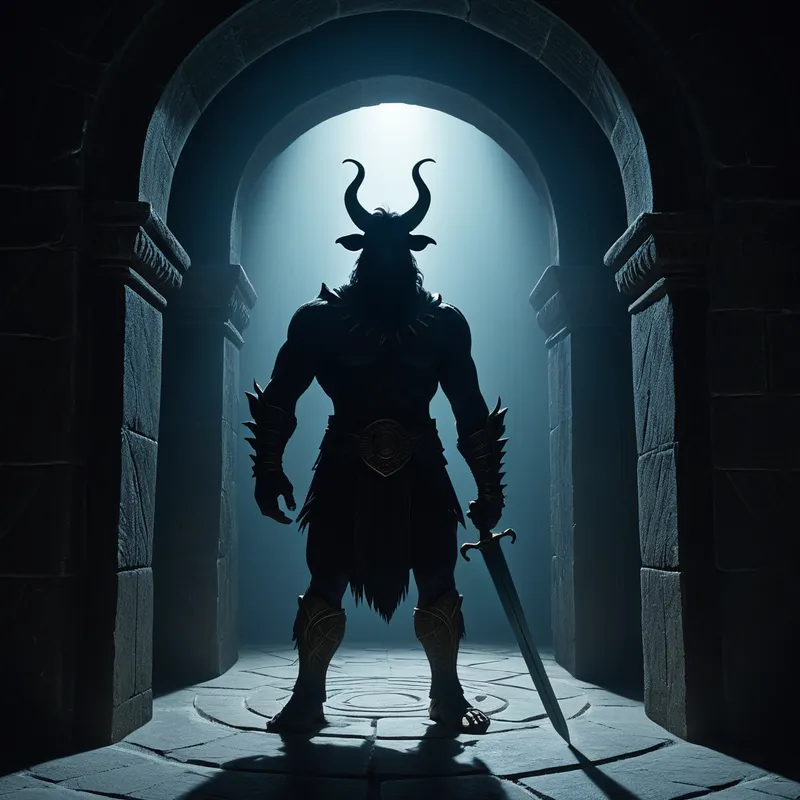
Hear now the tale of the maze that was not stone, but fate itself, woven by the cleverest hands in all [the world](/myths/the-world “Myth from Tarot culture.”/). It begins not with a king, but with a bull—a bull not of [the earth](/myths/the-earth “Myth from Hindu culture.”/), but sent from [the sea](/myths/the-sea “Myth from Greek culture.”/), a dazzling white beast of [Poseidon](/myths/poseidon “Myth from Greek culture.”/). To [Minos](/myths/minos “Myth from Greek culture.”/), lord of Crete, the god gave this sign of favor, demanding its return. But [Minos](/myths/minos “Myth from Greek culture.”/)’s heart was covetous; he kept the glorious creature and sacrificed another in its stead. From [the sea](/myths/the-sea “Myth from Greek culture.”/)’s wrath and a queen’s unnatural passion, a horror was born: the [Minotaur](/myths/minotaur “Myth from Greek culture.”/), a creature of ravenous hunger, with the body of a man and the head of a bull.
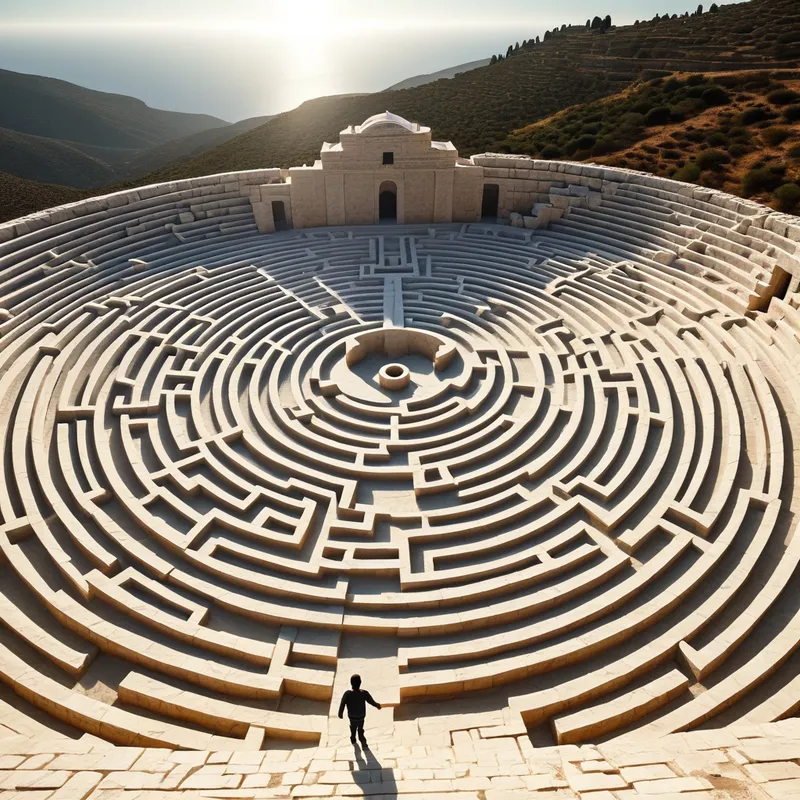
The king’s shame was as deep as his fear. He summoned Daedalus, [the architect](/myths/the-architect “Myth from Various culture.”/) whose genius bordered on the divine. “Build me a prison,” commanded Minos, “from which this… [thing](/myths/thing “Myth from Norse culture.”/)… can never escape. A place to hide my sin from the sun.” And Daedalus, whose mind held the secrets of geometry and the soul, conceived of the [Labyrinth](/myths/labyrinth “Myth from Various culture.”/). He did not build a simple dungeon, but a waking dream of stone—a path that turned back on itself, corridors that led only to other corridors, a puzzle with a monstrous heart. No wall was straight for long; every choice was a deception. Into its center, the bellowing Minotaur was thrust, and the gates were sealed.
Yet a maze that contains a monster must be fed. To atone for the death of his son in Athens, Minos demanded a terrible tribute: every nine years, seven youths and seven maidens were sent into [the Labyrinth](/myths/the-labyrinth “Myth from Greek culture.”/)’s mouth, a sacrificial feast for the beast within. The stone halls drank their terror, until the hero [Theseus](/myths/theseus “Myth from Greek culture.”/), son of Poseidon, volunteered to be part of the tribute. In Crete, the king’s daughter, Ariadne, saw him and was struck by love—and by a spark of rebellion against her father’s cruel design.
She went to the creator of the maze, Daedalus, now himself a prisoner of his own creation, held by Minos to keep its secrets. “How does one walk the path and return?” she pleaded. And Daedalus, the weaver of traps, gave her the means of escape: a simple skein of thread. “Tie one end here, at the entrance,” he instructed. “Let the rest unravel as you go. The path in will become the path out.”
In the profound silence of the Labyrinth, with only the sound of his own breath and the distant, echoing snort of the beast, Theseus played out the thread. He moved deeper into the winding darkness, the stone cold and indifferent, until he stood in the central chamber. There, in the gloom, [the Minotaur](/myths/the-minotaur “Myth from Greek culture.”/) charged. It was not a battle of armies, but a primal struggle in a sunless womb of stone. With strength and fate, Theseus prevailed. Then, hand on the lifeline, he retraced his steps, pulling the past behind him, leading the surviving Athenians out from the belly of the beast and into the blinding Cretan light.
But the story of the maze does not end with the hero’s exit. Minos, enraged by the betrayal and the loss of his monster, imprisoned Daedalus and his young son, [Icarus](/myths/icarus “Myth from Greek culture.”/), in a high tower. Yet you cannot cage the mind that conceived the Labyrinth. Looking to the birds, Daedalus crafted wings of feathers and wax. “Follow my path,” he warned [Icarus](/myths/icarus “Myth from Greek culture.”/). “Fly [the middle way](/myths/the-middle-way “Myth from Buddhist culture.”/). Not too low, where the sea’s damp will clog your wings, nor too high, where the sun’s fire will melt them.” They leapt from their prison into [the sky](/myths/the-sky “Myth from Persian culture.”/), a father and son transformed. But [Icarus](/myths/icarus “Myth from Greek culture.”/), drunk on the freedom of the air, soared ever upward, until the sun’s heat loosened the wax, the feathers scattered, and he fell, a brief, brilliant star extinguished in the sea below. Daedalus flew on, a creator forever marked by the cost of his escape, leaving the empty Labyrinth behind as a silent monument to ingenuity and its consequences.
Cultural Origins & Context
The myth of the Labyrinth is woven from many threads of pre-Greek and Greek culture. Its core likely originates in the magnificent, sprawling palace complexes of Minoan Crete (c. 2000-1450 BCE), whose ruins at Knossos feature a confusing, multi-level layout that could easily have inspired later tales of a maze. The bull was central to Minoan religion and ritual, as frescoes of bull-leaping attest, making the figure of the Minotaur a potent Greek reinterpretation—and demonization—of older Cretan symbols.
The story as we know it was crystallized in the oral tradition and later by poets and tragedians. It is a foundational Athenian myth, used to explain and glorify their supposed historical dominance over Crete. Theseus’s [triumph](/myths/triumph “Myth from Roman culture.”/) symbolized Athenian civic order and courage overcoming monstrous, archaic tyranny. The myth was performed in rituals, painted on pottery, and recounted as a parable of cunning, sacrifice, and the perils of overreaching, with Daedalus representing the awesome, double-edged power of human invention.
Symbolic Architecture
The [Labyrinth](/symbols/labyrinth “Symbol: The labyrinth represents a complex journey, symbolizing the intricate path toward self-discovery and understanding one’s life’s direction.”/) is the ultimate [symbol](/symbols/symbol “Symbol: A symbol can represent an idea, concept, or belief, serving as a powerful tool for communication and understanding.”/) of the complex, winding [structure](/symbols/structure “Symbol: Structure in dreams often symbolizes stability, organization, and the framework of one’s life, reflecting how one perceives their environment and personal life.”/) of the unconscious mind. It is not a [prison](/symbols/prison “Symbol: Prison in dreams typically represents feelings of restriction, confinement, or a lack of freedom in one’s life or mind.”/) of [chaos](/symbols/chaos “Symbol: In Arts & Music, chaos represents raw creative potential, uncontrolled expression, and the breakdown of order to forge new artistic forms.”/), but of designed [confusion](/symbols/confusion “Symbol: A state of mental uncertainty or disorientation, often reflecting internal conflict, lack of clarity, or overwhelming choices in waking life.”/). Its center does not hold a [treasure](/symbols/treasure “Symbol: A hidden or valuable object representing spiritual wealth, inner potential, or divine reward.”/), but a [shadow](/symbols/shadow “Symbol: The ‘shadow’ embodies the unconscious, repressed aspects of the self and often represents fears or hidden emotions.”/)—the [Minotaur](/symbols/minotaur “Symbol: The Minotaur, a creature from Greek mythology, is often interpreted as a symbol of inner turmoil and the struggle between human and beast.”/), the unintegrated, bestial [aspect](/symbols/aspect “Symbol: A distinct feature, quality, or perspective of something, often representing a partial view of a larger whole.”/) of [the self](/myths/the-self “Myth from Jungian culture.”/) born from [shame](/symbols/shame “Symbol: A painful emotion arising from perceived failure or violation of social norms, often involving exposure of vulnerability or wrongdoing.”/) and hidden desire.
The hero’s task is not to slay the monster, but to confront the part of himself that the monster represents.
Daedalus is the archetypal [Creator](/symbols/creator “Symbol: A figure representing ultimate origin, divine power, or profound authorship. Often embodies the source of existence, innovation, or personal destiny.”/), whose intellect can solve any [problem](/symbols/problem “Symbol: Dreams featuring a ‘problem’ often symbolize internal conflicts or challenging situations that require resolution and self-reflection.”/) but cannot foresee the full consequence of his creations. The Labyrinth is his masterpiece and his trap, a [metaphor](/symbols/metaphor “Symbol: A figure of speech where one thing represents another, often revealing hidden connections and deeper truths through symbolic comparison.”/) for the brilliant, isolating structures of [the ego](/myths/the-ego “Myth from Jungian culture.”/) that can entrap even their architect. Ariadne’s thread is the slender, conscious [intention](/symbols/intention “Symbol: Intention represents the clarity of purpose and direction in one’s life and can symbolize motivation and commitment within a dream context.”/)—love, [purpose](/symbols/purpose “Symbol: Purpose signifies direction, meaning, and intention in life, often reflecting personal ambitions and core values.”/), [insight](/symbols/insight “Symbol: A sudden, deep understanding of a complex situation or truth, often arriving unexpectedly and illuminating hidden connections.”/)—that must be paid out to navigate the inner darkness and find [the way](/myths/the-way “Myth from Taoist culture.”/) back to the world. The [flight](/symbols/flight “Symbol: Flight symbolizes freedom, escape, and the pursuit of one’s aspirations, reflecting a desire to transcend limitations.”/) with wings of wax and feathers represents the perilous [ascent](/symbols/ascent “Symbol: Symbolizes upward movement, progress, spiritual elevation, or striving toward higher goals, often representing personal growth or transcendence.”/) of [spirit](/symbols/spirit “Symbol: Spirit symbolizes the essence of life, vitality, and the spiritual journey of the individual.”/) and ambition, a necessary escape that carries within it the seed of tragic [loss](/symbols/loss “Symbol: Loss often symbolizes change, grief, and transformation in dreams, representing the emotional or psychological detachment from something or someone significant.”/) (Icarus) through hubris.
The Dreamer’s Resonance
To dream of a labyrinth is to experience the [psyche](/myths/psyche “Myth from Greek culture.”/)’s signal that one is in a state of existential or psychological confusion. The somatic feeling is often one of mounting anxiety, a tightening in the chest, a sense of being turned around in one’s own life. The dreamer may feel pursued or may be seeking something unnamed in the center.
This dream pattern indicates a process of confronting the personal “Minotaur”—a repressed emotion, a shameful memory, a raging instinct that has been walled off and fed by negative energy. The dream is the psyche’s attempt to run the thread, to map the territory of a complex problem or emotional knot. There is no monster to fight in the waking world, only an aspect of the self that feels monstrous and must be faced, understood, and integrated. The dream-labyrinth is the mind’s workshop for this slow, inward turning.
Alchemical Translation
The myth models the complete alchemical cycle of psychic transmutation, or individuation. The [prima materia](/myths/prima-materia “Myth from Alchemical culture.”/) is the base, unconscious state: the shameful secret (Minos’s sin) that gives birth to a consuming complex (the Minotaur).
- Confinement (The Labyrinth): The ego, through its own cleverness or defense mechanisms (Daedalus), constructs a complex structure to contain the problem. This is the [nigredo](/myths/nigredo “Myth from Alchemical culture.”/), the blackening, where one feels lost in one’s own psyche.
- The Descent (Theseus’s Entry): Conscious will (the hero) must voluntarily descend into this confusion, aided by a connecting principle from the anima/animus (Ariadne’s love, represented by the thread).
- The Confrontation (Battle with the Minotaur): This is the crucial mortificatio and [separatio](/myths/separatio “Myth from Alchemical culture.”/). The heroic consciousness does not annihilate [the shadow](/myths/the-shadow “Myth from Jungian culture.”/), but engages it, struggles with it, and ultimately liberates its energy from its monstrous form.
- The Return (Following the Thread): Integrating the insight gained, the conscious self retraces its path, now with understanding, reclaiming the lost parts (the other tributes) and emerging renewed.
- The Ascent (Flight of Daedalus and Icarus): The final stage is sublimatio—transcending the old, confining structure altogether. The psyche seeks a new, aerial perspective. Yet here lies the ultimate warning: the spirit (Icarus) that flies too high, identifying solely with its liberated, inflated state, risks a fatal fall. True integration requires grounding as well as aspiration.
The labyrinth is solved not by seeing it from above, but by trusting the thread within. The flight from it is not an escape from the self, but a tragic lesson in the balance required to carry the self into a new world.
Thus, the myth teaches that the path to wholeness is a winding one of confrontation, guided by love, tempered by wisdom, and forever mindful of the heights to which our own ingenuity can both raise and ruin us.
Associated Symbols
Explore related symbols from the CaleaDream lexicon: