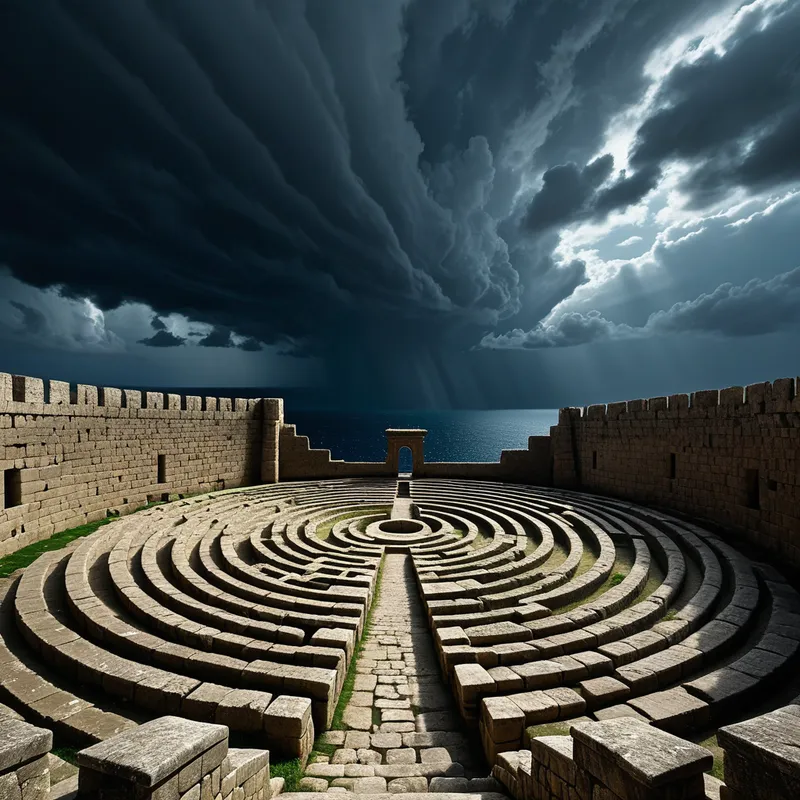
Labyrinth Myth Meaning & Symbolism
A hero enters a winding, inescapable maze to face a monstrous secret at its heart, emerging transformed by the perilous journey inward.
The Tale of the Labyrinth
Listen, and hear a tale not of stone and earth, but of pride and consequence, of a path that winds into the very dark of the soul. In the age when gods walked close to mortals, a king’s shame demanded a cage. Not of iron bars, but of cunning and stone. The master-craftsman Daedalus, his mind a forge of impossible designs, was commanded to build a prison from which nothing born of earth could escape. He did not build walls, but a riddle. He built the Labyrinth.
Its entrance was a silent mouth in the sun-baked earth of Crete. To step inside was to leave the world. The path did not go forward or back; it turned in on itself, a serpent swallowing its own tail. The air grew still and cool, smelling of damp clay and old fear. The only sound was the echo of your own breath, thrown back at you by the endless, identical walls. Left, right, double-back, a staircase leading only to another identical corridor. The sun was a forgotten memory. Here, the mind unraveled before the feet ever tired.
And at the heart of this stone intestine, it waited. The Minotaur. Its breath was hot and foul, a low rumble in the dark. Its form was a blasphemy—the powerful, sweating bulk of a bull, crowned with heavy horns, yet standing upright with the desperate, intelligent rage of a man trapped in a beast’s body. It was the king’s secret, fed on tribute, a living monument to unnatural desire and royal shame.
Into this waking nightmare came the prince Theseus, not with an army, but with a spool of thread. The princess Ariadne, whose heart saw the monster for what it was—her own family’s torment—gave him the clue: a simple skein of flax. As he descended, he paid out the thread, a fragile, gleaming lifeline back to a world of light and love. Deeper he went, the roars growing louder, the stench thickening. The final corridor opened into a vast, dark chamber.
The confrontation was not glorious. It was brutal, intimate, and desperate. Man and monster, reflections of order and chaos, clashed in the absolute dark. When it was done, Theseus stood panting, the beast slain. But the victory was hollow without the path out. Then he saw it—the slender, almost invisible thread, glowing faintly in the oppressive gloom. He followed it, hand over hand, through the dizzying turns, the thread his only tether to sanity and self. He emerged into the blinding sun, not just from a maze of stone, but from the belly of a nightmare, reborn.
Cultural Origins & Context
The labyrinth myth is most famously crystallized in the Greek mythos of Theseus and the Minotaur, recorded by poets like Ovid and woven into the foundational narratives of Athenian identity. However, the symbol itself is far older and more widespread. It appears carved into rock faces in Etruscan tombs, traced on the floors of Gothic cathedrals like Chartres, and woven into the folklore of cultures from Scandinavia to India.
In its earliest forms, such as the simple, unicursal (single-path) designs found in Neolithic sites, the labyrinth was likely not a puzzle but a prescribed path—a ritual tool. To walk it was to undertake a symbolic journey to a sacred center and back, a form of pilgrimage, meditation, or initiation. The Greek myth complexified this symbol, transforming it from a ritual path into a trap, infusing it with psychological terror and moral narrative. It was a story told to explain rites of passage, the terrifying transition from youth to adulthood, and the Athenian civic triumph over Minoan power. It was a bard’s tale of heroic national identity, but its roots tapped into a universal human experience of being lost within a structure of one’s own making.
Symbolic Architecture
The labyrinth is the ultimate symbol of the psyche’s hidden, convoluted structure. It is not a random maze, but a designed, intricate pattern with a single, winding path to a center. This makes it distinct from a maze, which is designed to confuse with choices and dead ends. The labyrinth offers no choices, only the journey.
The labyrinth is the ego’s construction around the Self; a necessary, confounding structure built to contain what we dare not name.
The Minotaur is the shadow incarnate—the repressed, instinctual, and “monstrous” aspect of the personality that is fed by shame (King Minos’s secret) and hidden at the core of our complex, defensive structures. It is not purely evil, but a natural force made destructive through neglect and imprisonment. Theseus represents the conscious ego, the part of us that must voluntarily descend into the unconscious to face this content. His weapons are courage and cunning, but his true tool is Ariadne’s thread.
This thread is perhaps the most profound symbol: it is the syntropy, the connecting principle. It is the thread of consciousness, of memory, of love, of the analytic process, or of spiritual faith—whatever tether allows the ego to venture into the chaos of the unconscious without becoming permanently lost. It is the promise of return and integration.
The Dreamer's Resonance
When the labyrinth appears in modern dreams, it signals a profound process of inward navigation. The dreamer is not lost in the world, but within the architecture of their own psyche. Somatic sensations often accompany this dream: a feeling of constriction, of weight, of being trapped, or the frantic heartbeat of searching.
To dream of wandering a labyrinth suggests a period of confusion where life’s path feels circuitous and purposeless, yet the dreamer senses a compelled direction. The walls may represent rigid thought patterns, familial expectations, or career trajectories that feel inescapable. To dream of finding the center and confronting a figure or presence there marks a critical moment of shadow confrontation. The monster may appear as a frightening person, a wild animal, or even a beloved figure with terrifying aspects. This is the psyche’s imperative to face what has been avoided. To dream of having or losing the thread speaks directly to one’s sense of connection to reality, therapy, a creative project, or a core relationship that serves as the guiding lifeline through inner turmoil.
Alchemical Translation
The myth of the labyrinth is a precise map for the alchemical process of individuation. The first stage, nigredo (the blackening), is the voluntary descent—the acceptance of depression, confusion, or crisis that leads one into the labyrinthine depths of the self. The hero’s journey is not outward, but inward.
The alchemical gold is not found by escaping the maze, but by fully encountering what the maze was built to contain.
The confrontation with the Minotaur is the mortificatio—the killing of the old, unconscious identification with the shadow. One does not befriend the Minotaur as it is; one confronts the raw, unintegrated instinct and transforms it through conscious engagement. The slaying is not a act of violence against the self, but the dissolution of the form the shadow has taken due to repression. The following of Ariadne’s thread back to the light is the albedo (whitening) and citrinitas (yellowing)—the illuminating insight and the conscious re-ascent, integrating the knowledge of the center into the daylight world.
The final stage, rubedo (reddening), is the return to the world, transformed. Theseus emerges, but he is now the man who has been to the center and returned. The labyrinth, once a prison, becomes a remembered initiation. For the modern individual, this translates to the transformative power of facing one’s deepest fears, traumas, or denied aspects. The path is never straight, the center is terrifying, but the thread—whether therapy, art, relationship, or spiritual practice—allows us to navigate the most confounding constructions of our own souls and return, whole.
Associated Symbols
Explore related symbols from the CaleaDream lexicon: