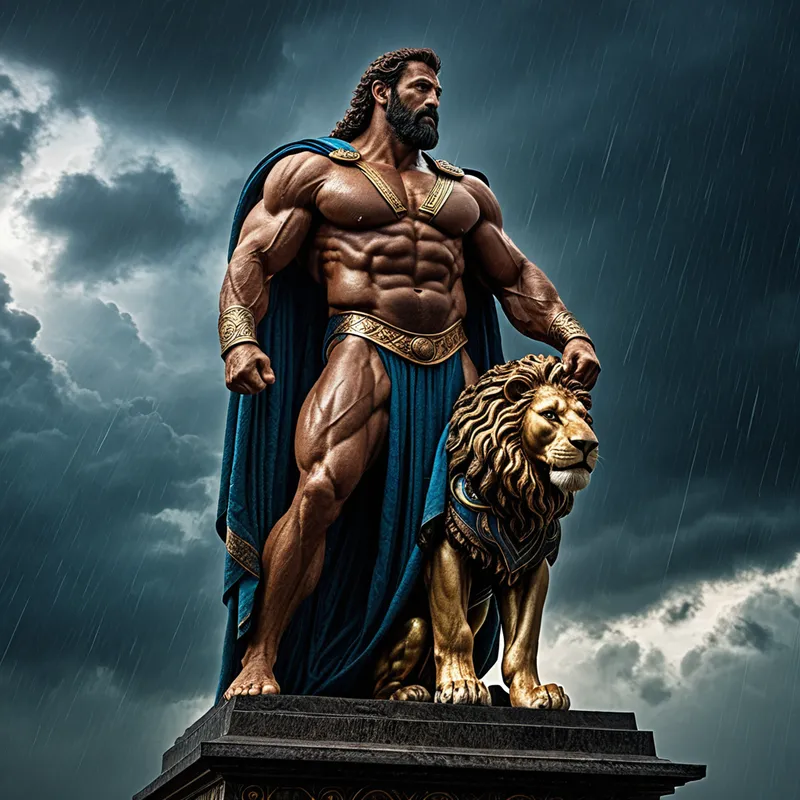
Labors of Hercules Myth Meaning & Symbolism
A hero's brutal atonement becomes a path of initiation, forcing him to confront monstrous projections of his own shadow to achieve immortality.
The Tale of the Labors of Hercules
Hear now the tale of the strongest man who ever lived, and the heaviest burden he was forced to bear. It begins not with glory, but with madness—a crimson fog sent by Hera, the queen of heaven whose wrath was as eternal as the stars. In that divine fury, Heracles saw not his wife and children, but monstrous shapes from a nightmare. When the fog lifted, he stood amidst the terrible stillness of his own home, his hands stained with a crime that no river could ever wash clean.
The hero was broken. The oracle at Delphi, her voice echoing from the sacred cleft, gave him no pardon, only a path. To be purified, he must enter the service of his lesser cousin, Eurystheus, and perform ten labors—a number that would swell to twelve through trickery and refusal. This was his sentence: to chase monsters across the world, to descend into realms where the sun fears to shine, all for a king who hid in a bronze jar at the sound of his name.
He walked into the sun-baked valley of Nemea, where a lion with a hide like stone stalked the land. His arrows clattered uselessly from its pelt, so he met it with his hands, choking the life from it in its own dark cave, and from then on wore its skin—a cloak of his first conquered fear. In the swamps of Lerna, he faced the Hydra, whose heads sprouted two-fold with each one he severed, until he learned to burn the necks with fire, turning poison to ash. He chased the Ceryneian Hind for a year, a test of patience, and captured the Erymanthian Boar by driving it into deep snow.
He did not just hunt beasts; he cleansed the world of filth, shoveling the vast Augean Stables in a single day by diverting rivers. He drove away the Stymphalian Birds with deafening bronze rattles. From the fiery breath of the Cretan Bull to the carnivorous mares of Diomedes, he brought order through sheer, unyielding force.
But then, the labors turned inward, toward the edges of the map and the self. For the belt of the warrior-queen Hippolyta, he sailed to the land of women, a task of diplomacy twisted by Hera’s mischief into bloodshed. He journeyed west, to the land of sunset, and stole the red cattle of the monster Geryon, standing at the very pillar of the world. His greatest descent was his eleventh task: to bring back Cerberus from the house of Hades himself. Unarmed, guided by Hermes, he walked the path of shades, confronted the lord of the dead, and emerged dragging the writhing hound by its chain, having stared into the abyss and returned.
His final labor was the most impossible: to pluck the golden apples from the garden of the Hesperides, guarded by a dragon and known only to the Titan Atlas. Heracles, using cunning where strength would fail, offered to hold the weight of the sky if Atlas would fetch the apples. When the Titan tried to leave him there forever, the hero tricked him back into his eternal burden. With the apples in hand, his sentence was complete. The man who had been a slave to atonement was now free, his name destined for immortality.
Cultural Origins & Context
The myth of Heracles (Romanized as Hercules) is not a single, frozen story but a living tapestry woven over centuries, from the Bronze Age to the height of Classical Greece. He was a pan-Hellenic hero, claimed by every city-state yet belonging to none, a figure of folk tale, cult worship, and epic poetry. The canonical cycle of the Twelve Labors was crystallized in the works of poets like Hesiod and later mythographers, serving as a foundational narrative template.
His tales were performed by bards in royal halls and recounted in communal festivals. Functionally, Heracles was a civilizing force in myth. His labors often purified regions of monstrous threats, making the wild world safe for human order, thus mirroring the Greek colonial and civic impulse. Furthermore, as a hero who suffered immensely, achieved apotheosis (becoming a god), and was welcomed onto Olympus, he offered a potent model of hope: that even the most profound suffering, even crime and madness, could be transcended through relentless effort and endurance. His cults promised protection and strength, making him both a divine intercessor and the ultimate self-made god.
Symbolic Architecture
Beneath the epic confrontations lies a profound map of the psyche. The Labors are not merely a punishment but a brutal, enforced initiation. Heracles begins in a state of miasma (ritual pollution) from his unwitting kin-slaying—a psychological state of being overwhelmed by one’s own shadow, the unconscious aspects of the self that, when ignored, can erupt destructively.
The hero’s journey is always, at its core, a dialogue with the monstrous. Each labor is a facet of the unintegrated self made flesh.
The Nemean Lion represents the raw, untamed aggression of the ego, which cannot be pierced from the outside (arrows) but must be confronted and integrated intimately (strangled by hand). The Lernean Hydra is the problem that multiplies when attacked directly—the neurotic pattern, the addiction, the lie that grows two new heads for every one cut off. It requires the “fire” of conscious awareness to cauterize its root. The Augean Stables symbolize the accumulated psychic filth, the decades of neglected emotional and mental refuse, requiring a divine intervention (the redirected rivers) to flush clean.
The later labors move from personal shadow-work to engaging with the archetypal realms: the journey to the Amazons (confronting the inner anima, the feminine principle), the cattle of Geryon (confronting greed and the monstrous triple-form of a bloated ego), and the ultimate descent for Cerberus. Here, the hero must enter Hades—the collective unconscious—and bring back its guardian. This is the integration of death itself, the acceptance of mortality and the darkest aspects of existence, as a necessary step to wholeness.
The Dreamer’s Resonance
When the pattern of the Labors stirs in modern dreams, it signals a profound, often arduous process of psychic integration is underway. The dreamer may not see Hercules, but they feel the assignment of an impossible task by a shadowy, external authority (an employer, a parent, an inner critic)—this is the voice of Eurystheus, the tyrannical super-ego.
Somatically, this can manifest as chronic fatigue, a feeling of carrying a crushing weight, or tension in the shoulders and jaw—the body bearing the burden of the sky. Dream narratives might involve being sent to clean a vast, filthy space (the stables), to capture or contain a wild, dangerous animal (the boar, the bull), or to navigate a labyrinthine bureaucracy that feels alive and predatory (the Cretan Labyrinth, though not a Labor, shares this energy). These dreams point to aspects of the dreamer’s own vitality, rage, or instinctual nature that have become monstrous through repression and now demand a heroic, focused engagement.
Alchemical Translation
The alchemical process mirrored in the Labors is the opus contra naturam—the work against nature. Heracles begins as prima materia, the base, flawed substance (a murderer in madness). His suffering is the nigredo, the blackening, the descent into utter despair and recognition of shadow.
The labors are the iterative stages of calcination, dissolution, and coagulation, where the psyche is broken down by ordeal and rebuilt with new understanding.
Each victory is a small albedo (whitening), a moment of clarity and purification. Cleaning the stables is a sublimation of the base into the useful; capturing the sacred hind is the pursuit of the elusive, spiritual anima. The final labors represent the rubedo (reddening) and integration. Holding the sky for Atlas is taking on the full weight of conscious responsibility. Stealing the apples of the Hesperides, the golden fruit of immortality at the western edge of the world, symbolizes achieving the aurum non vulgi—the non-common gold, the true, indestructible Self.
Heracles does not simply return to society; he transcends it, achieving apotheosis. For the modern individual, the alchemical translation is not about becoming a god, but about achieving a state of psychic integrity where one is no longer a slave to the unconscious, the complexes, or the tyrannical inner king. The Labors model the ultimate individuation journey: through confronting what we fear most in ourselves, we reclaim our dispersed power and, piece by brutal piece, forge an immortal character.
Associated Symbols
Explore related symbols from the CaleaDream lexicon: