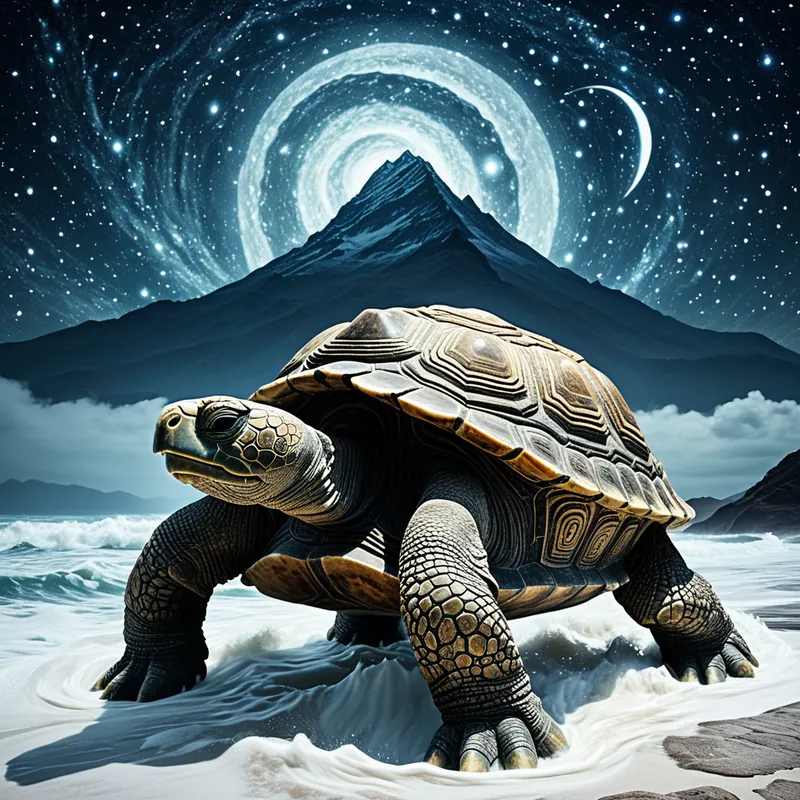
Kurma Myth Meaning & Symbolism
The second avatar of Vishnu, Kurma is the divine tortoise who supports the churning rod of Mount Mandara during the quest for the nectar of immortality.
The Tale of Kurma
In the age when the world was young and weary, a great lassitude had fallen upon the cosmos. The Devas, the shining ones, had grown weak, their light dimmed by the curse of a sage’s wrath. The Asuras, the mighty titans of ambition, saw their strength wane, their power hollow. The universe itself seemed to sigh, its axis tilting towards entropy. From this shared despair, a desperate hope was born: to churn the primordial ocean of milk, the Kshirasagara, and from its depths retrieve the nectar of immortality, the Amrita.
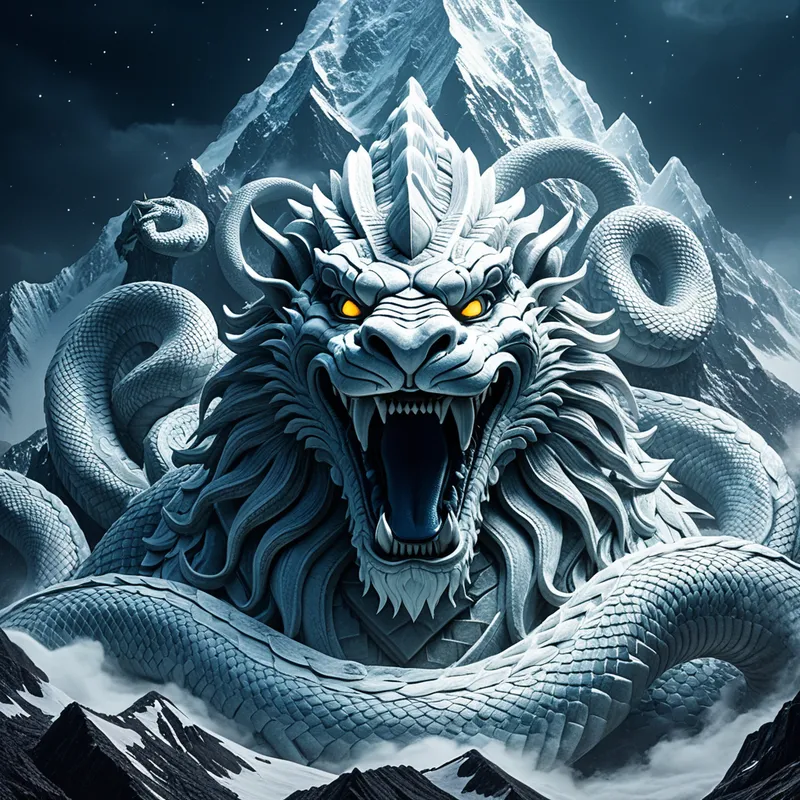
But how does one churn an ocean? The Devas went to Vishnu, whose eyes hold the patience of eternity. He counseled a great alliance, a temporary truce between light and shadow. The Asuras, ever hungry for power, agreed. Together, they uprooted the colossal mountain Mandara to be their churning rod. They persuaded the king of serpents, the mighty Vasuki, to be their rope, coiling his infinite length around the mountain’s peak. The Devas took the head of the serpent, the Asuras its tail. And they began to pull.
The mountain spun. It churned the milky waters into a frothing maelstrom. But a calamity unfolded—the mountain had no foundation. Its immense weight began to bore into the soft bed of the ocean, sinking, threatening to vanish into the abyss and shatter the great work. The churning faltered. Despair returned, deeper than before.
Then, from the still center of Vishnu’s being, a form emerged. Not with a thunderous crash, but with the profound, silent certainty of bedrock rising. He became Kurma, the cosmic tortoise. His shell, vast as a continent and etched with the patterns of time, dove beneath the waves. With infinite patience, he placed his back against the sinking base of Mount Mandara. He did not grab or clutch; he simply offered himself as the foundation. The mountain settled. Its weight, which would crush a world, was borne by a serene, unyielding presence. The churning could begin anew.
And churn it did. From the ocean’s depths, first came poison, a black, searing smoke that threatened to scorch creation—Halahala. Then came wonders: the wish-fulfilling cow, the goddess of wine, the moon, the celestial elephant. Finally, rising with a radiance that put the stars to shame, came Dhanvantari, holding the glowing pot of Amrita. The quest was complete, but the alliance shattered in the scramble for the prize. Yet, through it all, Kurma remained, unmoving, the silent, steadfast pivot upon which the fate of the universe turned.
Cultural Origins & Context
The myth of Kurma is a central episode in the epic narrative of the Samudra Manthan, which appears in several Puranic texts, most notably the Mahabharata and the Vishnu Purana. It belongs to the genre of Itihasa-Purana, which served as the primary vehicle for transmitting cosmological, philosophical, and ethical teachings to the populace. Recited by bards and scholars in temple courtyards and royal halls, this story was not mere entertainment; it was a metaphysical map.
Its societal function was multifaceted. It explained the origins of celestial objects and divine beings in the Hindu cosmos. It modeled a profound theological truth: that preservation (Dharma) often requires not dramatic intervention, but foundational support. It also presented a complex moral tableau, showing that even the highest goals (immortality) can require uneasy alliances with one’s opposites (the Asuras), and that the process of creation inevitably brings forth both poison and nectar. The story validated the virtue of steadfastness and the often-invisible role of the supporter, a crucial concept in a society built on intricate systems of duty and sacrifice.
Symbolic Architecture
Kurma is not an actor, but an axis. The tortoise avatar represents the primordial, non-negotiable foundation upon which any great work—whether cosmic or psychological—must be built.
The true work of transformation begins not with the first pull, but with the finding of the bedrock that can bear the weight of the churn.
The ocean of milk is the unmanifest potential of the psyche, the collective unconscious, teeming with latent treasures and horrors. Mount Mandara is the axis of consciousness, the disciplined effort (tapas) required to delve into those depths. The serpent Vasuki is the vital, ambivalent energy of desire and instinct, which can be used as a tool for elevation or destruction. The Devas and Asuras represent the eternal psychic conflict: our aspirational, ordering principles versus our chaotic, shadowy drives.
Kurma’s role is the critical integration. He is the supporting function of the psyche. He symbolizes the ego’s capacity to become a stable vessel, to contain the tremendous pressures of inner conflict and deep exploration without fragmenting. His shell is the boundary of the self, strong enough to bear the weight of the mountain, yet part of the living being. He does not participate in the frantic pulling; he embodies the calm center that makes the pulling possible. He is the embodiment of the earth element—patience, endurance, and the willingness to descend into the depths to provide stability from below.
The Dreamer's Resonance
When the archetype of Kurma stirs in the modern unconscious, it often manifests in dreams of profound support or its terrifying absence. One may dream of finding an ancient, immovable stone in a stormy sea to stand upon, or conversely, of the ground dissolving beneath one’s feet. Somatic sensations might include a heavy, solid feeling in the spine and lower back, or acute anxiety centered in the legs and feet—the body’s foundation.
Psychologically, this pattern emerges when an individual is undertaking a significant inner or outer work that feels overwhelming. They are “churning their ocean”—perhaps in therapy, a creative endeavor, or a life crisis—and are in danger of being swallowed by the process. The dream of Kurma signals that the psyche is seeking, or has found, its foundational strength. It is the dream of resilience. It asks the dreamer: What is your shell? What part of you can become the unwavering base that holds the mountain of your efforts? The appearance of this myth in dreams is a call to cultivate conscious endurance, to develop the capacity to be present and solid amidst internal chaos, and to trust that from this steadfastness, both poison and nectar will rise to be dealt with.
Alchemical Translation
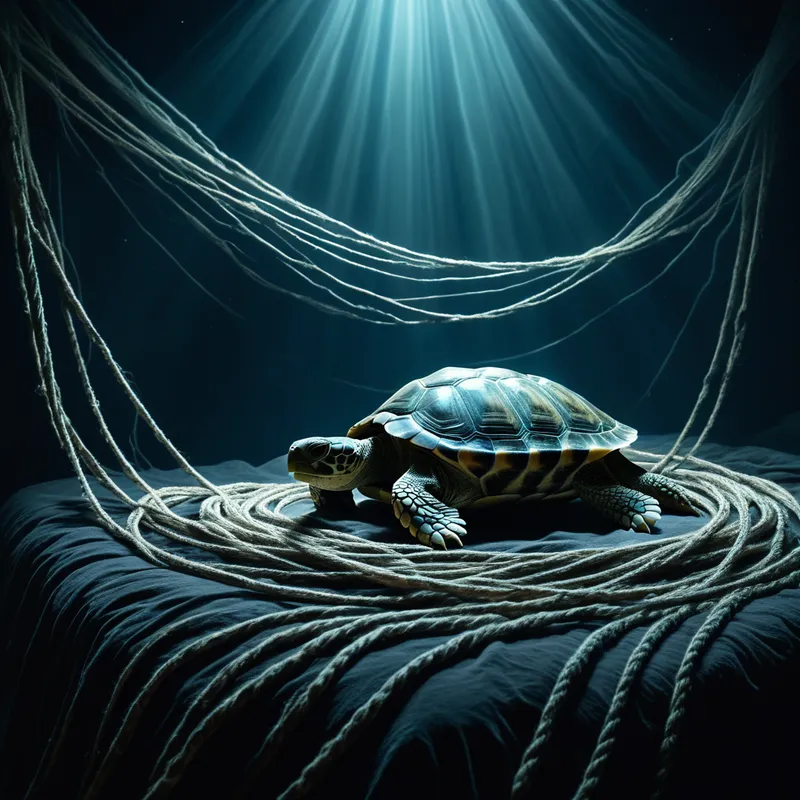
The alchemy of Kurma is the alchemy of the vessel. In the process of individuation, we are all churning our personal ocean. We uproot our familiar identities (the mountain), engage our raw, often contradictory energies (the serpent), and partner with our inner demons and angels. The inevitable first product is poison—the repressed traumas, shadow aspects, and psychic toxins that must be acknowledged and transformed (often with the help of a “Shiva” function of consciousness that can contain it).
The nectar of the Self can only be distilled in a vessel that does not crack under the strain of its own becoming.
But before any of this can proceed, the ego must perform the Kurma transformation. It must cease identifying solely with the “puller” (the heroic ego striving for goals) and learn to become the “support.” This is a humble, often unseen task. It involves developing emotional and psychological resilience, creating healthy boundaries (the shell), and finding one’s ethical and existential bedrock. It is the work of grounding. The modern individual must descend, like Kurma, into the depths of their own being to find that unshakable core of presence. From that stable center, the chaotic but necessary work of self-discovery can proceed. The treasures that emerge—creative gifts, deeper wisdom, a more authentic personality—are the Amrita. And while the outer world may scramble for its own prizes, the individual who has integrated Kurma remains centered, knowing that the true immortality is not in the elixir itself, but in having become the tortoise that made its discovery possible.
Associated Symbols
Explore related symbols from the CaleaDream lexicon: