Kur the Underworld Dragon Myth Meaning & Symbolism
The myth of the god Ninurta's battle with Kur, the primordial dragon of the underworld, embodying the struggle to impose order on chaos and life on death.
The Tale of Kur the Underworld Dragon
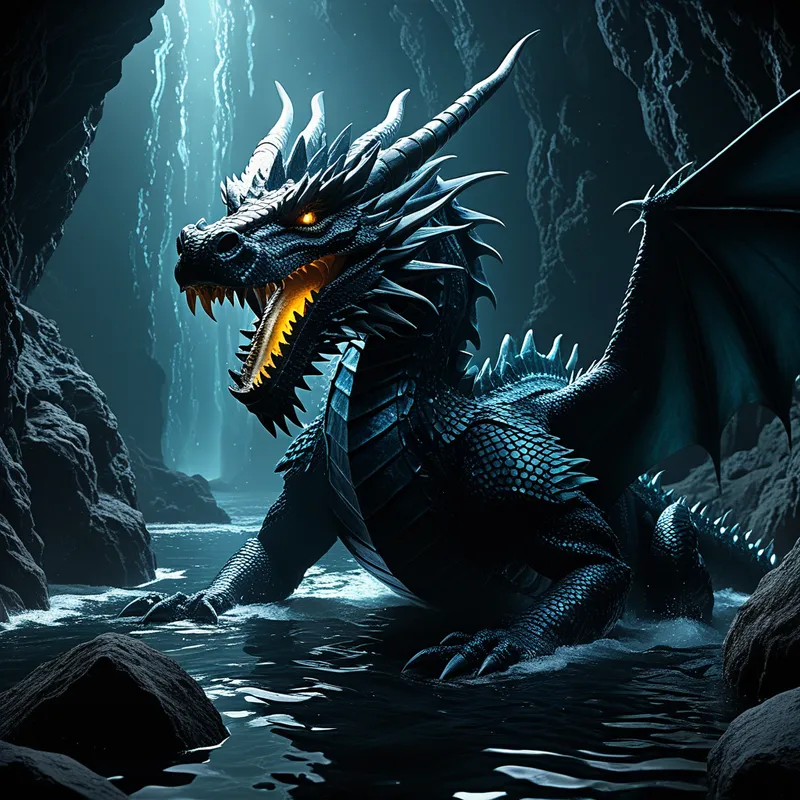
In the time before time was measured, when the world was young and raw, there lay a place beneath the places. It was not a land of the dead, not yet, but a realm of the not-born, the formless, the churning potential that refused to be shaped. This was Kur. And Kur was not just a place; it was a being. A dragon of such immensity that its coils were the mountain ranges, its breath the subterranean winds, its roar the grinding of continental plates. It was the primal Chaos, sleeping fitfully beneath the ordered world of the gods.
Above, in the bright realm of An and the fertile domain of Enlil, a terrible theft occurred. The Tablet of Destinies, the very source of cosmic order and divine authority, was stolen. The thief was Anzû, a creature born of Kur’s rebellious spirit. With the Tablet, Anzû could unravel the fabric of creation. The gods trembled. Their power, the very laws of reality, were held hostage by chaos.
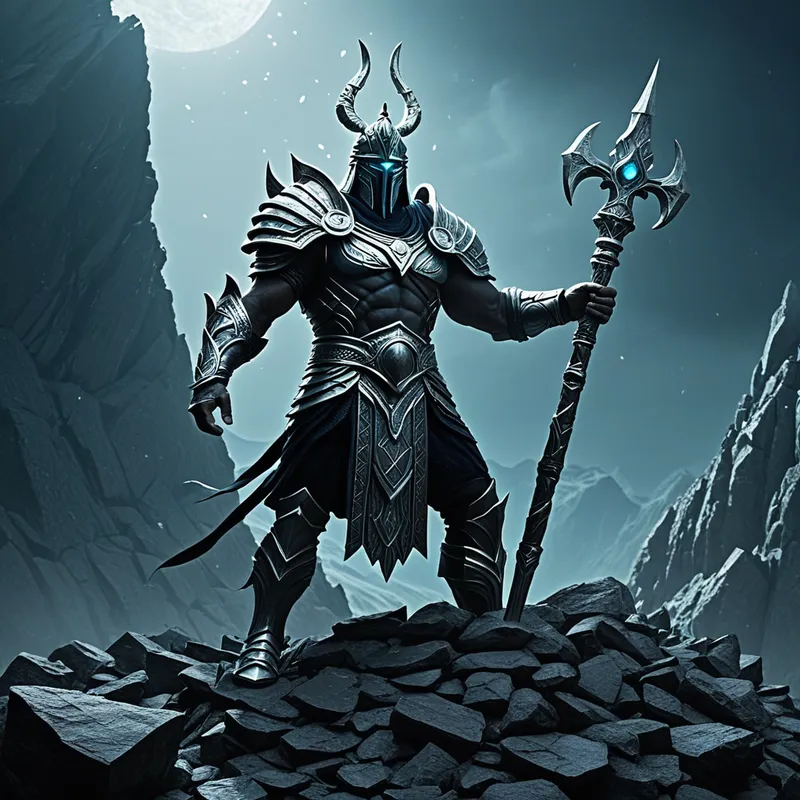
None dared face the thief, for he now commanded the fates. Until one stepped forward: Ninurta, the fierce son of Enlil. His heart was a furnace, his will like forged bronze. He took up his talking mace, Sharur, and went to war. A battle of thunder and talon ensued. Sharur flew, whispering strategies, striking true. Ninurta, with a hero’s cry that split the clouds, let loose an arrow that found its mark. Anzû fell, the Tablet clattering from his grasp. Order was restored. The gods breathed again.
But the victory was incomplete. The root of the rebellion remained. Kur, the great dragon below, had stirred. Enraged by the defeat of its offspring, it began to rise. It was not attacking a city or a god; it was attacking reality itself. It sent the Waters of the Abzu, the sweet waters of the deep, flooding upward to drown the fertile lands. It caused the salt sea to invade the river beds. The boundaries between land and water, life and the formless deep, began to dissolve. The world was returning to the primordial soup from which it was made.
Ninurta, still stained with the blood of Anzû, heard the cry of the earth. He stood at the crumbling edge of the world, where the Tigris met the abyss. Before him, the waters churned, and from the depths, the true enemy emerged. Not a beast with a single heart, but the heart of the world’s own darkness. Kur’s form was vast, indistinct—a mountain that moved, a serpent of stone and water, its eyes like pits into the void before creation.
This was no battle of strength alone. Sharur whispered of a deeper strategy. To fight the formless, one must give it form. To fight the rising waters, one must build a containing wall. Ninurta did not merely strike the dragon; he engaged it. He hurled mountains upon it, not just as weapons, but as foundations. With each blow that shattered Kur’s stone scales, Ninurta directed the debris. He piled the stones, he channeled the raging waters. He fought chaos with architecture.
Finally, with a heave that shook the heavens, he pinned the great dragon. He did not slay it, for Kur could not be slain—it was the foundation of the world itself. Instead, he transformed it. The body of Kur became the bedrock. The wild waters it unleashed were tamed into irrigation canals. The stones of its defeat became the dikes and boundaries that held back the sea and defined the land. The dragon of the underworld was made to bear the weight of the world above. From its corpse, order was born anew. Ninurta stood upon the conquered mountain of chaos, and below him, the land was fertile, defined, and safe. The dragon was now the foundation stone.
Cultural Origins & Context
This myth, found in the fragmentary epic “Ninurta and the Turtle” and alluded to in hymns like “Lugal-e,” comes from the heart of ancient Mesopotamia, the land between the rivers. For the Sumerians, life was a precarious gift wrested from two terrifying forces: the blistering sun of the arid plain and the unpredictable, flooding waters of the Tigris and Euphrates. Their world was literally built on silt deposited by chaotic floods—a perfect metaphor for creation emerging from formless waters.
The story of Ninurta and Kur was not mere entertainment. It was a cosmological anchor, recited by priests and scribes to explain and justify the very nature of their civilization. The myth provided a divine precedent for the most critical, ongoing human activity in Sumer: hydraulic engineering. Building dikes, digging canals, and controlling water was the act of Ninurta. Every farmer who piled mud to reinforce a canal bank was participating in this eternal, sacred battle against the return of chaos. The myth sacralized their daily struggle for survival, transforming it from mere labor into a ritual re-enactment of the god’s triumph.
Symbolic Architecture
At its core, the myth of Kur is the archetypal drama of Cosmos versus Chaos. Kur is not evil in a moral sense; it is the necessary, terrifying foundation—the undifferentiated potential, the unconscious, the raw matter that both precedes and threatens all structure.
The dragon is the shadow of creation itself, the chaos that must be confronted and shaped, not annihilated, for it is the substance from which order is built.
Ninurta represents the principle of Me—divine order, differentiation, and conscious will. His battle is the psychic act of bringing consciousness to the unconscious, form to the formless. Significantly, he does not kill Kur. He integrates it. The dragon’s body becomes the landscape. This is a profound psychological truth: we do not “defeat” our primal chaos, our shadow, or our traumatic depths. We learn to build our conscious life upon them, to channel their raw power into structures that sustain us.
The stolen Tablet of Destinies represents the ego’s fear of losing control, of having its sense of order and identity (its “destiny”) usurped by chaotic, unconscious forces (Anzû). Ninurta’s victory over Anzû is the reclamation of ego-function, but the subsequent battle with Kur is the far greater work: the engagement with the source of that chaos itself.
The Dreamer's Resonance
When this myth stirs in the modern psyche, it often manifests in dreams of foundational collapse or overwhelming, formless threat. Dreaming of tidal waves, earthquakes, or being swallowed by the earth are somatic echoes of Kur’s rising. These are not prophecies of disaster, but symbols of a psychological process where long-contained aspects of the self—repressed emotions, old traumas, unexpressed creativity—are flooding into consciousness.
The dreamer may feel they are drowning in undefined anxiety or rage. This is the “Waters of the Abzu” breaking their banks. The psyche is in a state of de-structuring, where old ego-boundaries are dissolving. It is a terrifying but necessary prelude to growth. The dream-ego in this state is not yet Ninurta; it is the land being flooded. The psychological task is to find the “Ninurta principle” within—the assertive, structuring, conscious faculty that can begin to build containment, to name the flood, to channel the chaotic waters into identifiable feelings and patterns.

Alchemical Translation
The journey from being flooded by Kur to building upon Kur is the alchemical process of individuation. It is the opus of a lifetime.
First, there is Nigredo, the blackening: the confrontation with the shadow, the eruption of chaos (Kur’s attack). This is the painful, necessary dissolution of outworn attitudes and identifications. The ego feels its “Tablet of Destinies” has been stolen; its sense of who it is and how the world works is shattered.
Then, Albedo, the whitening: the reclamation of conscious will (defeating Anzû). This is the moment of clarity, of saying “this chaos is not me, and I will fight it.” It is an important but intermediate victory, often mistaken for the final goal.
The true transmutation occurs in Citrinitas, the yellowing, and Rubedo, the reddening: the engagement with and integration of the chaos itself (battling and building upon Kur). This is where conscious effort (Ninurta) engages with the raw material of the unconscious (Kur) and transforms it into a new internal structure. The rage becomes boundaries. The grief becomes compassion. The formless fear becomes the fertile soil for new life.
The hero’s ultimate task is not to live in a world without dragons, but to learn that his throne must be built upon the dragon’s tamed and honored back.
For the modern individual, this means moving beyond simply “managing” symptoms or “defeating” bad habits. It means delving into the foundational wounds, the primal patterns, the “Kur” of one’s personal psyche, and undertaking the slow, heroic work of building a new, more resilient self from that very material. The goal is not a sterile peace, but a dynamic, fertile order sustained by a conscious relationship with the deep, churning power below.
Associated Symbols
Explore related symbols from the CaleaDream lexicon:
- Dragon — The primordial force of chaos and the unconscious, the formless potential that must be confronted and integrated to build a stable conscious world.
- Water — The Waters of the Abzu, representing the formless, emotional, and creative depths of the unconscious that can both nourish and flood the psyche.
- Mountain — The transformed body of Kur, symbolizing the stable foundation, achievement, and enduring structure built from conquered chaos.
- Earth — The realm that is both threatened by and ultimately built upon Kur, representing the grounded self, fertility, and the material result of psychic integration.
- Chaos — The essential state of Kur, the undifferentiated raw material of existence and the psyche from which all order must be wrested.
- Order — The principle embodied by Ninurta and the Tablet of Destinies, the conscious structuring of reality and the self against the relentless pull of chaos.
- Hero — The archetype of Ninurta, representing the conscious will and courage required to engage with deep chaos for the sake of renewal and creation.
- Underworld — Kur as a place, the psychological domain of the shadow, repressed contents, and the foundational layers of the psyche.
- Stone — The shattered scales of Kur that become building blocks, symbolizing the hard, enduring truths and memories used to construct ego boundaries.
- Journey — The descent and confrontation, the essential psychic movement from the surface of consciousness into the depths to engage with the foundational self.
- Sacrifice — The offering of the old, undifferentiated state (Kur’s chaotic freedom) to create a new, structured reality that can support life.
- Rebirth — The new world that emerges from the transformed body of the dragon, symbolizing the renewed psyche born from the integration of shadow contents.