Kundalini Awakening Myth Meaning & Symbolism
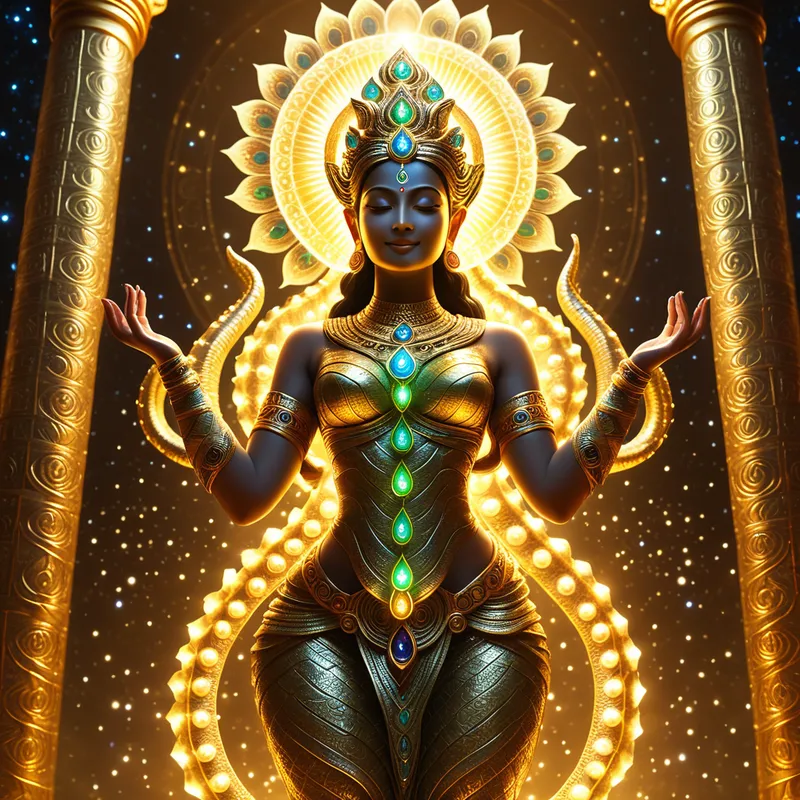
The dormant serpent goddess coiled at the base of the spine awakens, ascending through sacred centers to unite with the divine, dissolving all duality.
The Tale of Kundalini Awakening
Listen. In the silent, sacred cavern of the human form, a goddess sleeps. She is not in a temple of stone, but in a temple of flesh and spirit, at the very root of being, where the spine meets the earth of the pelvis. Here, in the Muladhara, she rests—Kundalini Shakti. She is a serpent of infinite potential, coiled three and a half times around a lingam of obsidian, her head blocking the entrance to the Sushumna Nadi, the royal road to the heavens within.
She sleeps the sleep of ages, of lifetimes, while the winds of breath (Prana) move in the side channels, Ida and Pingala, and the world of duality—pleasure and pain, heat and cold, self and other—plays out its endless drama above her. The seeker, the yogi, sits. Through austerity, through devotion, through the fierce grace of a guru, the sacred fires are lit. The breath becomes a single flame. The mind becomes a still lake. The invocation is not of words, but of profound, resonant silence.
And in that silence, she stirs.
A warmth, a tremor, a cosmic sigh at the base of the spine. The first coil loosens. She lifts her hood, and she is not a mere serpent, but the Mother of the Universe in her dynamic, unmanifest form. She begins her ascent, entering the Sushumna, a river of nectar and fire. As she rises, she encounters the lotus flowers, the chakras, each a sealed palace of latent power and forgotten memory.
At the Svadhisthana, the lotus of desire, she purifies its waters, turning turbulent waves into a creative sea. At the Manipura, she absorbs its blazing solar fire, transforming egoic flame into the light of discernment. At the Anahata, she pauses. The sealed lotus bursts open, and a soundless sound, the unstruck beat (Anahata Nad), fills the inner space. Here, the seeker weeps with a love that has no object.
Onward she climbs, a comet of consciousness. The Vishuddha is cleansed, and speech becomes mantra, truth itself. The Ajna is pierced, and the illusion of separateness begins to shatter like glass. The thousand-petaled lotus at the crown, the Sahasrara, awaits—the abode of Shiva, the silent, static, all-aware Lord.
With a final, glorious surge, Kundalini reaches the summit. She meets her beloved, Shiva. In that union, a lightning flash of amrita—nectar of immortality—floods the entire body. Serpent and ascetic, dynamism and stillness, Shakti and Shiva, are revealed as One. The coiled potential becomes uncoiled actuality. The sleeper awakens, not to a dream, but to the only reality that ever was. The individual drop merges with the ocean, and in that merging, knows itself to have always been the ocean.

Cultural Origins & Context
The myth of Kundalini is not a single narrative from a canonical text like the Mahabharata or Ramayana. It is a living, experiential doctrine that emerged from the esoteric heart of Shaktism and Tantra, intricately linked to Hatha Yoga. Its primary scriptures are the Tantras and later medieval manuals like the Hatha Yoga Pradipika and the Shiva Samhita. This knowledge was traditionally passed down orally, from guru to initiated disciple (shishya), in a direct lineage (parampara). It was considered a dangerous and powerful secret, not for intellectual curiosity but for direct realization.
Its societal function was profoundly transgressive and transformative. While orthodox Brahminical ritual focused on external fire sacrifices (yajna), the Kundalini path internalized the entire process. The body itself became the altar, the breath the offering, and consciousness the divine fire. This was a democratization of the most profound mystical experience, theoretically available to anyone with the dedication and guidance to undertake the arduous inner journey, regardless of birth or social status.
Symbolic Architecture
The myth is a perfect map of the individuation process, written in the symbolic language of energy and consciousness. Every element is a facet of the psyche.
The serpent asleep at the root is the totality of our unlived life, our dormant potential, and the primal, instinctual energy that modern psychology might call the libido, in its fullest, most cosmic sense.
The coiled serpent represents potential energy, the compressed archetype of the Divine Feminine (Shakti) in its unmanifest state. The three and a half coils may symbolize the three states of consciousness (waking, dreaming, deep sleep) and the half, the transcendent fourth state (Turiya), or the three gunas and what lies beyond. The central channel, Sushumna, is the axis of the Self, the spine of the world-tree within. The ascending journey through the chakras is the sequential integration of the psyche’s layers—from survival and desire, through power and emotion, to communication, intuition, and finally, transcendent unity.
The ultimate union with Shiva is the reconciliation of opposites: the dynamic, creative, energetic principle (the anima) with the static, aware, witnessing consciousness (the animus or the Self). It is the end of inner conflict, the resolution of the tension between being and becoming.
The awakening is not an acquisition, but a remembrance; not a journey to a new land, but the realization that you have always been home.
The Dreamer’s Resonance
When this myth stirs in the modern dreamer, it rarely appears as a literal serpent. Instead, it manifests as profound somatic and psychological upheavals signaling a crisis that is also an initiation.
Dreams may feature intense, involuntary physical sensations: dreams of vibrating, of electric currents running through the body, of heat rising from the base of the spine. One might dream of climbing an endless ladder or staircase inside a dark tower, of roots transforming into brilliant light, or of a central pillar in a house cracking open to reveal a core of molten gold. There are dreams of terrifying yet beautiful serpents, of giving birth to light, or of a sudden, catastrophic/ecstatic explosion at the crown of the head.
Psychologically, this parallels a period where unconscious contents are forcibly pushing into consciousness. It can feel like a psychic emergency—anxiety, overwhelming emotions, old traumas surfacing, a sense of the ego-structure dissolving. The dreamer is experiencing the “rising” of repressed life force, which must purify and integrate each level of their being (the chakras as psychological complexes) on its way to a more unified state. It is the psyche’s innate drive toward wholeness asserting itself with volcanic force.

Alchemical Translation
The Kundalini myth provides the ultimate alchemical blueprint for psychic transmutation. The base metal of our fragmented, identified ego-consciousness is turned into the gold of realized Self.
The first alchemical stage, nigredo (the blackening), is the recognition of the serpent’s dormancy—the dark, coiled mass of our unconscious potential and shadow. The seeker’s discipline (yoga) is the albedo (the whitening), the purification of the vessels (the nadis and chakras) to prepare for the ascent. The awakening itself is the citrinitas (the yellowing), the dawning of the inner sun, the illumination of each psychic center.
The pain of transformation is the friction of a smaller self being polished away by a larger reality.
The final union is the rubedo (the reddening), the sacred marriage of opposites within the psyche, resulting in the creation of the “philosopher’s stone”—the integrated, embodied Self that is both fully human and transparent to the divine. For the modern individual, this is not about acquiring supernatural powers but about the heroic inner work of facing one’s depths, integrating shadow and light, and allowing one’s personal identity to be reconfigured around the central, axial truth of one’s being. The goal is not to escape the world, but to meet it with a consciousness that has touched its source, transforming daily life into a continuous, conscious sacrament.
Associated Symbols
Explore related symbols from the CaleaDream lexicon: