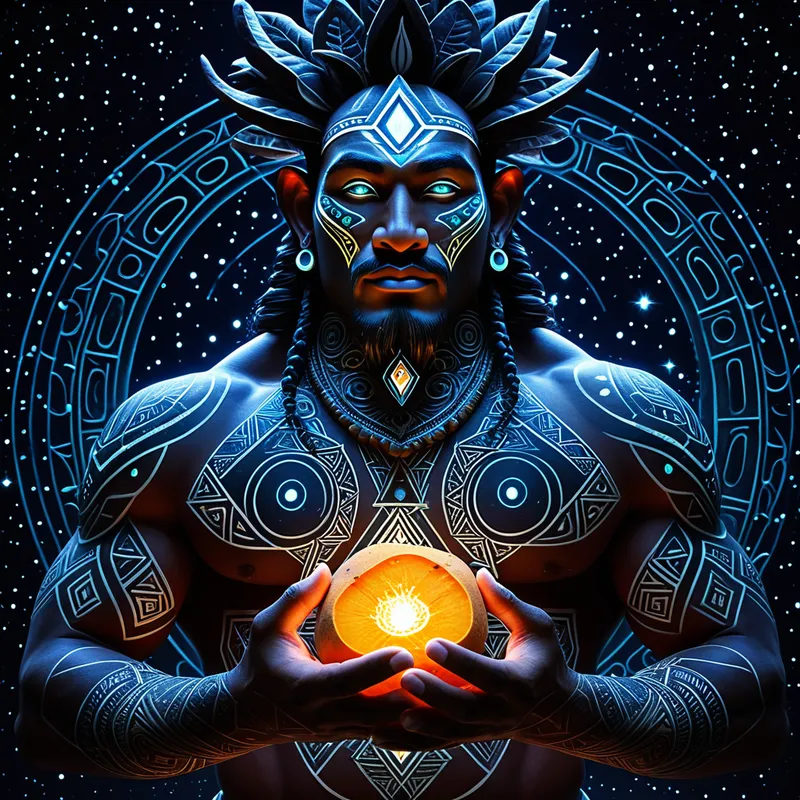
Kumara Myth Meaning & Symbolism
A myth of divine descent, where the god Kumara journeys to the underworld to retrieve the life-giving sweet potato for humanity.
The Tale of Kumara
Listen, and let the smoke of the earth-oven carry this story to you. In the time when the sky, Rangi, still pressed close upon the earth, Papa, and their children dreamed in the cramped darkness, there was a hunger. Not just of the belly, but of the spirit. The people ate the fern-root, the berries, the birds from the forest, but their souls remained thin, their lives tethered to mere survival.
Then came Kumara. He was not born of the light, but was a child of the deep, a deity whose essence was the fertile dark. He saw the people’s longing, a silent cry that rose like mist from the valleys. He heard the whispers of Hine-nui-te-pō, the great lady of night, who held in her dark womb a secret treasure: the kumara itself—a tuber of sun captured underground, food that was both substantial and sweet, a paradox of earth and sustenance.
Kumara knew the law: what belongs to the realm of Whiro must stay, guarded by fear and the finality of death. To retrieve it was to make the impossible journey, the whakamomori. But the people's need was a hook in his heart. So, without fanfare, he turned from the world of light. He walked to the places where the cliffs wept black water, to the steaming fissures in the earth, the ngutu of the world.
Down he went, into Rarohenga. The air grew thick and cold, smelling of damp clay and forgotten things. Phosphorescent fungi were the only stars. Strange, sighing echoes replaced the wind. He passed the shades of ancestors, who reached for him with silent, cold longing. He faced the guardians of the deep, forms of shifting shadow and sharp stone, their voices the grind of tectonic plates. He did not fight them with a spear, but stood firm, his intention a quiet flame in the overwhelming dark. "I come for the life of those above," he intoned, and his words were absorbed by the endless night.
Finally, in the deepest chamber, where the roots of the world-tree Tāne drank from the waters of chaos, he found it. Not a hoard, but a simple, humble vine, its leaves a faint, stubborn green in the gloom, clinging to a thread of light from some unimaginable source. And from its tendrils hung the tubers—lumps of potential, storing sunlight they had never seen.
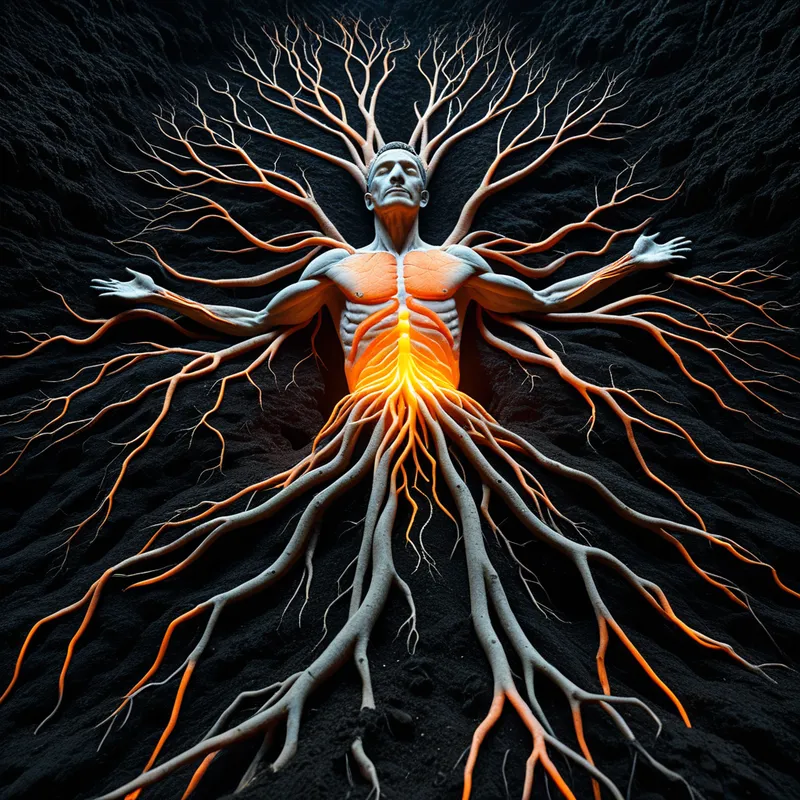
To take it was to die. He knew this. The treasure of death could only be purchased with a death. So, Kumara laid himself down upon the dark soil. He willed his divine essence, his mana, into the vine. His form dissolved, not into nothing, but into the very substance of the plant. His flesh became the tuber, his blood the sap, his breath the hidden vitality within. He did not conquer the underworld; he married it. He became the bridge.
And from that union, a new vine grew, vigorous and strong. It climbed, not toward a sun it knew, but toward a memory of one. It pushed through layers of rock and soil, a green spear piercing the belly of the earth, until it broke the surface in the world of humans. There, it unfurled its leaves to the true sun, and offered its fruit: the kumara, the body of the god, given freely. The people tasted it, and their hunger was filled, and in that filling, they tasted the sweetness of sacrifice, the nourishment born of a journey into the heart of darkness.

Cultural Origins & Context
The myth of Kumara is woven deeply into the agrarian soul of Eastern Polynesia, particularly for the Māori of Aotearoa (New Zealand). Here, the sweet potato was not merely a crop; it was a vital staple whose successful cultivation meant the difference between life and death in a new, sometimes harsh environment. The myth served as a sacred charter, a karakia in narrative form, that explained the origin of this precious food and prescribed the correct, reverential relationship with it.
It was a story told by tohunga during the planting and harvesting seasons, embedding practical horticultural knowledge within a spiritual framework. The rituals surrounding kumara cultivation—the sacred rua kumara, the strict tapu—were direct enactments of the myth. The storage pit mirrored the underworld; the seed tubers were the preserved essence of Kumara himself, sleeping in the dark earth. The myth thus functioned as a societal compass, aligning human labor with cosmic order, teaching that food is a gift born of divine sacrifice, demanding respect, ritual, and reciprocity.
Symbolic Architecture
At its core, the myth of Kumara is a profound map of the soul's necessity to engage with its own depths to bring forth nourishment. Kumara is not a warrior who slays a monster, but a deity who undergoes a radical dissolution of self.
The greatest nourishment does not come from conquering the dark, but from being reconstituted by it.
The kumara itself is the ultimate symbol: life (the tuber) stored within death (the underground), sweetness born from engagement with the bitter soil. It represents latent potential, the undiscovered treasure of the psyche that can only be accessed through descent. The underworld, Rarohenga, is not merely a place of punishment, but the realm of the unconscious, the fertile void where all forms germinate. Kumara's journey is one of voluntary whakamomori—a letting go of a previous, whole identity to become the seed of something new for the collective.
The act of becoming the plant is alchemical. He is the prima materia that undergoes putrefaction and regeneration, transforming from a discrete god-form into a generative process. His "death" is not an end, but a redistribution of his essence into a new, life-sustaining pattern.
The Dreamer's Resonance
When this myth stirs in the modern dreamer, it often manifests as dreams of underground journeys: finding hidden rooms in the basement of one's childhood home, exploring caves, or being buried yet able to breathe. The somatic feeling is one of profound pressure and containment, but not necessarily panic. There is a sense of necessary incubation.
Psychologically, this signals a process of engaging with the personal or collective shadow. The dreamer is being called to retrieve something vital that has been lost, repressed, or left in the "underworld" of their unconscious. This could be a forgotten talent, a buried trauma that needs integration, or a source of instinctual vitality. The treasure is always something that feels both deeply personal and strangely foreign—like the kumara, a "sun" found in the dark. The dreamer in this phase may feel withdrawn, heavy, or in a period of depression, but within that state, a crucial inner work of reorganization is occurring. The ego is learning to hold still while a deeper, more essential part of the self reforms the very ground of being.
Alchemical Translation
For the individual on the path of individuation, Kumara's myth models the stage of mortificatio and solutio—the dissolution and solution. Our conscious identity, the "god" we believe ourselves to be, must often be surrendered for a greater purpose. This is not a heroic battle, but a humble, terrifying offering.
Individuation demands we become the bridge between our conscious light and our unconscious darkness, allowing our old form to dissolve so a new, nourishing life can grow from the synthesis.
The modern "journey to the underworld" might be a deep therapy process, a creative block, a spiritual crisis, or a devastating life loss. The "Kumara process" asks: Can you go into this darkness not to escape it, but to find what life is stored there? Can you offer up your current understanding of yourself, allowing it to be broken down and recomposed into a form that can nourish not just you, but your wider world? The triumph is not in emerging unscathed, but in emerging fundamentally changed—having integrated the shadow material so thoroughly that it becomes the source of your sustenance and creativity. You become the vine that connects the depths to the surface, turning the raw material of pain, instinct, and mystery into the sweet fruit of meaning, purpose, and authentic life. You discover that your true nourishment was always waiting in the last place you thought to look: within your own consented descent.
Associated Symbols
Explore related symbols from the CaleaDream lexicon: