Kuebiko Myth Meaning & Symbolism
A kami of wisdom and agriculture who knows everything but is unable to move, embodying the paradox of boundless knowledge and physical limitation.
The Tale of Kuebiko
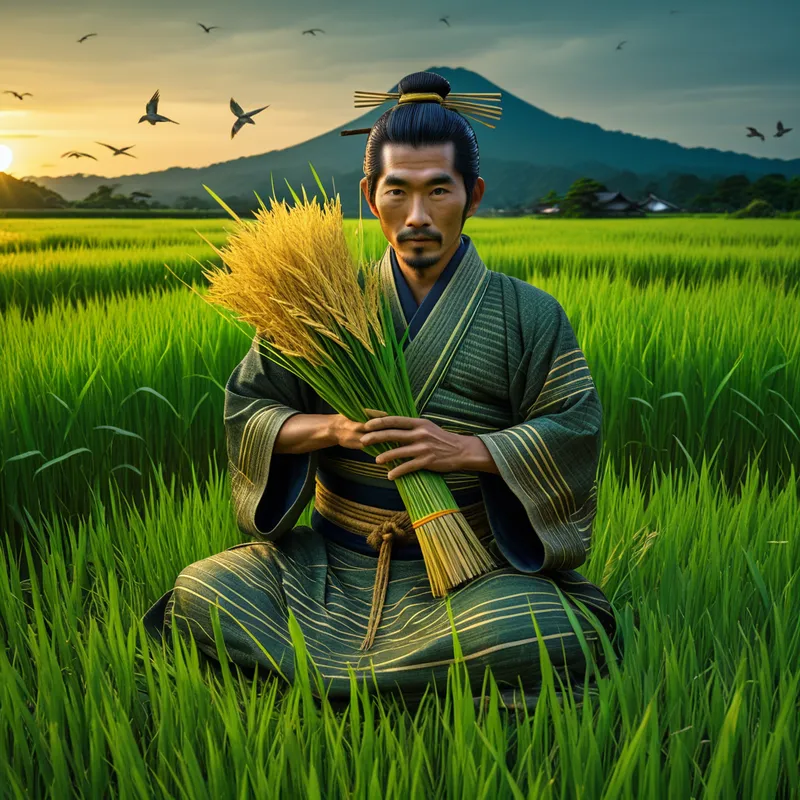
Listen, and let the wind carry you to a time when the world was still being sung into being. In the high, sacred plain, where the eight million kami gathered, there was one who did not arrive with thunder or flame. His name was Kuebiko. He was not fashioned from the forge of mountains nor the breath of the storm. He was crafted from the patient earth itself—his body the steadfast trunk of an ancient tree, his limbs the sturdy bamboo, his flesh the woven straw of the first harvest.
While his brethren, like the impetuous Susano-o, raced across the land shaping valleys with their rage, and the sun goddess Amaterasu wove light from her loom, Kuebiko remained. He was planted at the crossroads of a nascent village, where the first rice shoots broke through the mud. He did not move. He could not.
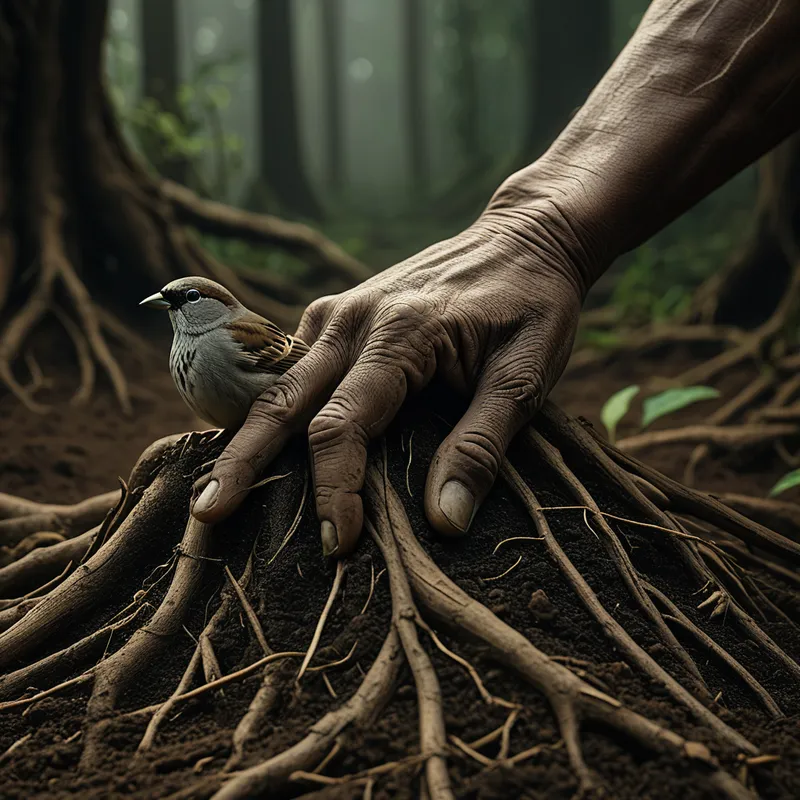
Yet, his stillness was not emptiness. It was a profound, deep-listening. The sparrows, those tiny messengers of the air, would come to him. They would alight upon his straw shoulders, chirping of far-off fields, of storms brewing beyond the horizon, of the fox’s cunning and the badger’s trick. The wind would sigh through his bamboo frame, telling tales of the ocean’s salt and the mountain’s chill. The earthworms whispered to his roots of the secrets hidden in the dark, fertile deep. Kuebiko absorbed it all. He knew the path of every insect, the name of every herb, the precise moment the first drop of rain would fall. He was the memory of the land, the repository of all that was and all that could be known through patient witness.
The people of the village, struggling to coax life from the soil, soon learned of his nature. They would approach, hesitant at first. “Great Kuebiko,” a farmer would ask, bowing low, “when should we plant the seed?” And Kuebiko, his voice the rustle of dry reeds, would speak not of himself, but of the sparrow’s nest now holding three eggs, and the particular shade of green on the willow downstream. The farmer, understanding, would know the time was near. A child, lost and weeping, would be guided home by the sudden, purposeful flight of a sparrow from Kuebiko’s hand—a silent command from the kami who saw all paths.
His was a kingdom of absolute knowledge, bounded by the horizon his messengers could reach. And his throne was the unmoving earth. He was the wise one who knew everything about the world, yet could not take a single step into it. His power was absolute, and his limitation, absolute. This was his nature, his sacred and sorrowful truth.
Cultural Origins & Context
The figure of Kuebiko is recorded in Japan’s oldest chronicles, the Kojiki and the Nihon Shoki, texts that sought to codify the divine origins of the islands and the imperial line. He is not a major narrative protagonist like Izanagi or Amaterasu, but appears in catalogues of kami, often described succinctly. This very brevity is telling. He is a folk deity, a kami of the people and the land, whose wisdom is practical, agricultural, and communal.
He represents a pre-systematized layer of Shinto belief, where deities were intimately tied to specific locales and functions. Kuebiko is the genius loci of the village crossroads, the guardian of practical knowledge and folk wisdom. His myth was likely passed down not through epic recitation, but through practical invocation. Farmers, hunters, and travelers would acknowledge him, understanding that wisdom often comes from staying put and observing, that the one who knows the land best may be the one who never leaves it. He embodies the agrarian ideal of rootedness and the profound understanding that comes from a lifelong, intimate dialogue with a single place.
Symbolic Architecture
Kuebiko is a living paradox, and in that paradox lies his deepest symbolism. He is the archetype of the Sage, but a sage of a particular kind.
He is the mind that contains the world, housed in a form that cannot enter it. This is the primary wound and primary gift of the intellectual, the scholar, the analyst.
His body of straw and wood connects him directly to the cycle of life, death, and rebirth—the very essence of agriculture. He is not abstract intelligence; he is knowledge fermented in the soil. His inability to walk symbolizes the potential paralysis of the intellect. One can know all the maps, all the theories, all the stories of journeying, and yet be utterly incapable of taking the first step. The sparrows represent the necessary intermediaries—the senses, intuition, and external reports that bring information to the sequestered mind. Without them, the sage is merely a statue.
Yet, his paralysis is also his grounding. Because he cannot chase experience, he must let experience come to him. He becomes the still point, the center around which knowledge coalesces. He represents the wisdom of allowing rather than seizing, of deep listening over proclamation. In a culture that valued harmony with nature (shizen), Kuebiko models the ultimate harmony: becoming so much a part of the environment that the environment confides in you.
The Dreamer's Resonance
To dream of Kuebiko is to dream of a profound somatic and psychological bind. You may find yourself in a dream library of infinite scope, able to access any information instantly, yet your legs are stone, or your chair has grown roots into the floor. This is the dream of the analyst paralyzed by their own analysis, the writer frozen by research, the individual who has mentally prepared for every life scenario but cannot live any of them.
The somatic experience is one of heavy grounding—a feeling of being weighed down, pinned, or immensely solid. This is not always unpleasant; it can feel like security, but a security that borders on entombment. Psychologically, this dream pattern signals a critical juncture in the process of individuation. The conscious mind (the knowing self) has accumulated vast resources, but it has become disconnected from the body and the instinctual, moving self—the part that acts. The dream presents the paradox in its raw form: you are all-knowing and utterly stuck. The task it implies is not to gain more knowledge, but to find a way to move with the knowledge you have.

Alchemical Translation
The alchemical process modeled by Kuebiko is not one of heroic questing, but of sacred integration. The goal is not to cure his paralysis so he can walk like other kami. That would destroy his essence. The goal is the transmutation of the paralysis itself from a curse into the cornerstone of his power.
The first step in this psychic alchemy is the acceptance of the paradox. The modern individual must confront that their greatest strength (deep knowledge, analytical ability, foresight) is inextricably linked to their greatest weakness (overthinking, inertia, fear of action). One does not exist without the other.
The second step is the cultivation of the “sparrows”—the functions that can move where the core self cannot. This means consciously developing intuition, trusting gut feelings, delegating, listening to the reports of the body (somatic awareness), and valuing the experiences of others as valid data. It is learning to rule a kingdom through wise emissaries.
The final translation is the grounding of knowledge into wisdom. Kuebiko’s knowledge is of the rice paddy, the weather, the village—it is immediate and applicable. The alchemical work asks: How can your vast internal knowledge be planted in the specific soil of your life? How can it bear fruit in action, in relationship, in a single, well-timed decision? This is the moment the straw kami speaks to the farmer. The knowledge ceases to be a library in the mind and becomes a seed in the hand. The paralysis, once a prison, becomes the stable ground from which truly transformative, because perfectly timed, action can finally grow. One becomes the wise center, not the stranded periphery.
Associated Symbols
Explore related symbols from the CaleaDream lexicon: