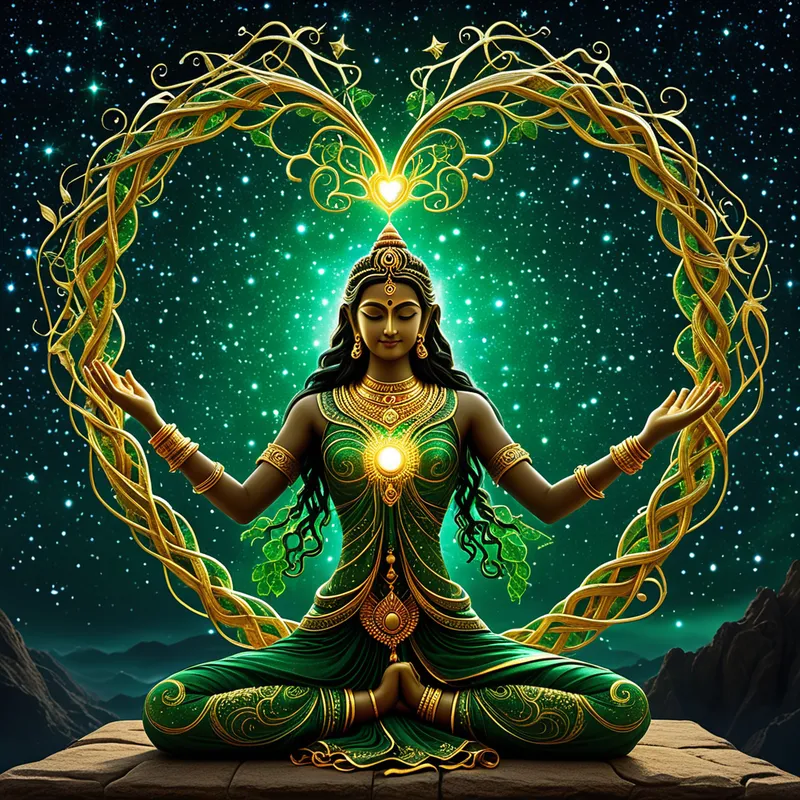
Kudzu Myth Meaning & Symbolism
A tale of a celestial vine born from divine conflict, binding the cosmos in its embrace, teaching the paradox of entanglement and ultimate liberation.
The Tale of Kudzu
Listen, and let the silence between the stars speak. Before time was measured in breaths, when the universe was a single, unbroken note of potential, a great stirring occurred in the heart of Brahma. From his contemplation, a conflict was born—not of malice, but of profound creative tension. The Asuras, embodiments of potent, raw power, and the Devas, keepers of luminous order, clashed. Their battle was not fought on any earthly field, but in the subtle realms of existence itself, a storm of ambition and light that threatened to unravel the delicate threads of creation.
From the sweat of this cosmic struggle, where divine fury met unwavering duty, something new took root. It was not a weapon, nor a shield. It was a seed of pure, binding intention. It fell into the fertile dark between realms and sprouted instantly. This was Kudzu. It did not grow as a tree grows, reaching for the sun. It grew as consciousness grows, weaving, connecting, embracing.
First, it was a single, slender tendril of living jade, threaded with veins of gold. Then it was a thousand. It moved with a silent, inevitable grace. It found the Asuras in their fervor, their forms blazing with chaotic energy. Without piercing or harming, Kudzu coiled around their limbs, their torsos, a gentle but unyielding embrace. It did not suppress their power; it held it, like a vase holds water. The more they struggled, the more beautifully and tightly the vine wove itself, until each mighty Asura was encased in a living, breathing lattice of verdant light, their fury transformed into a serene, contained glow.
The Devas watched, awestruck and wary. But Kudzu turned its attention to them next. It approached the radiant Indra, the wise Agni, the nurturing Prithvi. It did not discriminate between chaos and order. With the same gentle insistence, it began to weave around their divine forms. They did not resist, sensing a purpose deeper than conquest. The vine bound their luminosity, connecting them to each other and to their subdued foes. Soon, the entire host of celestial beings was interconnected in a magnificent, pulsating web of Kudzu, a living net cast across the cosmos.
In the center of this web, a profound stillness emerged. The conflict was not won or lost; it was integrated. The binding force became the source of a new equilibrium. The vine, having fulfilled its purpose, did not wither. It became the subtle architecture of connection itself, its roots in the dark earth of potential and its blossoms in the highest realms of consciousness. It was seen then not as a chain, but as the sacred lattice that allows the universe to hold its shape, teaching that to be bound is not always to be imprisoned, but sometimes to be held in the necessary form for a greater becoming.

Cultural Origins & Context
The myth of Kudzu finds its roots not in the grand, centralized epics like the Mahabharata or Ramayana, but in the rich, regional soil of folk narratives and Puranic allegories. It is a story passed down by village storytellers and forest-dwelling sages, often told during the planting season or at twilight, when the boundaries between worlds grow thin. Its societal function was multifaceted: it was an etiological tale explaining the inherent tension and balance in nature and society, a pedagogical tool for teaching children about restraint and interdependence, and a contemplative puzzle for ascetics pondering the nature of Maya (cosmic illusion) and attachment.
The myth served as a cultural model for understanding dharma (duty/order) not as a rigid law imposed from above, but as a dynamic, organic binding that arises from the interplay of all forces. It legitimized social structures and familial duties as a kind of necessary, sacred binding, while simultaneously hinting at the transcendental freedom that exists within and beyond that very structure. The tellers were often those who lived close to the land, for whom the relentless, embracing growth of actual kudzu vines was a daily reality, transformed through myth into a cosmic principle.
Symbolic Architecture
At its core, Kudzu symbolizes the principle of Pasha—the bond or noose. In Hindu Shaiva and Shakta tantric thought, the universe is an interplay of consciousness (Shiva) and the binding energy of manifestation (Shakti), often depicted as cords or nets. Kudzu is the visible form of this binding Shakti.
The vine does not ask if you are god or demon; it only knows you are something that needs to be held in the tapestry of being.
Psychologically, it represents all that entangles the individual psyche: the complexes (samskaras), the compulsive patterns, the social obligations, and the very fabric of the ego itself. It is not inherently evil; it is the necessary structure that gives form to our raw, chaotic potential (the Asuras) and contains our spiritual aspirations (the Devas) until they are ripe. The myth’s genius lies in its non-dual resolution. The binding is not followed by a heroic cutting, but by a serene integration. The ultimate symbol is the living net—confinement that is also connection, limitation that defines possibility.

The Dreamer's Resonance
When the pattern of the Kudzu myth arises in modern dreams, it signals a profound somatic and psychological process of containment and integration. The dreamer may find themselves in a familiar place—their childhood home, their office—slowly being overgrown by gentle but persistent vines. There is rarely panic, but a deep, somatic feeling of being held in place.
This dream imagery manifests when the unconscious is attempting to bind overwhelming or conflicting energies. Perhaps a burst of creative chaos (an Asura-like impulse) or a rigid, idealistic drive (a Deva-like principle) is threatening to destabilize the psyche. The dreaming culture.") mind, in its wisdom, conjures the vine to enact a process of gentle containment. The somatic sensation is often one of deep pressure, a slight constriction in the chest or limbs, mirroring the psyche's act of drawing disparate parts together. It is the body feeling the "knots" of a new psychological structure being tied. The dream is an invitation not to fight the entanglement, but to feel its purpose—to discover what part of you is being woven into a larger, more stable whole.

Alchemical Translation
The alchemical journey modeled by Kudzu is not the classic hero's journey of slaying dragons, but the more subtle, tantric path of transmutation through embrace. The modern individual's process of individuation often involves confronting inner "demons" (shadow aspects, repressed desires) and "gods" (inflated ideals, spiritual bypassing). The instinct is to battle or banish them.
Kudzu proposes a different operation: the opus contra naturam of conscious binding.
The first step to liberation is not breaking the bonds, but recognizing the sacred geometry of the knot that binds you.
The alchemical stages are clear: First, Conflict (Nigredo): The inner Asuras and Devas clash, creating the psychic "sweat" or tension. Second, Binding (Albedo): The conscious ego, adopting the role of the vine, must learn to gently but firmly contain these opposing forces. This is not repression, but the creation of a holding vessel—through therapy, art, ritual, or mindful discipline. Third, Integration (Citrinitas): Within this living vessel, the opposed forces cease fighting and begin to interact, their energy feeding the web of the self. The binding vine becomes a nervous system of connection. Finally, Liberation-in-Form (Rubedo): One discovers that the true freedom is not freedom from the bonds, but freedom within them. The individual realizes they are both the woven and the weaver. The vine of personal history, trauma, and talent is no longer a constraint, but the very lattice upon which the unique gem of the individuated self is displayed—a liberation found not in escape, but in profound, conscious embodiment.
Associated Symbols
Explore related symbols from the CaleaDream lexicon: