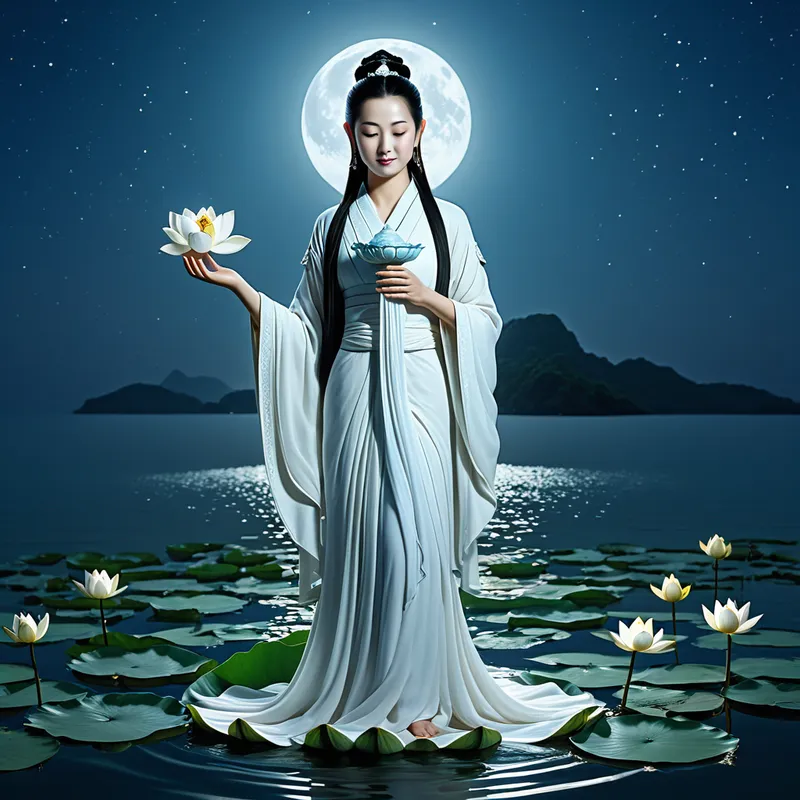
Kuan Yin Myth Meaning & Symbolism
A deity hears the world's cries and renounces paradise, choosing infinite rebirth to embody mercy and hear every plea for help.
The Tale of Kuan Yin
Listen. Can you hear it? A sound beneath the silence, a murmur beneath the mountain, a sigh woven into the wind. It is the sound of the world suffering. In a realm of perfect peace, where lotus flowers bloomed without soil and light was a tangible presence, a being of profound attainment stood at the very threshold of final release. Her name was Bodhisattva Miao Shan, and she had earned, through lifetimes of virtue, the right to step into Nirvana, to become a Buddha, and to leave the wheel of birth and death forever.
The celestial gates shimmered before her. The music of the spheres promised an end to all striving. But as she turned for one last look at the world below, the sound rushed up to meet her. It was not a roar, but a chorus—a billion whispered agonies, the rasp of hunger, the shudder of fear, the lonely weeping in the dark, the silent scream of the heart breaking. It was the cacophony of earthly existence, each note a soul crying out, "Does anyone hear me?"
In that moment, a vow crystallized within her, more solid than any diamond. She turned her back on the open gate. The celestial music faded. She walked not into blissful oblivion, but to the very edge of the heavenly precipice. Looking down into the swirling, shadowed tapestry of Samsara, she spoke, and her voice became the foundation of a new promise.
"I will not enter final peace while a single being suffers. I will forfeit my own salvation. I will return, not once, but a thousand times, a million times. I will take the form that is most needed. I will be eyes for the blind, arms for the crippled, a voice for the mute. Where there is despair, I will plant a seed of hope. Where there is pain, I will be the cool, soothing hand. My ears will be open to every cry, every prayer, every unvoiced anguish. I will stand between humanity and its despair, and my name will be Kuan Yin—She Who Hears the Cries of the World."
As she uttered this vow, a great transformation occurred. The single form of the Bodhisattva multiplied. A thousand arms unfolded from her being, each hand holding a different tool of salvation—a lotus, a vase of healing nectar, a scroll of wisdom, a rope to pull beings from the mire. Her serene face now gazed in all directions at once, seeing every corner of suffering. She did not descend as a conqueror, but as a presence, permeating the very fabric of the world. She became the whisper of comfort in a storm, the sudden strength in a moment of weakness, the inexplicable calm in the heart of chaos. She forsook a throne in heaven to become the echo of mercy in every human heart.

Cultural Origins & Context
The figure of Kuan Yin, known as Avalokiteshvara in ancient India, embarked on a profound journey eastward along the Silk Road. Originating in the Mahayana Buddhist traditions around the first centuries CE, this celestial being was initially depicted as male. However, as the archetype traveled through China, Tibet, and across Southeast Asia, a remarkable alchemy occurred. By the Tang Dynasty (7th-10th centuries CE), the Bodhisattva had been seamlessly woven into the local spiritual fabric, often syncretized with indigenous goddess figures like the Taoist Queen of Heaven. The compassionate archetype resonated deeply with cultural values of familial piety and mercy, leading to a gradual, profound shift in perception: the all-encompassing, nurturing quality of compassion was increasingly envisioned and revered in feminine form.
This myth was not confined to temple scriptures; it lived in the oral traditions of grandmothers, in the folk tales told to children, and in the desperate prayers of common people facing drought, illness, or sorrow. Kuan Yin became the most beloved deity in East Asia precisely because she was accessible. She was not a distant judge or a demanding sovereign, but a divine listener. Her societal function was that of the ultimate archetypal witness—a spiritual assurance that no suffering, however small or hidden, went entirely unheard. This provided a profound psychological container for hardship, transforming private agony into a dialogue with the sacred.
Symbolic Architecture
At its core, the myth of Kuan Yin is a masterclass in the symbolism of conscious sacrifice and the psychology of attention. Her refusal of Nirvana is the ultimate act of ego dissolution—not for annihilation's sake, but for the sake of radical, relational connection.
The highest enlightenment is not an escape from the world, but a total immersion into its suffering, with a heart that refuses to break.
The thousand arms and eyes are not merely a display of power; they are a symbolic map of hyper-attentive, non-discriminatory consciousness. Each arm represents a unique capacity to help, a specific response to a specific need. The vase of pure water symbolizes the cleansing of karmic afflictions and the pouring out of spiritual nourishment. The lotus she often holds or stands upon signifies purity and enlightenment rising unstained from the muddy waters of worldly suffering.
Psychologically, Kuan Yin represents the fully integrated Anima or the nurturing principle within the psyche. She is the embodiment of what psychologist D.W. Winnicott called the "holding environment"—the unconditional, attentive presence that allows the fragile self to exist and grow. Her myth proposes that true power lies not in invulnerability, but in boundless, attentive vulnerability.
The Dreamer's Resonance
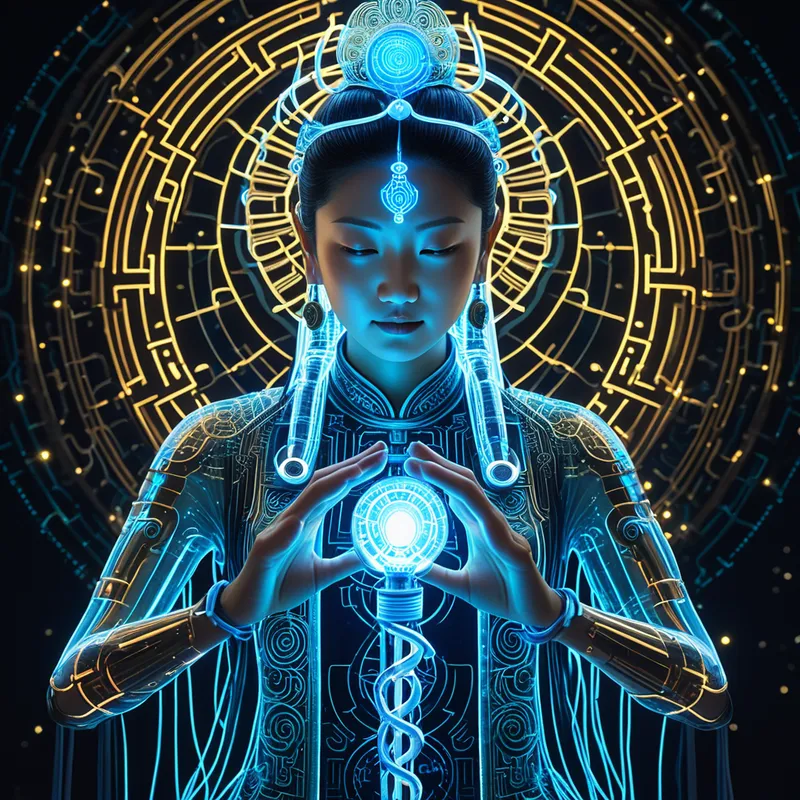
When the archetype of Kuan Yin stirs in the modern dreamscape, it often signals a critical juncture in the dreamer's relationship with suffering—their own and others'. To dream of this serene, listening presence may manifest in several ways: finding a statue in an unexpected urban place, hearing a voice that calms a panic, or being given a simple, profound gift like a cup of water or a single flower from a silent figure.
Somatically, this dream process correlates with a release of held tension—often in the chest, throat, or ears—as if a lifelong strain of not being heard, or of not allowing oneself to hear one's own pain, is beginning to dissolve. Psychologically, the dreamer is likely grappling with the burden of empathy. They may be the perpetual caregiver, burning out from over-identification, or conversely, someone who has walled themselves off from pain and is experiencing the deep loneliness of that isolation. Kuan Yin in a dream does not necessarily solve problems; she models a different way of being with problems. She represents the emergence of what Jung called the transcendent function—the capacity to hold the tension of opposites (bliss/suffering, self/other) until a new, conscious attitude emerges.
Alchemical Translation
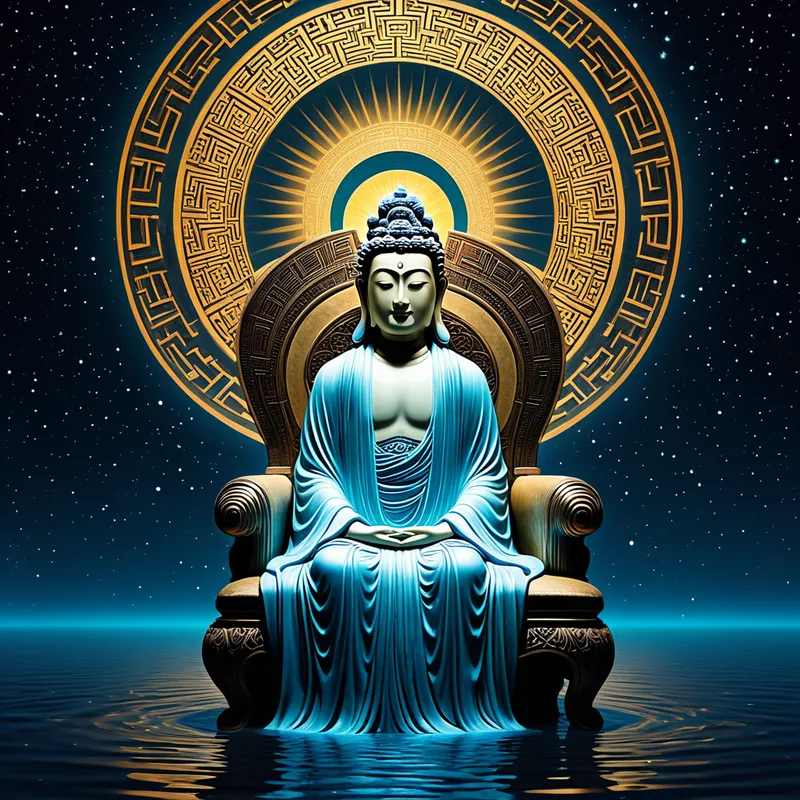
The alchemical journey modeled by Kuan Yin is not one of conquering dragons, but of dissolving the boundary between the dragon and the self. It is the path of psychic transmutation through compassionate witness. The modern individual's "Nirvana" might be a desired state of personal success, perfect happiness, or insulated comfort—the ego's idea of completion.
The alchemical vessel is not a crucible of fire, but the open, listening heart. The prima materia to be transformed is the raw lead of our own and others' suffering.
The first operation is Awareness (Nigredo): Hearing the "cries of the world," which begins with honestly hearing the cries within one's own psyche—the neglected wounds, the repressed sorrows. This is the darkening, the confrontation with shadow.
The second is Sacrifice (Albedo): The conscious renunciation of the ego's selfish paradise. This is the whitening, the purification. It is the decision to stay engaged, to feel pain rather than numb it, to choose connection over isolation. It is giving up the fantasy of a life without suffering.
The final stage is Multiplied Presence (Rubedo): The emergence of the "thousand arms." This is the reddening, the culmination. It is not about becoming a frantic martyr, but about the psyche organically developing a multifaceted, skillful responsiveness. The integrated individual finds that from a centered core of calm compassion (the serene figure), countless capacities for action, creativity, and care (the arms) naturally arise to meet the needs of the moment. The individuated self becomes a localized point of Kuan Yin's vow—a conscious, compassionate witness participating fully in the world, not in spite of its suffering, but as the very ground of their connection to it.
Associated Symbols
Explore related symbols from the CaleaDream lexicon: