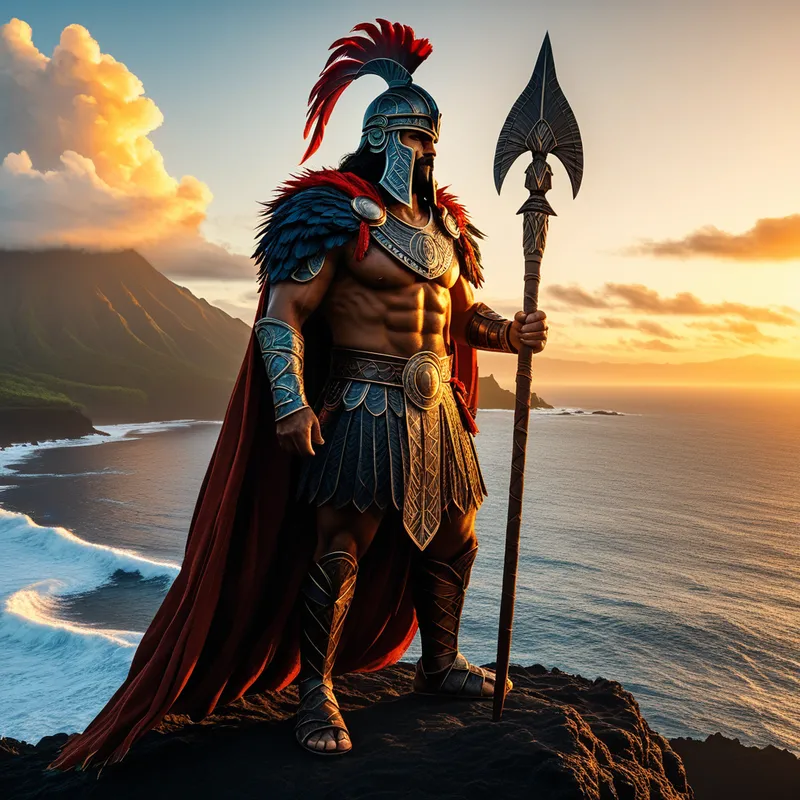
Ku God of War Myth Meaning & Symbolism
The myth of Ku, the Hawaiian god of war, reveals the sacred power of disciplined force, necessary sacrifice, and the forging of order from primal chaos.
The Tale of Ku God of War
Listen. Before the songs of peace, there was the silence of potential, and from that silence, a rhythm was born. It was not the gentle rhythm of the waves, but the deep, tectonic pulse of the earth itself, the heartbeat of Papa. And to give this pulse form, to give this latent force a name and a purpose, the god Wākea called forth his son.
His name was Kū. He did not emerge from the sea foam or a whispered dream. He was hewn from the dark basalt of the newborn islands, his bones the coral, his sinew the tough ʻōhiʻa lehua vine. His domain was not the soft cloud or the deep fish-run, but the hard edge, the defining line. He was the god of the upright post, the sharpened adze, the boundary stone. And so, he became the god of war.
But his war was not mere chaos. It was the terrible, necessary work of making space for life. In the beginning, the world was dense, tangled, a profusion of growth without distinction. Kū looked upon this and saw not abundance, but a suffocating blanket. To build a heiau, you must first clear the ground. To plant a loʻi kalo, you must channel the wild water. To establish a family, a community, a kingdom, you must define what is yours and protect it from what is not.
His most sacred and fearsome aspect was Kūkāʻilimoku, "Ku the Snatcher of Islands." This was the aspect invoked by the aliʻi who sought to unite the fractured lands under the law of one. The rituals for this Ku were severe. The air in the temple grew heavy with the scent of ʻiliahi smoke and solemn chants. The offering was the ultimate sacrifice, the kanaka pule, a life given so that the social body might live, so that order might be imposed upon the ever-lurking threat of dissolution.
The people knew: when the feathered image of Kū was raised, the time for soft words was over. The time for the hard, clear action of the spear had come. He was the clenched fist, the set jaw, the unyielding spine of the community. He was the terrifying price paid for safety, the grim father who fights so his children may sleep without fear. His story is not one of a battle won, but of the eternal, sober willingness to stand at the boundary and say, "This far, and no further."
Cultural Origins & Context
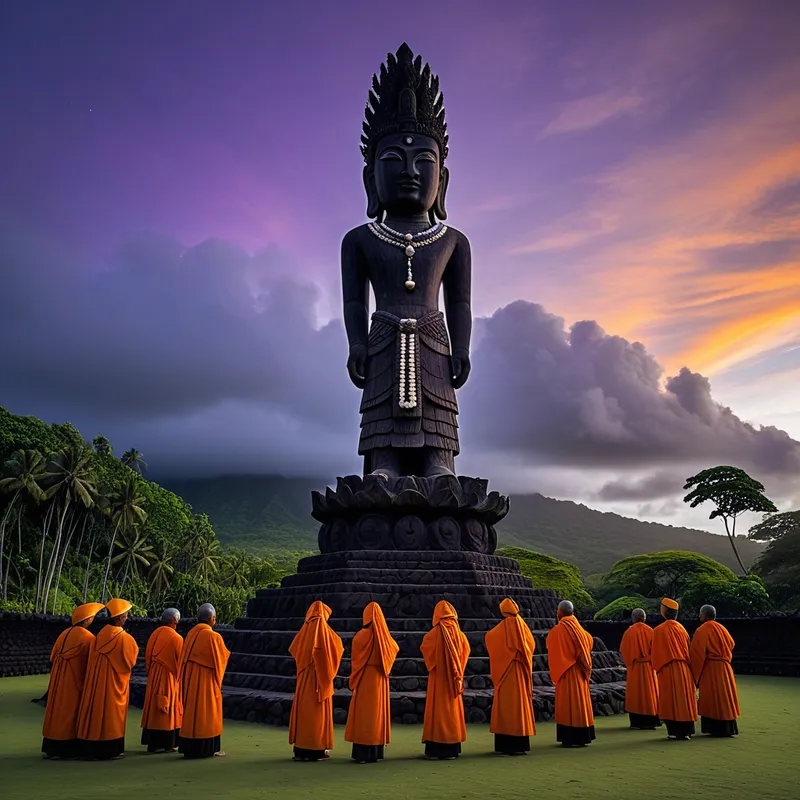
The mythology of Kū is inextricably woven into the political and spiritual fabric of pre-contact Hawaiian society. Unlike a distant Olympian, Kū was a functional god, a divine template for the roles of men and rulers. His myths were not merely stories for entertainment but operational cosmologies, recited by the kahuna and embodied by the aliʻi.
The transmission was oral, rhythmic, and performative. Chants (mele) and prayers (pule) invoked Kū for specific purposes: before battle, during the construction of a canoe or a house, at the inception of a political campaign. The most potent form, Kūkāʻilimoku, was the personal war god of the paramount chiefs, like Kamehameha I. The carved kiʻi of this aspect, bristling with feathers, was a literal standard carried into conflict, a divine mandate for unification.
Societally, Kū governed the "male" spheres: war, politics, fishing, forestry, and canoe-building. He represented the principle of pono (righteousness, balance) as achieved through assertive, sometimes violent, action. His worship enforced the hierarchy and kapu (sacred law) system, reminding all that the structure which provided sustenance and identity was born from and maintained by a sacred, disciplined force.
Symbolic Architecture
At its core, the myth of Kū is about the psychology of structure. He symbolizes the innate human capacity to impose form on the formless, to create order from chaos, and to defend that order once it is made. This is not a gentle process. It requires differentiation, separation, and the hard edges of definition.
The sword that defends the hearth is forged in the same fire as the sword of conquest. Ku represents the moment we must choose which it will be.
Psychologically, Kū is the archetype of the disciplined will. He is the part of the psyche that can say "no," that can set boundaries, delay gratification, and channel raw, undirected energy (libido) into focused, goal-oriented action. He is the antithesis of the diffuse, nurturing, all-accepting mother principle. He is the father who says, "This is the way. Walk it." His shadow side is rigidity, tyranny, oppression for its own sake, and the sacrifice of the individual to the idol of the system—the aspect where the protector becomes the jailer.
The kanaka pule is the ultimate symbol of this psychic economy. It represents what must be "killed" or surrendered within ourselves to achieve a higher order. A childish dependency must be sacrificed for adult responsibility. A diffuse fantasy must be sacrificed for a concrete plan. Comfort must be sacrificed for growth.
The Dreamer's Resonance
When the energy of Kū stirs in the modern dreamscape, it often manifests as dreams of confrontation, fortification, or solemn duty. One might dream of building a wall against a rising tide, standing guard at a door, or holding a heavy, ceremonial object that demands respect.
Somatically, this can feel like tension in the jaw, shoulders, and spine—the body's armor bracing. Psychologically, the dreamer is likely grappling with a need for greater structure, discipline, or self-assertion in their waking life. They may be in a situation that demands they "take a stand," define their boundaries, or fight for something they value. Conversely, if the Ku energy is out of balance, the dream may feature oppressive fathers, rigid institutions, or scenes of senseless sacrifice, pointing to an internalized tyranny or a life being lived under a crushing, external "should" that stifles the soul's softer, more creative impulses.
Alchemical Translation
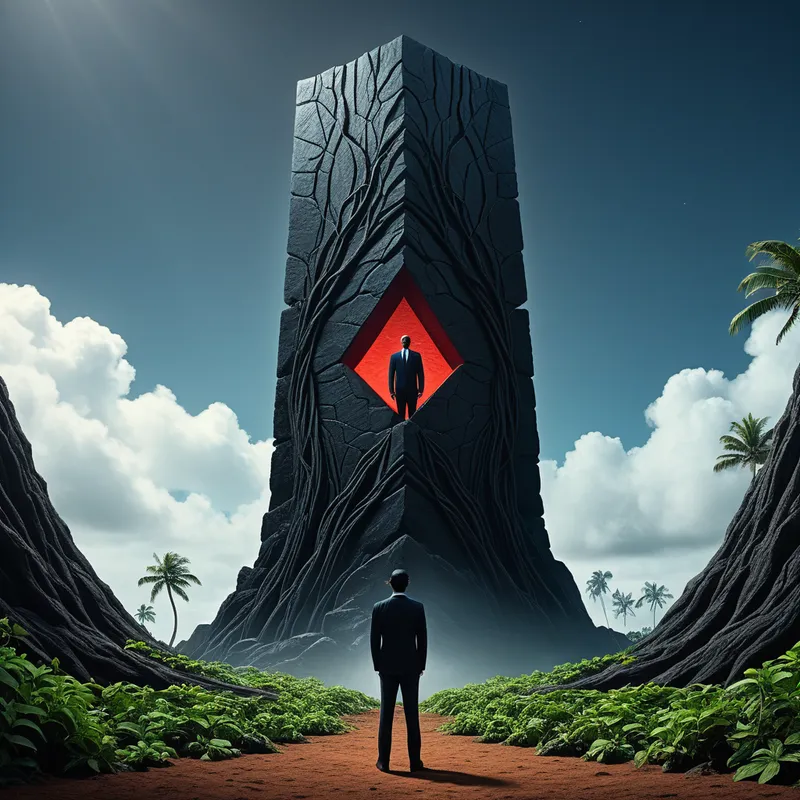
The individuation process, the journey toward psychic wholeness, requires a Ku phase. One cannot integrate the unconscious without first developing a strong enough ego-structure to encounter it without being dissolved. Ku represents this necessary stage of consolidation and fortification.
The alchemist's vessel must be sealed before the great work can begin. Ku is the forging of that vessel—the conscious identity strong enough to contain the transformative fire.
The modern seeker translates the myth by engaging in their own "sacred work." This is the disciplined practice—whether in art, career, relationship, or therapy—that demands daily sacrifice of laziness or fear. It is the act of carving out a defined identity ("This is who I am, and this is what I stand for") from the chaotic mass of possibilities and societal expectations. It is the willingness to engage in the inner war against one's own passivity, procrastination, and cowardice.
The triumph is not annihilation of the "other," but the establishment of a stable, conscious center from which one can later engage with the deeper, more fluid and creative aspects of the self (represented by gods like Lono or Pele). One must become a sovereign before one can afford to be generous. One must have a territory of the self before one can open its borders. Ku’s myth teaches that this sovereignty is won not by chance, but by the solemn, sustained application of will—the warrior's path to inner order.
Associated Symbols
Explore related symbols from the CaleaDream lexicon:
- Sacrifice — The central, somber ritual of Ku's worship, representing the conscious surrender of one thing of value to secure or honor something of greater value, be it social order or inner integrity.
- Warrior — The human embodiment of the Ku principle, representing disciplined action, courage, protection, and the willingness to engage in necessary conflict for a defined purpose.
- Temple — The heiau dedicated to Ku, symbolizing a consecrated space where raw power is ritualized, contained, and directed toward a sacred end.
- Stone — The unyielding, foundational material of Ku's idols and temples, representing permanence, boundary, and the hard, enduring truth of a principle or a vow.
- Order — The ultimate goal of Ku's fierce energy, the establishment of structure, law, and hierarchy from primal chaos, both in society and within the individual psyche.
- Spear — The weapon and symbol of Ku, representing focused direction, penetrating insight, and the active, masculine principle that defines and defends.
- Father — Ku as the archetypal stern father, the principle that provides structure, law, discipline, and security, demanding sacrifice for the greater good of the family or tribe.
- Blood — The potent offering in Ku's rituals, symbolizing the life-force given to nourish and strengthen the social or spiritual body, the stark price of maintained order.
- Mountain — Like the volcanic peaks of Hawaii, Ku represents a towering, immovable presence, a defining feature of the landscape that provides perspective and a formidable challenge.
- Crown — The feather helmet or lei of the aliʻi invoking Ku, symbolizing the sovereignty, authority, and heavy responsibility that comes with the power to command and protect.
- Boundary — The essential function of Ku, creating the defining line between self and other, sacred and profane, order and chaos, that which is protected and that which is excluded.
- Rage — The raw, untamed fuel of Ku's power, which must be ritualized and channeled through discipline into effective action, lest it become destructive chaos.