Kraken Myth Meaning & Symbolism
A colossal sea-beast from Norse lore, embodying the terrifying, creative abyss of the unconscious mind and the primal chaos beneath ordered reality.
The Tale of Kraken
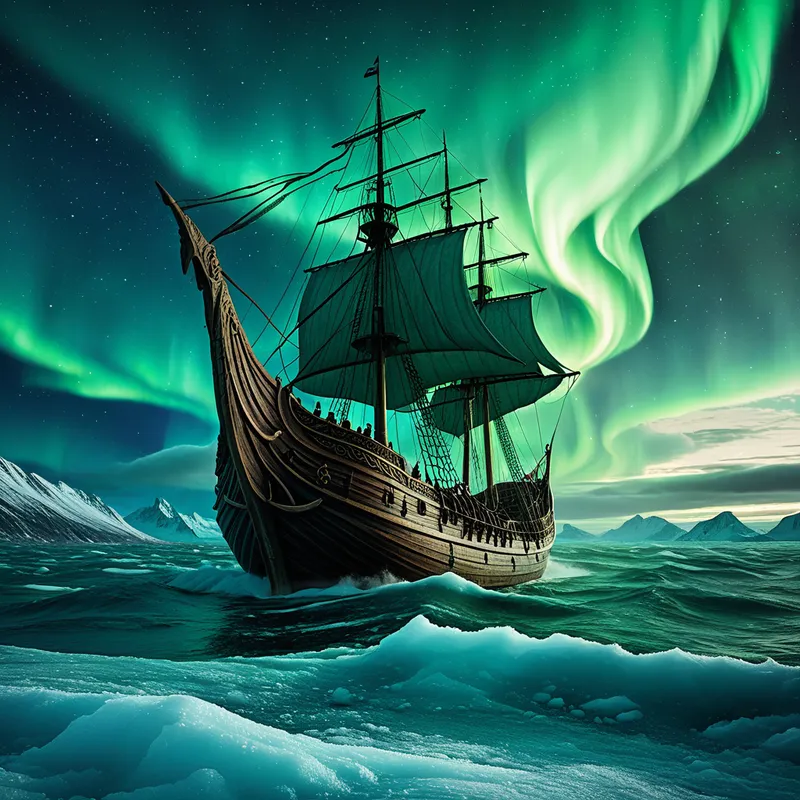
Hear now, a tale not of the sun-drenched lands, but of the realm where [the world](/myths/the-world “Myth from Tarot culture.”/) ends—the [Ginnungagap](/myths/ginnungagap “Myth from Norse culture.”/) made liquid. Where the salt wind screams and the waves are mountains that grind the bones of [the earth](/myths/the-earth “Myth from Hindu culture.”/). Here, in the whale-road’s heart, the sailors whisper of Hafgufa, [the sea](/myths/the-sea “Myth from Greek culture.”/)-mist, and of a [thing](/myths/thing “Myth from Norse culture.”/) older than [Jörmungandr](/myths/jrmungandr “Myth from Norse culture.”/), older perhaps than the gods themselves.
They say that when the storms have raged themselves to exhaustion and an uncanny calm descends upon the Ægir’s domain, that is when the wise helmsman grows most fearful. For it is a lure, a held breath. The sea grows still as polished Bifröst glass, and a strange scent, like the rot of a thousand drowned forests, perfumes the air. Then, from the profound black, islands that are not islands begin to rise.
First, you see the spines, like a submerged mountain range breaching. Barnacles the size of shields cling to skin like ancient stone. The [water](/myths/water “Myth from Chinese culture.”/) boils and heaves, and the true form reveals itself—a living continent of flesh and rage. Arms, each a league long and studded with suckers that could pluck a whale from the deep, churn the sea into a maelstrom. Its eye, when it deigns to open, is a pit into the world’s first darkness, reflecting no light, only swallowing it.
The longship, proud dragon of the waves, becomes a twig in a child’s whirlpool. The bravest warrior’s sword is a needle against this [leviathan](/myths/leviathan “Myth from Biblical culture.”/). [The Kraken](/myths/the-kraken “Myth from Greek culture.”/) does not fight; it is the storm. It is the sea deciding to reclaim what it has lent. Timbers scream and snap. Men are plucked from [the deck](/myths/the-deck “Myth from Tarot culture.”/) like berries from a branch, or swallowed whole by the vortex that forms as the beast descends. Its passing is not a defeat, but an absorption. The sea closes over the wreckage, the calm returns, and [the mist](/myths/the-mist “Myth from Celtic culture.”/) hangs heavy, holding the secret. Only the lucky—or the cursed—who witness it and live, carry the tale ashore, their eyes forever holding the image of [the abyss](/myths/the-abyss “Myth from Kabbalistic culture.”/) made flesh.
Cultural Origins & Context
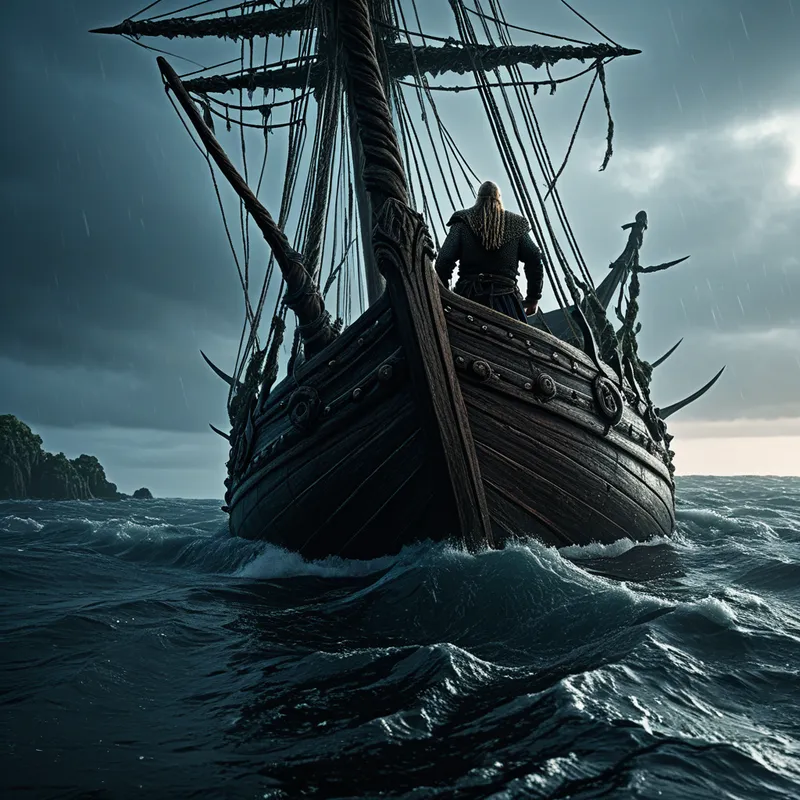
The entity we now blanket with the name Kraken finds its roots in Old Norse sagas and natural histories, less as a singular named monster and more as a category of primordial sea-beast. The Konungs skuggsjá (The King’s Mirror), a 13th-century Norwegian educational text, describes the Hafgufa and Lyngbakr—enormous, island-like creatures that lure fish (and by extension, ships) to their doom. These accounts sit at [the crossroads](/myths/the-crossroads “Myth from Celtic culture.”/) of myth, sailor’s yarn, and early attempts at marine biology.
This was not a story told in the warm mead-hall for simple thrill. It was a narrative born on the deck of a ship, in the watchful dark, passed from weathered helmsman to green boy. Its function was profoundly practical and existential. It gave a name and a shape to the ultimate maritime peril: the unpredictable, all-consuming fury of the ocean itself. The Kraken was the personification of the North Sea’s capricious violence, the logical extreme of a rogue wave or a sudden squall. It served as both a warning against hubris—no matter how skilled the sailor, the deep holds greater powers—and a framework for understanding catastrophic, senseless loss. In a culture that navigated by stars and courage, the Kraken represented the absolute limit of human mastery, the chaotic wild that always surrounded the ordered world of [Midgard](/myths/midgard “Myth from Norse culture.”/).
Symbolic Architecture
Psychologically, the Kraken is an almost pure [archetype](/symbols/archetype “Symbol: A universal, primordial pattern or prototype in the collective unconscious that shapes human experience, behavior, and creative expression.”/) of the unconscious in its most terrifying, impersonal form. It is not the personal [shadow](/symbols/shadow “Symbol: The ‘shadow’ embodies the unconscious, repressed aspects of the self and often represents fears or hidden emotions.”/) of repressed desires, but the collective shadow—the formless, churning, creative-destructive potential that existed before [the ego](/myths/the-ego “Myth from Jungian culture.”/), before order, before light.
The Kraken does not sleep in the deep; it is the deep. To encounter it is to meet the part of reality that is utterly indifferent to your existence, your plans, or your gods.
It symbolizes the autonomous complexes that can rise from the [psyche](/myths/psyche “Myth from Greek culture.”/)’s [depths](/symbols/depths “Symbol: Represents the subconscious, hidden emotions, or foundational aspects of the self, often linked to primal fears or profound truths.”/) to shatter the carefully constructed [vessel](/symbols/vessel “Symbol: A container or structure that holds, transports, or protects something essential, representing the self, emotions, or life journey.”/) of the conscious [personality](/symbols/personality “Symbol: Personality in dreams often symbolizes the traits and characteristics of the dreamer, reflecting how they perceive themselves and how they believe they are perceived by others.”/) (the ship). Its tentacles represent the grasping, enveloping [nature](/symbols/nature “Symbol: Nature symbolizes growth, connectivity, and the primal forces of existence.”/) of undifferentiated psychic [material](/symbols/material “Symbol: Material signifies the tangible aspects of life, often representing physical resources, desires, and the physical world’s influence on our existence.”/)—overwhelming, [multi](/symbols/multi “Symbol: Multi signifies multiplicity and diversity, often representing various aspects of life or identity in dreams.”/)-faceted, and impossible to combat with the singular, pointed [logic](/symbols/logic “Symbol: The principle of reasoning and rational thought, often representing order, structure, and intellectual clarity in dreams.”/) of the conscious mind (the sword). The Kraken is [chaos](/symbols/chaos “Symbol: In Arts & Music, chaos represents raw creative potential, uncontrolled expression, and the breakdown of order to forge new artistic forms.”/) itself, the Uroboros of the sea, forever circling [beneath the surface](/symbols/beneath-the-surface “Symbol: A symbol of hidden depths and meanings, often exploring subconscious thoughts and feelings.”/) of our managed lives. It is the [eruption](/symbols/eruption “Symbol: A sudden, violent release of pent-up energy or emotion from beneath the surface, often representing transformation or crisis.”/) of the numinous in its terrifying [aspect](/symbols/aspect “Symbol: A distinct feature, quality, or perspective of something, often representing a partial view of a larger whole.”/), the mysterium tremendum et fascinans that annihilates to make [space](/symbols/space “Symbol: Dreaming of ‘Space’ often symbolizes the vastness of potential, personal freedom, or feelings of isolation and exploration in one’s life.”/) for something new, though what that may be is unknown to those it consumes.
The Dreamer’s Resonance
When the Kraken surfaces in modern dreams, it rarely does so in period costume. The dreamer may find themselves in a stable, modern setting—an office, a home—only to have the floor become transparent, revealing infinite dark water beneath, from which immense, shadowy forms begin to stir. Or they may be on a seemingly safe journey when the environment itself transforms into a maelstrom.
This dream signals a profound somatic and psychological process: the ego is being confronted by a surge from the unconscious that it cannot integrate or control. The dreamer is in the grip of what feels like a psychic tsunami—this could be a latent depression rising, a long-buried trauma making its presence known, or a creative impulse so vast and formless it threatens to dismantle their current identity. The body may register this as anxiety, a feeling of being “in over one’s head,” or a sense of impending dissolution. The dream is not necessarily a prophecy of doom, but a stark announcement: the depths are active. The old vessel of [the self](/myths/the-self “Myth from Jungian culture.”/) is no longer seaworthy for the journey ahead. The psyche is initiating a catastrophic restructuring, and the conscious mind is being invited—or forced—to witness the power of the forces at play.
Alchemical Translation
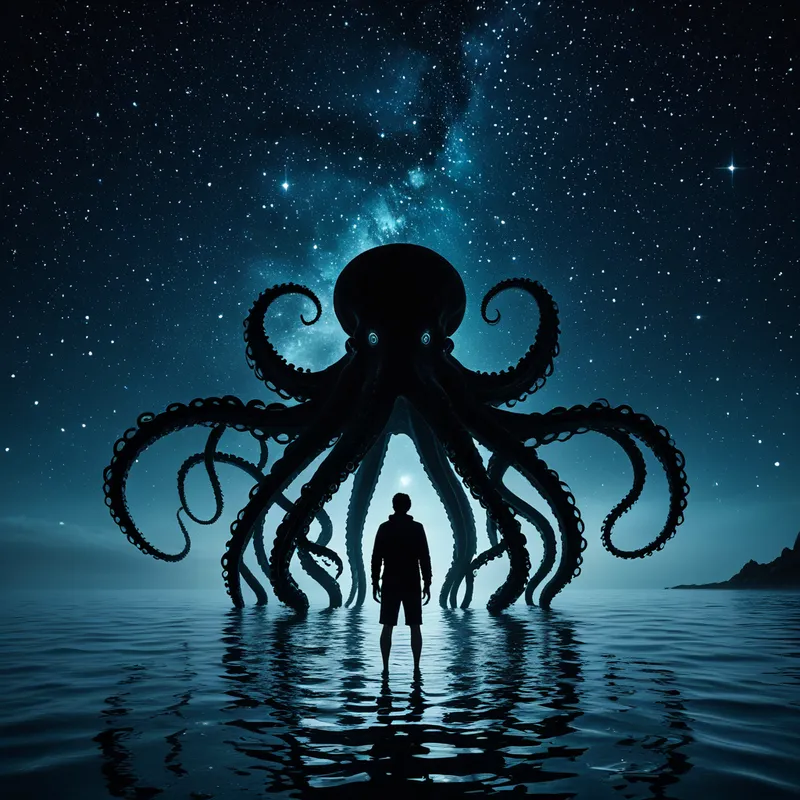
The alchemical process mirrored in the Kraken myth is the [Nigredo](/myths/nigredo “Myth from Alchemical culture.”/)—the blackening, the putrefaction, the descent into the prime matter. In individuation, this is the necessary, painful stage where one’s conscious attitudes, [persona](/myths/persona “Myth from Greek culture.”/), and neurotic structures are dissolved by contact with [the shadow](/myths/the-shadow “Myth from Jungian culture.”/) and the unconscious.
The triumph is not in slaying the beast, but in surviving the encounter with the knowledge that you and the abyss are made of the same primordial stuff.
The [Viking longship](/myths/viking-longship “Myth from Norse culture.”/)—the sturdy, directed, heroic ego—must be shattered. The Kraken’s maelstrom represents the chaotic, enveloping stage where all former distinctions (self/other, safe/dangerous, controlled/chaotic) are obliterated. This is not a failure, but the beginning of the work. To be “swallowed by the Kraken” is to be immersed in the [unus mundus](/myths/unus-mundus “Myth from Alchemical culture.”/), the unified psychic field before differentiation.
For the modern individual, this translates to those life periods where everything falls apart: career, relationship, health, identity. The alchemical task is not to rebuild the same ship, but to endure the dissolution without fragmenting entirely, to find the tiny, indestructible core of the Self within the whirlpool. The Kraken does not offer a battle; it offers an initiation into scale. By facing this inner leviathan, one learns that the psyche is vaster, wilder, and more ancient than the ego’s small kingdom. From this black sea, if one can endure, the new, more authentic consciousness may eventually be forged—not from oak planks and iron rivets, but from the reconciled knowledge of both the sailor and the deep.
Associated Symbols
Explore related symbols from the CaleaDream lexicon: