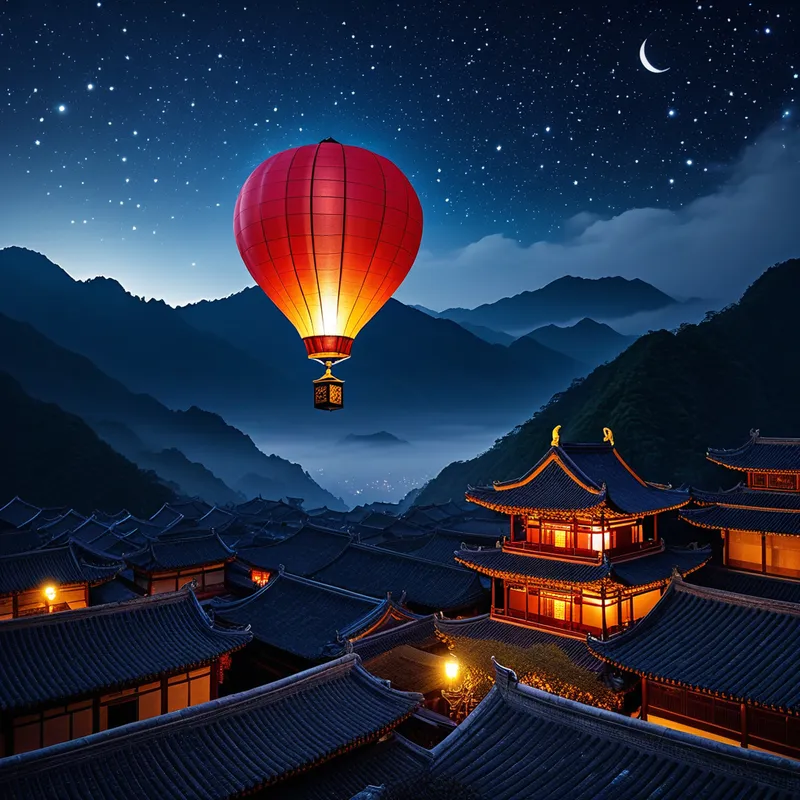
Kongming Lantern Myth Meaning & Symbolism
A lantern of fire and bamboo, born from ancient strategy, becomes a vessel for wishes and a symbol of the soul's luminous release into the night sky.
The Tale of Kongming Lantern
The air was thick with the scent of damp earth and desperation. In the heart of the Three Kingdoms, a vast army lay encamped, its spirit as heavy as the fog that clung to the river valleys. They were trapped, encircled by a foe whose numbers blotted out the land like locusts. In the commander’s tent, the flicker of a single oil lamp danced across maps of impossible terrain. Here sat Zhuge Liang, the man they called the Wolong. His brow was not furrowed in panic, but in deep, silent communion with the principles of heaven and earth.
He saw not just soldiers and swords, but the flow of Qi and the patterns of the stars. The enemy waited, a silent, tightening noose. To send a runner for aid was suicide; to light a signal fire would betray their last position. Hope, it seemed, could find no passage through the physical world.
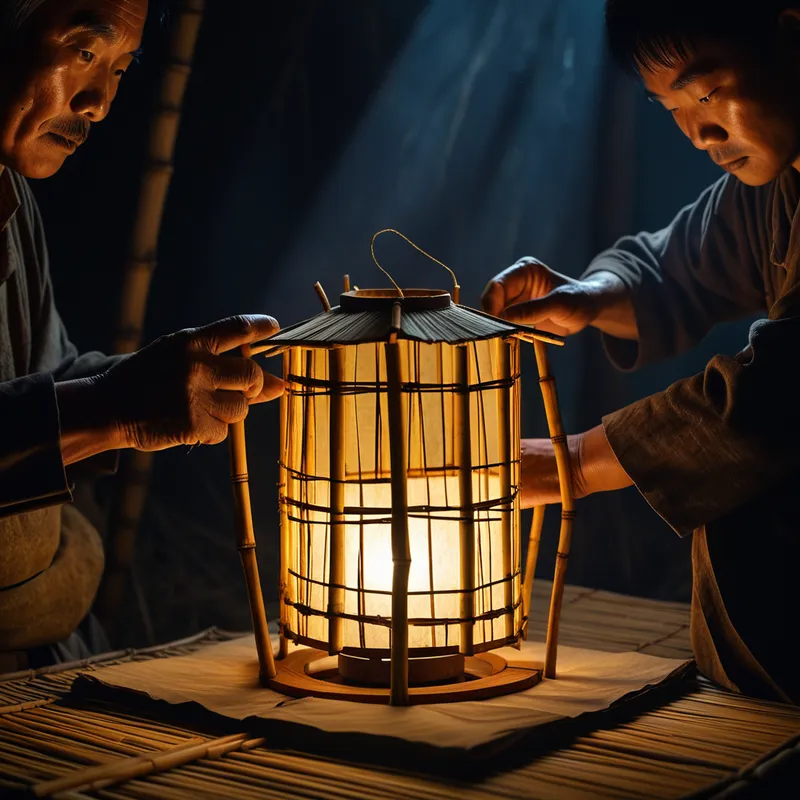
Then, his gaze fell upon the simple objects of the camp: bamboo from the grove, paper used for messages, the wax of sealing candles. An idea, fragile as a moth’s wing, alighted in his mind. It was not born of brute force, but of a profound yielding—a willingness to use the very nature of things against themselves. He called for his artisans. Through the night, they worked not with steel, but with pliant cane and sheer membrane. They fashioned a skeletal sphere, a fragile womb of paper. At its base, they fixed a small platform, and upon it, a source of heat.
As the first grey light threatened the horizon, Zhuge Liang stood before his creation. He placed a lit candle upon the platform. The men watched, breath held. For a moment, nothing. Then, the paper walls began to tremble. The hot air, the breath of fire, filled the cavity. The lantern strained against the hands that held it, alive with a gentle, insistent urgency. On his signal, they released it.
It did not fly like an arrow. It ascended. A silent, golden pear, it rose from the mist-shrouded camp. It climbed, a tiny, defiant star born from human wit, piercing the gloom. From the besieging camps, eyes looked up. They saw not a lantern, but an omen—a celestial sign, a mysterious fire moving with purpose against the vault of heaven. Fear, the twin of ignorance, seized them. They whispered of divine intervention, of portents they could not understand. In their confusion, their vigilance broke.
And from the distant mountains, the allied scouts saw the singular, climbing light. They saw the coded message written not in ink, but in luminescence and trajectory: Here we are. The spirit is unbroken. Come. The lantern drifted on the high currents until its fuel was spent, and it returned to earth, its duty complete. The siege was broken not by a sword, but by a sigh of hot air and a vision of light.
Cultural Origins & Context
The myth of the Kongming Lantern is woven into the rich tapestry of Chinese folklore, inextricably linked to the historical figure of Zhuge Liang (181–234 CE). While the lantern as a practical object likely existed in simpler forms before, its legend is firmly anchored to his persona as the archetypal strategist-sage. The story was not preserved in a single canonical text but was propagated through oral tradition, historical romances like the Romance of the Three Kingdoms, and local folklore.
Its societal function was multifaceted. On one level, it served as an etiological myth, explaining the origin of the sky lantern. More profoundly, it reinforced core cultural values: the supremacy of wisdom (Zhi) over brute strength, the power of ingenious adaptation, and the belief that human intellect could harmonize with natural principles to achieve the impossible. It transformed a military tool into a symbol of hope and communication, a narrative that allowed the object to be seamlessly adopted into peacetime festivals. The storyteller, often an elder or a performer, was not just recounting history; they were imparting a lesson in resourcefulness and the luminous potential of the human mind when faced with darkness.
Symbolic Architecture
At its core, the Kongming Lantern is a perfect symbolic vessel for the interplay of fundamental forces. Its structure is a mandala of meaning: the bamboo frame represents resilience and flexible strength; the paper skin symbolizes fragility, receptivity, and the boundary between inner and outer worlds; the fire is the animating spirit, the transformative Qi, consciousness, and desire.
The lantern teaches that ascent requires a vessel that is both strong enough to hold its shape and fragile enough to be lifted. The soul's container must be precisely this paradox.
The act of release is the central psychological motif. The lantern must be let go to fulfill its purpose. It symbolizes the release of a message, a prayer, a wish, or a part of the self that must travel beyond the individual to achieve its end. It is a ritual of non-attachment with intentionality. The fire, trapped yet nourishing, does not consume its vessel but instead uses the heat of its consumption to create lift—a profound alchemical image of suffering or effort transformed into elevation.
Psychologically, Zhuge Liang represents the Ego in its highest function: not as a tyrant, but as a servant of the larger Self. He listens to the situation (the unconscious content of the trapped army) and synthesizes available resources (memories, talents, instincts) into a novel, transcendent solution—the lantern as a symbolic transcendent function.
The Dreamer's Resonance
To dream of a Kongming Lantern is to encounter a symbol of nascent release and communication with the unseen. The somatic feeling is often one of tension in the chest or diaphragm—a "held breath"—followed by the relief of ascent.
If you are lighting the lantern, you are in a stage of conscious preparation. You are gathering your resources (bamboo/frame of your life, paper/your vulnerabilities) and igniting your intention (the fire). This dream speaks to a psychological process of consolidating a wish, a creative idea, or a need for help that you are preparing to send "upward" into the realm of awareness or outward into the world. The anxiety in the dream often mirrors the fear that your vessel—your plan or your exposed self—is too fragile.
If you are watching the lantern ascend, you are in a stage of release. This can indicate the process of letting go of a burden, a grief, or an old identity. The lantern carries it away. The feeling is melancholic yet peaceful, representing trust in the process. A lantern failing to rise, or catching fire, signals a fear that your expressed vulnerability will be destroyed, or that your inner "fuel" (passion, will) is misaligned with your structure, leading to collapse rather than elevation.
Alchemical Translation
The myth of Kongming Lantern models the individuation process as an act of ingenious, luminous self-crafting. The besieged army is the psyche feeling trapped by complexes, external pressures, or an impasse (the nigredo). The conscious ego, represented by Kongming, must retreat from frantic action into contemplative observation (theoria).
The construction of the lantern is the albedo. Here, disparate elements of the personality—one's resilient history (bamboo), one's sensitive and permeable boundaries (paper), and one's driving libido or passion (fire)—are consciously assembled into a new, temporary synthesis. This is not the final, fixed state of the Self, but a purpose-built vehicle for transcendence.
Individuation is not about building a permanent monument, but about learning the art of crafting the right vessel for the necessary journey.
The release and ascent are the citrinitas, the dawning of the liberating insight. The content that needed expression—the call for help, the repressed wish, the creative idea—is launched from the personal into the transpersonal realm. It is offered up. This act changes the inner landscape; the "besieging" forces (critical inner voices, outdated patterns) are dispelled by the awe of this luminous, self-generated phenomenon.
Finally, the lantern's peaceful descent after its duty symbolizes the rubedo integrated back into earth. The insight doesn't vanish; it returns, transformed, as lived experience. The psyche is no longer besieged. It has learned the eternal lesson: lightening the load often requires first building a careful fire, and true freedom is found in the graceful, intentional release of what you have tenderly made.
Associated Symbols
Explore related symbols from the CaleaDream lexicon: